


Understanding the Marketing Hurdles for Small Businesses
Small businesses face unique marketing obstacles. This listicle tackles eight key challenges, offering actionable strategies to overcome them and achieve sustainable growth. We’ll explore practical solutions for limited budgets, brand visibility, navigating the complexities of digital marketing, targeting the right audience, measuring ROI, and competing with larger companies. We’ll also discuss generating consistent leads and achieving work-life balance while managing marketing effectively. Understanding these core challenges is the first step toward developing a successful marketing strategy. For small businesses seeking a competitive edge, understanding the fundamentals of SEO is crucial. Learn more with this resource: SEO for Small Business. This article will cover:
- Limited budget and resource constraints
- Building brand recognition
- Mastering digital marketing’s complexities
- Identifying and segmenting your target audience
- Measuring marketing ROI
- Competing with larger companies
- Lead generation and sales funnel management
- Balancing marketing efforts with time constraints
This listicle provides clear, actionable advice, moving beyond generic tips to offer concrete strategies you can implement immediately. We’ll dive into practical examples and unique approaches, giving you the tools to overcome these common small business marketing challenges.
1. Limited Marketing Budget and Resource Constraints
One of the most significant small business marketing challenges is the ever-present constraint of limited budgets and resources. Small businesses often operate with significantly less marketing capital than larger corporations. While large companies might allocate 10-15% of their revenue to marketing, small businesses frequently dedicate less than 5%, sometimes struggling to even reach that benchmark. This disparity creates an uneven playing field, forcing small business owners to make tough choices about where to invest their precious marketing dollars while competing against rivals with significantly deeper pockets. Beyond financial limitations, resource constraints also manifest as time scarcity. Small business owners often wear multiple hats, juggling everything from sales and customer service to product development and accounting, leaving little time for dedicated marketing efforts.
Making Every Dollar Count
This challenge isn’t insurmountable. Focusing on high-impact, low-cost strategies can level the playing field. For example, a local restaurant might leverage social media engagement instead of pricey television advertising. A service-based business might implement referral programs rather than pouring resources into paid search campaigns. Similarly, retailers might prioritize email marketing and build an organic social media presence instead of relying on expensive print advertising. These strategic choices allow small businesses to maximize their limited resources and compete effectively.
The following infographic visualizes the typical resource constraints small businesses face regarding their marketing budget, spend as a percentage of revenue, and dedicated marketing staff.
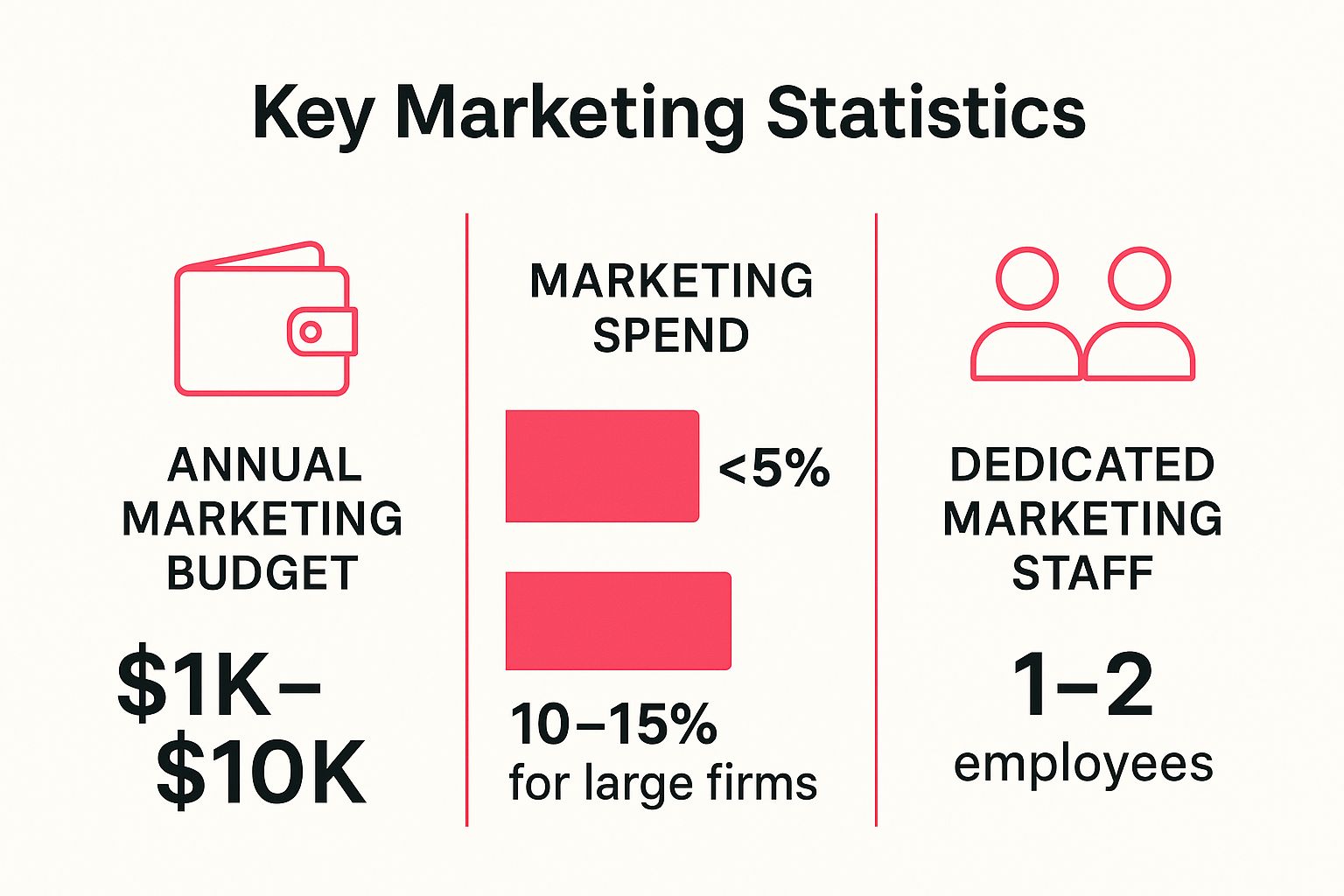
These figures highlight the stark contrast between small business marketing budgets and those of larger corporations, underscoring the need for resourceful strategies. The limited marketing staff also emphasizes the importance of automation and leveraging free or low-cost tools. Learn more about… digital marketing budget allocation to help you make informed decisions.
Smart Strategies for Limited Budgets
To overcome this challenge, consider these actionable tips:
- Allocate a minimum of 7-8% of gross revenue to marketing. This may seem difficult initially, but view it as an investment, not an expense.
- Focus your efforts. Instead of spreading resources thinly across multiple channels, concentrate on one or two proven marketing strategies. Dominate those channels before expanding.
- Embrace the 80/20 rule. Allocate 80% of your marketing budget to strategies with a proven track record and reserve 20% for experimenting with new approaches.
- Leverage free resources. Tools like Google My Business, social media platforms, and email marketing software offer powerful functionality without the hefty price tag.
- Track and measure religiously. Monitor every marketing dollar spent and analyze the results meticulously. Identify what works, what doesn’t, and adjust your strategy accordingly.
By implementing these strategies, small businesses can overcome resource limitations and achieve significant marketing success, even while competing against larger, well-funded competitors.
2. Lack of Brand Recognition and Market Visibility
New and small businesses face the enormous challenge of building brand awareness from scratch in crowded marketplaces. Without established reputations or widespread recognition, they struggle to gain consumer trust and compete for attention against established brands. This invisibility creates a vicious cycle where low awareness leads to fewer customers, resulting in less word-of-mouth marketing and continued obscurity. Small businesses often face challenges in allocating their marketing budget effectively. For those operating in the Middle East, guidance on tailored strategies, such as digital marketing for small business can be invaluable. Source: Digital Marketing for Small Business: Your Middle East Success Guide from Grassroots Creative Agency.

Consider Warby Parker, which built brand recognition through its unique direct-to-consumer model and social mission. Local coffee shops often compete against Starbucks by cultivating community engagement and a unique atmosphere. Boutique fitness studios differentiate themselves from large gym chains through personalized service. These examples demonstrate the power of focused brand building.
Shining a Light on Your Brand
Overcoming this “small business marketing challenge” requires a multi-pronged approach. It involves crafting a consistent brand identity, targeting a niche market, and actively engaging with potential customers. This can be achieved by leveraging both digital and traditional marketing channels strategically.
Smart Strategies for Building Brand Recognition
To combat the lack of brand recognition, consider these actionable tips:
- Develop a strong visual identity. Consistency across all touchpoints (website, social media, packaging) builds recognition.
- Focus on a niche. Becoming known for one specific thing initially is more effective than trying to be everything to everyone.
- Engage locally. Community involvement and sponsorships increase visibility within your target market.
- Create shareable content. Content that showcases brand personality can organically expand your reach.
- Encourage reviews. Testimonials and online reviews build trust and social proof.
- Partner strategically. Cross-promotions with complementary local businesses expose your brand to a wider audience.
By implementing these strategies, small businesses can break free from obscurity and establish a strong brand presence within their target market, ultimately attracting more customers and driving growth.
3. Digital Marketing Complexity and Rapid Technology Changes
The digital marketing landscape is in constant flux. Algorithm updates, emerging platforms, and evolving best practices create a moving target for small businesses. Owners often lack dedicated marketing expertise and struggle to keep up with these rapid changes while managing core operations. The complexity of digital tools, analytics, and optimization can feel overwhelming. For example, iOS 14.5’s privacy updates disrupted Facebook advertising, impacting many small businesses reliant on the platform. Similarly, Google’s core algorithm updates regularly reshape search engine results pages, requiring ongoing SEO adjustments.
Navigating the Digital Maze
This challenge is amplified by the rapid rise of new platforms like TikTok, forcing businesses to adapt content strategies and explore unfamiliar territory. Even established practices like omnichannel marketing can be difficult for small retailers to implement effectively. Falling behind on these trends can mean losing ground to competitors who are more digitally savvy. However, by adopting a strategic approach, small businesses can successfully navigate this dynamic landscape.
Staying Ahead of the Curve
Instead of trying to be everywhere at once, focus on mastering two or three key digital channels relevant to your target audience. Prioritize those that offer the best return on investment and align with your business goals. Subscribe to reputable marketing blogs and newsletters to stay informed about industry updates and emerging trends. For complex technical areas, consider investing in training or hiring specialists to manage specific aspects of your digital marketing strategy.
Actionable Steps for Success
Testing new approaches on a small scale before scaling campaigns can mitigate risks and ensure efficient use of resources. Joining small business marketing communities offers valuable opportunities for peer learning and shared insights. Leverage marketing automation tools to streamline repetitive tasks, freeing up time for strategic planning and creative development. Learn more about… advanced digital marketing strategies to maximize your ROI. By embracing a proactive and adaptable mindset, small businesses can successfully navigate the digital marketing landscape and achieve sustainable growth.
4. Ineffective Target Audience Identification and Segmentation
One of the most fundamental small business marketing challenges is ineffective target audience identification and segmentation. Many businesses struggle to pinpoint their ideal customer, leading to scattered marketing efforts and wasted resources. This challenge is often exacerbated by the desire to appeal to everyone, resulting in generic messaging that resonates with no one. Without a clear understanding of your target audience, your marketing campaigns become like shots in the dark, hoping to hit something, anything. This approach is inefficient and ultimately unsustainable for small businesses with limited budgets.
Focusing Your Marketing Efforts
Instead of trying to reach everyone, focus on understanding your ideal customer’s needs, motivations, and pain points. A local gym, for example, might find success targeting busy professionals by offering convenient 30-minute workout programs. Similarly, an accounting firm can specialize in a specific industry rather than offering general business services. Restaurants can use social media analytics to identify their core demographic and tailor their menu and atmosphere accordingly. These examples highlight the importance of targeting specific groups rather than casting a wide net. Digital marketing can be complex, especially for local businesses. Here’s a digital marketing for local businesses guide.
Smart Strategies for Targeting the Right Audience
To overcome this small business marketing challenge, start by analyzing your existing customer base to identify patterns and commonalities. Free tools like Google Analytics and Facebook Insights can also provide valuable audience data. Conducting surveys and interviews with current customers can further refine your understanding. Rather than trying to appeal to everyone, create 2-3 detailed buyer personas representing your ideal customers. Learn more about… customer segmentation techniques to help you create successful campaigns.
Actionable Tips for Audience Identification
- Analyze existing customers: Look for trends in demographics, purchasing behavior, and engagement.
- Use free tools: Leverage Google Analytics, Facebook Insights, and other platforms for valuable audience data.
- Conduct surveys and interviews: Gain deeper insights into customer needs and preferences.
- Create buyer personas: Develop 2-3 detailed profiles of your ideal customers.
- Test different messaging: Experiment with targeted messages for different audience segments.
- Monitor competitor audiences: Gain insights by analyzing your competitors’ social media followers.
By focusing your marketing efforts on a clearly defined target audience, small businesses can maximize their marketing ROI and achieve sustainable growth.
5. Measuring Marketing ROI and Attribution Challenges
One of the most significant small business marketing challenges is accurately measuring marketing ROI and attributing success to specific efforts. Small businesses often lack the sophisticated analytics tools and expertise of larger corporations, making it difficult to connect marketing activities directly to sales and revenue. This measurement gap can lead to wasted marketing spend on ineffective campaigns while potentially undervaluing successful strategies. Understanding the customer journey across multiple touchpoints, from initial awareness to final purchase, becomes crucial for accurate attribution.
Connecting the Dots Between Marketing and Sales
This challenge arises from the complexity of modern customer journeys. A customer might first encounter a business through a social media ad, then visit the website several times, subscribe to an email list, and finally make a purchase weeks later after clicking on a retargeting ad. Attributing the sale to a single touchpoint becomes problematic. For example, a local service business might track phone calls generated by Google Ads, but how can they determine if those calls resulted from other marketing efforts influencing the customer’s decision? Similarly, e-commerce stores using Google Analytics can measure website traffic from email marketing, but attributing the final purchase solely to email overlooks other influencing factors.
Strategies for Accurate Measurement
Overcoming this challenge requires a multi-faceted approach. From the outset, implementing robust analytics tools like Google Analytics with goal tracking is essential. Using unique phone numbers or promo codes for different marketing channels allows for better attribution. Customer surveys asking “How did you hear about us?” provide valuable qualitative data. Learn more about… measuring marketing campaign effectiveness to gain deeper insights.
Actionable Tips for Measuring ROI
To effectively measure your marketing ROI, consider these actionable tips:
- Track key metrics: Focus on metrics like cost per lead, customer lifetime value, and conversion rates. These provide insights into campaign performance and overall marketing effectiveness.
- Use UTM parameters: Implement UTM parameters for all digital marketing campaigns to track the source, medium, and campaign name of website traffic. This helps pinpoint which channels are driving the most valuable leads and conversions.
- Monitor leading indicators: Don’t solely focus on sales. Track leading indicators like website traffic, email opens, and social media engagement to gauge campaign performance early on and make necessary adjustments.
- Regularly analyze data: Consistently analyze your marketing data to identify trends, understand customer behavior, and optimize campaigns for better ROI.
By implementing these strategies, small businesses can gain a clearer understanding of their marketing ROI, optimize spending, and demonstrate the value of their marketing efforts.
6. Intense Competition from Larger, Well-Funded Companies
One of the most daunting small business marketing challenges is competing against corporate giants with seemingly limitless resources. These large competitors can afford expansive advertising campaigns, celebrity endorsements, and market saturation that smaller businesses simply can’t match. This disparity creates an uneven playing field, forcing small businesses to find innovative and resourceful ways to compete without breaking the bank. They must identify and leverage their unique advantages to stand out in a crowded marketplace.

Finding Your Niche and Owning It
The key to competing against larger companies isn’t to outspend them; it’s to outsmart them. Independent bookstores, for example, can compete with Amazon by offering personalized recommendations, hosting author events, and fostering a sense of community. Local hardware stores can differentiate themselves from big-box retailers by providing expert advice and convenient services. Similarly, boutique agencies can compete with large consulting firms by specializing in niche areas and offering personalized attention.
Smart Strategies for Competing with Goliaths
To overcome this challenge, consider these actionable tips:
- Focus on local SEO. Optimize your online presence to dominate local search results and attract customers in your geographic area. This is especially important for brick-and-mortar businesses.
- Emphasize your unique value proposition. What do you offer that larger competitors don’t? Perhaps it’s personalized service, unique product offerings, or a strong commitment to ethical sourcing. Highlight these differentiators in your marketing.
- Build strong community relationships. Sponsor local events, partner with other businesses, and actively engage with your community to build brand loyalty and generate word-of-mouth referrals.
- Target long-tail keywords. These highly specific search terms are often overlooked by larger competitors, allowing smaller businesses to rank higher in search results and attract targeted traffic.
- Leverage customer service as a differentiator. Provide exceptional customer service to build strong relationships and foster customer loyalty. This can be a powerful advantage over larger, impersonal corporations.
By implementing these strategies, small businesses can effectively compete against larger, well-funded companies, carving out their own space in the market and achieving sustainable growth.
7. Generating Consistent Leads and Managing Sales Funnels
One of the most persistent small business marketing challenges revolves around lead generation and sales funnel management. Creating a predictable and sustainable system for attracting potential customers is often a struggle. This frequently leads to a feast-or-famine cycle, making business planning and forecasting incredibly difficult. Without the resources for sophisticated marketing automation systems and dedicated sales teams, nurturing prospects through a complex sales funnel becomes a significant hurdle. Many small businesses also lack the expertise to design effective lead nurturing sequences that convert prospects into paying customers.
Building a Predictable Lead Pipeline
This challenge, however, can be addressed strategically. Small businesses can implement simple yet effective systems to manage leads and nurture them through the sales funnel. For example, a real estate agent might use automated email sequences to stay in touch with potential homebuyers, providing valuable information and building rapport over time. Similarly, consulting firms can create valuable content offers, such as ebooks or checklists, to capture leads and establish themselves as industry experts. Local service businesses can leverage review generation systems to build social proof and attract new customers. B2B companies can utilize LinkedIn outreach combined with targeted email marketing to generate qualified leads.
Smart Strategies for Lead Generation and Management
To overcome this challenge, small businesses can implement these practical tips:
- Implement a simple CRM system. This doesn’t need to be complex. A basic CRM will help track leads, interactions, and progress through the sales funnel.
- Create lead magnets. Offer valuable content like ebooks, checklists, webinars, or free consultations in exchange for contact information.
- Set up automated email sequences. Nurture leads over time with targeted emails providing valuable information and building relationships.
- Establish clear lead qualification criteria. Focus sales and marketing efforts on the most promising leads.
- Use multiple lead generation channels. Diversify your approach to reduce dependency on a single source of leads. This might include social media marketing, content marketing, email marketing, and networking.
- Follow up promptly. Respond to inquiries and new leads within 24 hours to demonstrate responsiveness and build momentum. Learn more about… generating consistent leads and managing sales funnels.
By adopting these strategies, small businesses can establish a more predictable and sustainable lead generation system, transforming the sales process from a sporadic endeavor into a consistent engine for growth.
8. Time Management and Work-Life Balance in Marketing Activities
One of the most pervasive small business marketing challenges is effectively managing marketing activities while maintaining a healthy work-life balance. Small business owners often wear multiple hats, juggling everything from operations and finance to customer service and product development. This leaves limited time for dedicated marketing efforts, often leading to neglect during busy periods or encroachment into personal time. The always-on nature of digital marketing further exacerbates this challenge, creating pressure to be constantly available and responsive across various online platforms.
Making Time for Marketing
This constant demand can be overwhelming, especially for solo entrepreneurs and small teams where marketing responsibilities fall squarely on already overloaded individuals. Imagine a restaurant owner struggling to maintain a vibrant social media presence during the dinner rush or a service business owner working late nights to manage marketing campaigns after a full day of client appointments. Retail store owners face similar struggles, finding it difficult to create consistent content while simultaneously managing daily operations. Even consultants battle to balance client work with essential business development activities.
This challenge highlights the need for efficient time management and strategic prioritization in marketing. It’s not about working harder, but working smarter. Allocating specific time slots for marketing activities, rather than addressing them ad-hoc, can significantly improve efficiency.
Smart Strategies for Time Management
To reclaim control of your time and integrate marketing effectively, consider these practical tips:
- Utilize scheduling tools. Batch and automate social media posts to maintain a consistent online presence without constant manual intervention.
- Establish dedicated marketing time. Block out specific times in your schedule solely for marketing activities, treating them as essential appointments.
- Streamline content creation. Develop content calendars and templates to simplify the process and ensure consistency.
- Delegate or outsource. Consider outsourcing specific marketing tasks, like graphic design or content writing, to free up your time for strategic activities.
- Prioritize high-ROI activities. During time-constrained periods, focus on marketing activities with the highest proven return on investment.
- Leverage mobile apps. Manage marketing tasks during downtime using mobile apps, optimizing short bursts of free time throughout the day.
By implementing these strategies, small businesses can integrate marketing effectively without sacrificing work-life balance, ensuring sustainable business growth without burnout.
Small Business Marketing Challenges Comparison
| Challenge / Item | Implementation Complexity 🔄 | Resource Requirements ⚡ | Expected Outcomes 📊 | Ideal Use Cases 💡 | Key Advantages ⭐ |
|---|---|---|---|---|---|
| Limited Marketing Budget and Resource Constraints | Low to Medium – constrained by budget and time | Minimal budget ($1K–$10K), limited staff | Focused, high-ROI marketing; limited scale | Small businesses needing cost-effective marketing | Drives creativity and strong ROI skills |
| Lack of Brand Recognition and Market Visibility | Medium – requires consistent branding efforts | Time-intensive, investment in visual identity | Growing awareness and trust over time | New businesses building initial market presence | Builds unique brand identity and rapid growth potential |
| Digital Marketing Complexity and Rapid Changes | High – requires ongoing learning and adaptation | Need for technical skills, training, possible hires | Access to advanced tools, global reach, data insights | Businesses adopting digital marketing in evolving landscape | Democratized tools with precise tracking |
| Ineffective Target Audience Identification | Medium – involves research and data analysis | Requires some research tools and customer data | Improved targeting and messaging efficiency | Businesses refining marketing through segmentation | Enables niche focus and better resource use |
| Measuring Marketing ROI and Attribution Challenges | Medium to High – complex tracking and analytics | Tools needed (Google Analytics, CRM), expertise | Better optimization and proof of marketing impact | Businesses needing to justify and improve marketing spend | Provides measurable insights and allocation clarity |
| Intense Competition from Larger Companies | Medium – requires strategic differentiation | Moderate, focus on local SEO and community | Ability to compete locally despite budget gaps | Small businesses in markets dominated by large firms | Agility, personalization, local market advantage |
| Generating Consistent Leads and Managing Funnels | Medium – setup of systems and ongoing management | CRM tools, automation systems, multi-channel use | More predictable lead flow and sales conversions | Businesses struggling with feast-or-famine lead cycles | Builds direct relationships and personalized sales |
| Time Management and Work-Life Balance | Medium – requires disciplined scheduling | Time, plus possible outsourcing or automation | Consistent marketing presence without burnout | Solo entrepreneurs and small teams balancing multiple roles | Enables focus on high-impact activities and avoids burnout |
Navigating the Marketing Maze: Empowering Small Business Success
Small businesses face unique marketing challenges in today’s competitive landscape. This article has explored eight common hurdles, from limited budgets and brand visibility to the complexities of digital marketing and measuring ROI. Overcoming these challenges is crucial for sustainable growth and achieving your business objectives. Let’s recap the key takeaways and empower your journey towards marketing success.
Key Takeaways for Conquering Marketing Challenges
Successfully navigating the marketing maze requires a strategic approach. We’ve discussed the importance of:
- Resourceful Budgeting: Maximizing your marketing impact even with limited resources by focusing on cost-effective strategies like social media marketing and content creation.
- Building Brand Awareness: Establishing a strong brand identity and leveraging online and offline channels to increase visibility and attract your target audience.
- Embracing Digital Evolution: Staying updated with the latest digital marketing trends and technologies to remain competitive and connect with customers effectively.
- Targeted Audience Engagement: Defining your ideal customer profile and segmenting your audience for personalized messaging and increased conversion rates.
- Data-Driven Decision Making: Implementing analytics tools and tracking key metrics to measure marketing ROI and optimize campaign performance.
- Competitive Differentiation: Highlighting your unique selling propositions and crafting a compelling brand story to stand out from larger competitors.
- Lead Generation and Nurturing: Implementing strategies to attract qualified leads and guide them through the sales funnel with targeted content and offers.
- Strategic Time Management: Prioritizing marketing tasks, leveraging automation tools, and maintaining work-life balance for sustainable marketing efforts.
Turning Challenges into Opportunities
By acknowledging and addressing these small business marketing challenges, you can transform obstacles into opportunities. These challenges are not insurmountable roadblocks, but rather stepping stones towards building a stronger, more resilient business. Remember, focusing on your target audience, adapting to the ever-evolving digital landscape, and consistently measuring your results are essential for long-term success.
Empowering Your Next Steps
Now is the time to take action. Review the strategies outlined for each challenge and begin implementing them within your own marketing plan. Start small, track your progress, and iterate based on your findings. Every step you take towards overcoming these challenges brings you closer to achieving your business goals.
Do you struggle with converting abandoned carts and retaining customers? Recapture lost revenue and boost customer loyalty with personalized, automated messaging. Explore how CartBoss can help you overcome these specific small business marketing challenges and drive significant growth. Visit CartBoss today to learn more.