



Unleash the Power of Both Channels
Stop choosing between SMS marketing vs email marketing. This listicle reveals six key strategies to integrate the immediacy of SMS with the richness of email for maximum impact. Learn how to build a multi-channel approach, segment effectively, optimize timing, align with your conversion funnel, adapt content formats, and prioritize compliance. If you’re an e-commerce business, marketer, or online retailer looking to boost engagement and conversions, this tactical list will show you how to optimize your marketing spend by combining SMS and email effectively.
1. Integrated Multi-Channel Approach
When considering SMS marketing vs email marketing, a powerful strategy often overlooked is integrating both into a coordinated multi-channel approach. Rather than viewing these channels as competing forces, this method leverages the unique strengths of each to create a more comprehensive and effective marketing strategy. This means using SMS for its immediacy – perfect for time-sensitive alerts and urgent communications – and utilizing email for its capacity to deliver richer, more detailed content. This synergistic approach allows businesses to connect with customers on their preferred platforms and at the most opportune moments.
This integrated approach isn’t just about blasting out messages on two different channels. It’s about carefully coordinating messaging, ensuring consistency in branding and tone, and strategically triggering communications based on user actions. For instance, a customer abandoning their cart might receive an immediate SMS message with a discount code to incentivize purchase completion. Then, a follow-up email could provide more detailed product information or customer testimonials, nurturing the lead further down the sales funnel. Features like coordinated messaging, sequential triggering, cross-channel data collection, unified analytics reporting, and consistent branding across both SMS and email are essential for successful implementation.
Examples of Successful Implementation:
- Sephora: Uses SMS for flash sale alerts and limited-time offers, while sending detailed product information, makeup tutorials, and personalized recommendations via email.
- Starbucks: Coordinates app notifications, SMS messages for immediate offers (like bonus stars for specific purchases), and email for rewards program updates and new product announcements.
- Amazon: Leverages SMS for crucial delivery notifications and order updates, while using email for personalized product recommendations, promotional deals, and review requests.
Actionable Tips for Implementation:
- Map the Customer Journey: Identify the optimal touchpoints for SMS and email throughout the customer lifecycle.
- Preference Centers: Empower customers to choose their preferred communication channel.
- Consistent Messaging Templates: Create templates that work seamlessly across both SMS and email, maintaining a unified brand voice.
- Automation is Key: Use marketing automation tools to coordinate timing and trigger messages based on user behavior.
- Cross-Channel Analytics: Track key metrics across both channels to optimize the mix and maximize ROI.
Pros and Cons of the Integrated Approach:
Pros:
- Higher overall engagement rates
- Broader reach across different user preferences
- Redundancy ensures critical messages are seen
- More touchpoints in the customer journey
- Flexibility to match message type with optimal channel
Cons:
- More complex to implement and manage
- Requires sophisticated marketing automation tools (like Omnisend, HubSpot, or Salesforce Marketing Cloud)
- Risk of message fatigue if poorly coordinated
- Higher overall costs than a single-channel approach
- Requires expertise in both SMS and email marketing
Why this Approach Deserves its Place in the List:
In the ongoing debate of SMS marketing vs email marketing, the integrated multi-channel approach offers a superior solution. It recognizes that each channel has its strengths and weaknesses, and by combining them strategically, businesses can achieve significantly better results than by relying on a single channel alone. This is particularly valuable for e-commerce businesses, online retailers, and anyone looking to optimize their marketing spend and improve customer engagement. This approach, popularized by platforms like Omnisend and advocated by marketing experts like Neil Patel, is becoming increasingly crucial in today’s competitive digital landscape.
2. Segmentation and Personalization Strategy
In the battle of SMS marketing vs email marketing, segmentation and personalization emerge as a crucial strategy for maximizing the effectiveness of both channels. This involves dividing your audience into specific groups and tailoring your messaging based on their individual characteristics, behaviors, and preferences. Instead of blasting out generic messages, you’re delivering highly relevant content that resonates with each segment, leading to increased engagement and conversions. This approach moves beyond simple demographic segmentation to encompass behavioral triggering, predictive personalization, and even AI-powered recommendations.

Features like dynamic content customization, custom fields and merge tags, and advanced segmentation tools empower marketers to create truly personalized experiences. For example, Netflix uses email to deliver personalized content recommendations and follows up with SMS reminders for new releases. Similarly, Spotify sends tailored playlist emails and uses text alerts to notify users about new releases from their favorite artists. Airbnb excels at this by sending personalized trip suggestions via email and then confirming bookings via SMS. These examples highlight how combining email and SMS, powered by robust segmentation, creates a highly effective communication strategy. Learn more about Segmentation and Personalization Strategy specifically for cart recovery.
This personalized approach deserves a prominent place in any SMS marketing vs email marketing comparison because it significantly enhances the customer experience and drives measurable results. The benefits include higher conversion rates, improved customer satisfaction, reduced unsubscribe rates, and a better return on investment (ROI) for your marketing spend. By delivering targeted messages that feel helpful rather than intrusive, you build stronger customer relationships and foster loyalty.
However, effective segmentation and personalization require a robust approach. You need substantial customer data to build accurate segments and personalize effectively. Implementing these strategies can be resource-intensive, requiring technical expertise and ongoing optimization. Data privacy is another critical consideration, and marketers must ensure they collect and use data responsibly. The technical complexity involved in implementing dynamic content and personalized messaging can be challenging, demanding specialized tools and expertise.
Pros:
- Higher conversion rates
- Improved customer experience
- Reduced unsubscribe rates
- Better ROI on marketing spend
- Builds stronger customer relationships
Cons:
- Requires substantial customer data
- Can be resource-intensive to implement
- Privacy concerns with data collection
- Technical complexity in implementation
- Requires ongoing optimization
Tips for Effective Segmentation and Personalization:
- Start with basic segmentation (demographics, purchase history) before advancing to behavioral targeting.
- Use progressive profiling to gather data gradually over time.
- Test different personalization elements to identify the areas with the highest impact.
- Ensure your messaging feels helpful and valuable, not intrusive or spammy.
- Regularly clean and update your data to maintain accuracy and relevance.
Pioneered by companies like Klaviyo and Mailchimp for email, and Twilio for SMS, and underpinned by Seth Godin’s “Permission Marketing” philosophy, personalized messaging recognizes the importance of treating customers as individuals. When considering SMS marketing vs email marketing, remember that personalization is key to maximizing the potential of both.
3. Time-Based Optimization Strategy
In the ongoing debate of SMS marketing vs email marketing, a crucial factor that often gets overlooked is timing. A Time-Based Optimization Strategy is a methodical approach to sending messages at the optimal times, recognizing that SMS and email operate on different timelines. SMS thrives on immediacy, perfect for urgent updates, while email allows for more detailed content consumption at the recipient’s leisure. This strategy hinges on understanding channel characteristics, audience behavior, and message urgency to maximize impact.
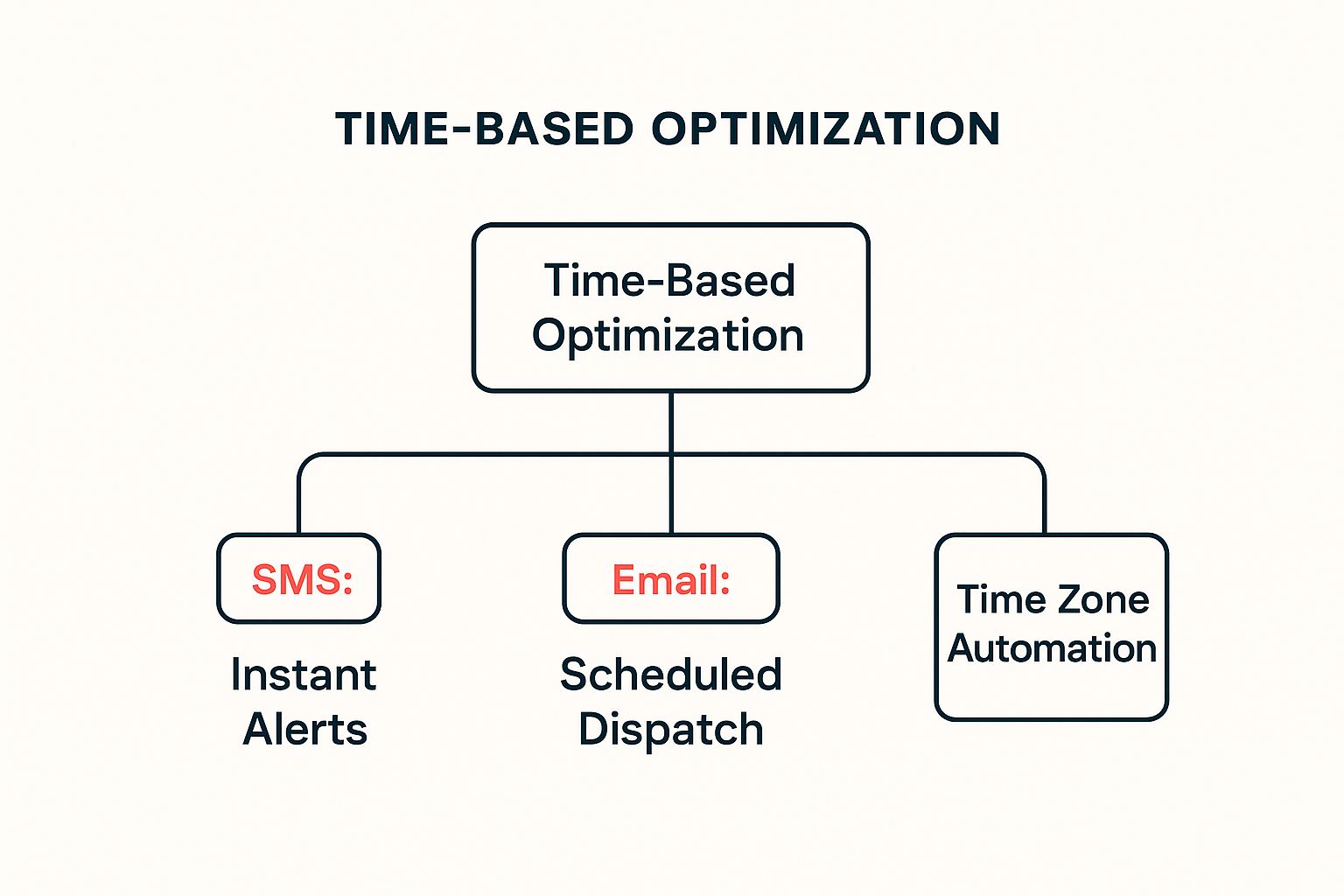
The infographic above visualizes the hierarchy of a Time-Based Optimization Strategy. At the top, we have the overall goal: maximizing engagement and conversions. This branches down into two main channels: SMS and Email. Under each channel, specific tactics are listed, such as using SMS for urgent updates and email for detailed promotions. Finally, the base level represents the metrics used to measure success: open rates, click-through rates, and conversions. As the infographic demonstrates, achieving optimal results requires a strategic approach to timing across both channels. A deeper understanding of how to best utilize each medium will improve your overall marketing performance in the sms marketing vs email marketing landscape.
This strategy leverages features like send-time optimization algorithms, time zone automation, day-of-week testing, urgency-based channel selection, and behavioral timing patterns. The benefits are substantial, including improved open and response rates, reduced message fatigue, a better customer experience, increased conversion rates, and more efficient resource allocation. However, implementing this strategy requires significant data collection and analysis, potentially advanced marketing automation tools, and ongoing testing to adapt to evolving patterns. Cultural and industry-specific timing variations, especially for global audiences, add further complexity.
Real-world examples highlight the effectiveness of this approach. OpenTable leverages SMS for immediate reservation reminders a few hours before the booking, while promotional offers are sent via email days in advance. Airlines use SMS for urgent flight delay notifications, but email for travel deals on Tuesday mornings when booking rates are typically highest. Retail brands send abandoned cart reminders via email within 24 hours, capitalizing on recent purchase intent, while flash sale notifications are delivered via SMS minutes before the event to create a sense of urgency.
Planning your content in advance is crucial for a successful SMS and email marketing strategy. A well-structured social media content calendar can help you maintain consistency and align your messaging across different channels. Create Your Social Media Content Calendar for Better Engagement from EvergreenFeed provides invaluable insights and templates for building an effective calendar.
To effectively utilize a Time-Based Optimization strategy in your own sms marketing vs email marketing efforts, consider these actionable tips: Analyze your highest engagement periods by channel, test sending critical messages via SMS during business hours and detailed content via email in the evenings, and remember to account for international time zones. Leverage automation to optimize send times based on individual user behavior, and reserve early morning SMS for only the most urgent communications. Learn more about Time-Based Optimization Strategy for e-commerce specific insights. Platforms like MailChimp (with its send time optimization feature), Omnisend (known for its timing studies), CoSchedule (with its “best time to send” research), and Twilio (offering timing optimization tools) have popularized and simplified time-based optimization. By strategically timing your messages, you can significantly enhance the effectiveness of both your SMS and email marketing campaigns.
4. Conversion Funnel Alignment Strategy
In the ongoing debate of SMS marketing vs email marketing, a strategic approach that leverages the strengths of both channels is the Conversion Funnel Alignment Strategy. This method focuses on mapping your SMS and email marketing efforts to specific stages of the customer journey and sales funnel. Recognizing that different channels excel at different points in the buying process is key to maximizing conversions and optimizing your marketing spend.
This strategy operates on the principle that a customer’s receptiveness to different communication channels changes as they move through the sales funnel. For example, email, with its capacity for richer content, is excellent for initial awareness and education. SMS, with its immediacy and high open rates, becomes incredibly powerful for time-sensitive offers and reminders as the customer nears a purchase decision. By strategically aligning each channel to the appropriate stage, you create a more effective and personalized customer experience.
Features of a Conversion Funnel Alignment Strategy:
- Journey-based messaging sequences: Crafting specific message flows for each stage of the funnel, tailored to the channel and the customer’s current needs.
- Channel-specific conversion metrics: Tracking key performance indicators like open rates, click-through rates, and conversions for each channel at each stage.
- Trigger-based progression through funnel: Automating the movement of prospects between stages based on their actions, such as signing up for a newsletter or adding an item to their cart.
- Stage-appropriate content formats: Using rich media like videos and catalogs in emails for awareness, and concise, action-oriented text messages for decision-making stages.
- Cross-channel attribution modeling: Understanding how each channel contributes to the overall conversion journey, allowing for more informed budget allocation and optimization.
Pros:
- Higher conversion rates throughout the funnel
- More efficient marketing spend
- Better customer experience with relevant messaging
- Clearer attribution of channel impact
- Optimized touchpoints at critical decision moments
Cons:
- Complex to implement across multiple systems
- Requires sophisticated tracking and attribution
- Channel preferences may vary by audience segment
- Needs continuous optimization and testing
- May require significant marketing automation investment
Examples of Successful Implementation:
- Warby Parker: Uses email for awareness with detailed product catalogs, then SMS for the consideration stage with personalized recommendations, and finally text confirmations for purchase decisions.
- Casper: Uses educational email content for top-of-funnel prospects, SMS for mid-funnel promotions and discounts, and both channels for post-purchase support.
- HubSpot: Uses email newsletters for awareness, targeted emails for consideration, and SMS for decision-stage webinar reminders.
Actionable Tips:
- Map your conversion funnel: Before assigning channels, clearly define each stage of your customer journey.
- Email for education: Leverage email’s capacity for detailed content early in the funnel.
- SMS for decisions: Deploy SMS for time-sensitive offers and reminders at crucial decision points.
- Track everything: Implement tracking pixels across channels to measure progression and attribute conversions accurately.
- Channel switching prompts: Encourage customers to opt-in to SMS at key funnel transitions.
- Segment and test: Test different channel sequences for various audience segments to optimize performance.
Why This Approach Matters in SMS Marketing vs Email Marketing:
Choosing between SMS marketing and email marketing is often a false dilemma. The Conversion Funnel Alignment Strategy allows you to leverage the distinct strengths of each, creating a synergistic approach that drives higher conversions and a better customer experience. Learn more about Conversion Funnel Alignment Strategy. This approach is particularly valuable for e-commerce businesses, marketing professionals, online retailers, and Shopify/WooCommerce store owners looking to optimize their marketing ROI and improve customer retention. The insights gleaned from analyzing multi-channel approaches, like those popularized by Shopify, ActiveCampaign, Digital Marketer, and Brian Balfour’s growth modeling, highlight the importance of strategic channel alignment. By understanding which channel best serves each stage of the customer journey, you can move beyond the “SMS marketing vs email marketing” debate and embrace a truly integrated and effective marketing strategy.
5. Content Format Optimization Strategy
In the ongoing debate of SMS marketing vs email marketing, Content Format Optimization Strategy emerges as a critical factor for success. This approach emphasizes tailoring content specifically for each channel’s unique strengths and limitations, acknowledging the fundamental differences between the concise nature of SMS and the richer, more detailed format of email. Instead of repurposing the same message, this strategy prioritizes designing content with the platform’s format as the primary consideration.
This method is crucial because SMS and email cater to different communication needs. SMS excels at delivering time-sensitive, urgent messages, leveraging its brevity and immediacy. Email, on the other hand, provides the space for in-depth storytelling, detailed product information, and visually engaging elements. By recognizing these distinctions and optimizing content accordingly, businesses can dramatically improve engagement and conversion rates. Features like channel-specific content templates, multimedia selection by channel, length and complexity optimization, visual vs. text balancing, and device-responsive design considerations are all integral to this strategy.
Consider how Dollar Shave Club leverages this principle. They utilize concise 160-character SMS messages for flash sales and time-sensitive offers, driving immediate action. Conversely, their emails feature extended product stories, customer testimonials, and high-quality visuals, fostering brand loyalty and providing more comprehensive product information. Similarly, The New York Times sends breaking news alerts through brief SMS messages, while delivering deeper analysis and feature articles through rich HTML emails. Domino’s Pizza employs SMS for order confirmations and simple tracking updates, reserving their emails for visually appealing menu promotions and detailed special offers.
Tips for implementing a Content Format Optimization Strategy:
- Create separate content briefs for SMS and email campaigns: This ensures focused messaging tailored to each platform’s strengths.
- For SMS, focus on clear CTAs and concise value propositions under 160 characters: Brevity and urgency are key.
- For email, use hierarchy with scannable headlines and detailed supporting content: Leverage the space available for richer communication.
- Test rich media in email but use links for SMS: Respect the limitations of SMS while maximizing the potential of email.
- Develop separate style guides for each channel: Maintain consistent branding while acknowledging platform-specific conventions.
- Consider text-only email alternatives for crucial communications: Ensure deliverability and accessibility across all devices. Learn more about Content Format Optimization Strategy offers further guidance.
Pros of this approach include:
- Higher engagement through format-appropriate content
- Better user experience on each channel
- Improved conversion rates
- More efficient content creation workflows
- Reduced risk of message fatigue
Cons to consider:
- Requires more content creation resources
- More complex to manage and maintain
- Needs channel-specific creative expertise
- May create messaging inconsistencies if poorly executed
- Requires rigorous testing across devices
This strategy is particularly beneficial for e-commerce businesses, marketing professionals, online retailers, and anyone managing multiple marketing channels. By understanding and implementing Content Format Optimization, businesses can maximize the impact of both SMS marketing and email marketing, driving engagement, conversions, and ultimately, revenue. The principles championed by experts like Ann Handley and resources like Copyblogger and the Mobile Marketing Association underscore the importance of this strategy in today’s multi-channel marketing landscape.
6. Compliance-First Engagement Strategy
In the ongoing debate of SMS marketing vs email marketing, a crucial differentiator, and a non-negotiable for successful campaigns, is a compliance-first engagement strategy. This approach prioritizes building marketing programs with legal compliance and privacy considerations baked into the foundation, rather than treating them as afterthoughts. This is particularly important considering the stricter regulations governing SMS marketing (TCPA, CTIA) compared to email (CAN-SPAM, GDPR, CCPA). A compliance-first strategy ensures your marketing efforts not only reach your target audience effectively but also respect their privacy and build trust, ultimately fostering a more sustainable, long-term relationship.
This strategy revolves around obtaining explicit consent, providing crystal-clear opt-out mechanisms, and adhering to privacy-respecting practices throughout the customer journey. Features like double opt-in processes, channel-specific compliance workflows, and jurisdiction-based messaging rules are key components. Automated compliance documentation and regular permission refreshing further solidify this proactive approach.
Why is this crucial for SMS marketing vs email marketing? SMS messages often have a higher open and engagement rate than emails, making the potential impact of non-compliant practices even greater. Imagine sending an unsolicited SMS message to thousands of recipients – the legal and reputational damage could be devastating. By contrast, a compliance-first approach allows you to leverage the power of SMS marketing responsibly and ethically.
Pros of a Compliance-First Approach:
- Reduced Legal Risk and Potential Fines: Avoid hefty penalties associated with TCPA, CTIA, GDPR, CCPA, and other regulations.
- Built Consumer Trust: Transparent practices foster confidence and strengthen brand loyalty.
- Higher Quality Subscriber Lists: Engaged subscribers who have explicitly opted in demonstrate genuine interest in your offerings.
- Lower Spam Complaints: Respecting user preferences minimizes the likelihood of being marked as spam.
- Sustainable Long-Term Marketing Programs: Building your marketing on a solid foundation of compliance ensures its longevity.
Cons of a Compliance-First Approach:
- May Result in Smaller Initial Audience Size: Requiring explicit consent can reduce the initial number of subscribers.
- More Complex Signup Processes: Implementing double opt-ins and managing granular permissions adds complexity.
- Additional Technical Implementation Requirements: Setting up automated compliance workflows and documentation requires technical investment.
- Regional Variations in Compliance Needs: Navigating different regulations across various jurisdictions can be challenging.
- Ongoing Monitoring of Changing Regulations: Staying up-to-date with evolving privacy laws requires continuous effort.
Examples of Successful Implementation:
- Uber: Provides clear SMS opt-in during account creation, separating consent for promotional messages from transactional updates.
- Airbnb: Implements region-specific compliance workflows tailored to the different regulations for EU vs. US customers.
- Target: Offers a comprehensive preference center enabling customers to manage granular channel-by-channel permissions for email and SMS.
Actionable Tips for E-commerce Businesses and Marketing Professionals:
- Implement separate consent mechanisms for SMS and email marketing.
- Make opt-out instructions clear and easily accessible in every message.
- Store consent records diligently, including timestamps and the source of consent.
- Regularly clean your lists and remove unengaged subscribers.
- Use a compliance checklist before launching every campaign.
- Consider working with compliance-focused ESP and SMS providers like Twilio, mentioned in their compliance tools and documentation.
For a deeper understanding of compliance, especially in the context of e-commerce SMS marketing, learn more about Compliance-First Engagement Strategy. This resource offers valuable insights into navigating GDPR and other relevant regulations.
This compliance-first approach, popularized by regulations like GDPR and CCPA, as well as tools and guidelines from organizations like Twilio, the DMA, OneTrust, and TrustArc, deserves its place in this list because it addresses a fundamental aspect of responsible and effective marketing. In the SMS marketing vs email marketing comparison, while both channels require adherence to regulations, the more stringent requirements of SMS necessitate a particularly rigorous compliance strategy. By prioritizing compliance, you not only mitigate legal risks but also build trust with your customers, laying the foundation for sustainable and impactful marketing campaigns.
6-Strategy SMS vs Email Marketing Comparison
| Strategy | 🔄 Implementation Complexity | 📊 Resource Requirements | ⭐ Expected Outcomes | 💡 Ideal Use Cases | ⚡ Key Advantages |
|---|---|---|---|---|---|
| Integrated Multi-Channel Approach | High – requires multi-tool setup and channel expertise | High – needs automation tools & expertise | Very High – broader reach and engagement | Brands targeting multiple user preferences and urgent + detailed messaging | Higher engagement, more touchpoints, flexible channel matching |
| Segmentation and Personalization Strategy | High – data-driven, AI integration, ongoing optimization | High – substantial customer data and analytics | Very High – increased conversions and ROI | Businesses with rich customer data aiming for relevance and personalization | Better customer experience, increased conversions, reduced unsubscribes |
| Time-Based Optimization Strategy | Medium-High – data analysis and continuous testing required | Medium – marketing automation with timing capabilities | High – improved open rates and reduced fatigue | Brands with time-sensitive messaging across different time zones | Optimized send times, better resource use, improved response rates |
| Conversion Funnel Alignment Strategy | High – requires tracking across funnel and channels | High – sophisticated tracking and automation tools | Very High – optimized conversions across funnel stages | Companies focused on structured customer journey and funnel optimization | Higher conversions, efficient spend, clear channel attribution |
| Content Format Optimization Strategy | Medium – need channel-specific creative expertise and testing | Medium-High – content creation resources for multiple formats | High – better engagement via format-tailored content | Teams aiming to maximize user experience on SMS vs email | Higher engagement, better UX, efficient workflows |
| Compliance-First Engagement Strategy | Medium-High – complex legal and technical requirements | Medium – tools for consent management and monitoring | High – reduced legal risks and sustainable lists | Businesses prioritizing legal compliance and customer trust | Reduced legal risk, higher trust, quality subscriber lists |
Maximize Your Marketing ROI with a Combined Approach
This article explored the key differences and advantages of SMS marketing vs email marketing, highlighting the power of a combined strategy. We’ve covered how an integrated multi-channel approach, coupled with smart segmentation and personalization, can significantly impact your bottom line. By optimizing your timing, aligning your messaging with the customer journey, tailoring content formats to each channel, and prioritizing compliance, you can unlock the full potential of both SMS and email. These strategies are crucial for e-commerce businesses, online retailers, and marketing professionals seeking to maximize their marketing ROI, especially those dealing with high cart abandonment rates or managing multiple clients. Mastering these concepts allows you to engage customers more effectively, boost conversions, and build lasting relationships, leading to sustainable growth in the competitive e-commerce landscape of 2025 and beyond.
Remember, the most effective approach leverages the strengths of both SMS marketing and email marketing. You can achieve this powerful synergy by implementing the strategies discussed – from personalized messaging to time-based optimization – creating a cohesive and impactful customer experience.
Ready to streamline your SMS and email marketing efforts and see a real impact on your abandoned cart recovery rate? CartBoss seamlessly integrates SMS and email campaigns, automating your marketing and helping you recover lost revenue. Start maximizing your ROI and recapture lost sales – explore the power of CartBoss today! CartBoss