


Do Not Disturb (DND) mode is a standard feature on every modern smartphone that silences incoming calls, texts, and notifications. For e-commerce store owners, it’s your customer’s digital “quiet please” sign. It signals they’re busy, sleeping, or simply don’t want to be interrupted. Understanding how DND works is critical to ensuring your SMS campaigns increase revenue instead of getting lost in a silent void.
What Do Not Disturb Mode Means for Your Bottom Line
Think of DND mode as a smart receptionist for your customer’s phone. When it’s on, it holds all but the most urgent calls and messages, letting the user focus without constant pings and buzzes.
It’s important to know that DND is not a blocker; your SMS message still gets delivered. The catch? It arrives silently. No sound, no vibration, no alert on the lock screen.
This is a huge deal for e-commerce brands that rely on timely offers to drive sales.
- A flash sale notification that lands without an alert completely loses its urgency.
- An abandoned cart reminder sent to a silent phone isn’t going to pull a customer back in that critical first hour.
DND essentially puts your message’s impact on hold until the customer decides to manually check their phone, which could be hours later—long after your offer has expired or they’ve purchased from a competitor.
Empowering Users, Reshaping Communication
DND puts the user back in control of their digital life—a fundamental shift in how people interact with brands. They are actively choosing when and how they receive marketing messages. This means blasting out texts at random times is a dead-end strategy that hurts your conversion rates and brand reputation.
This infographic breaks down the core functions of Do Not Disturb mode at a glance.
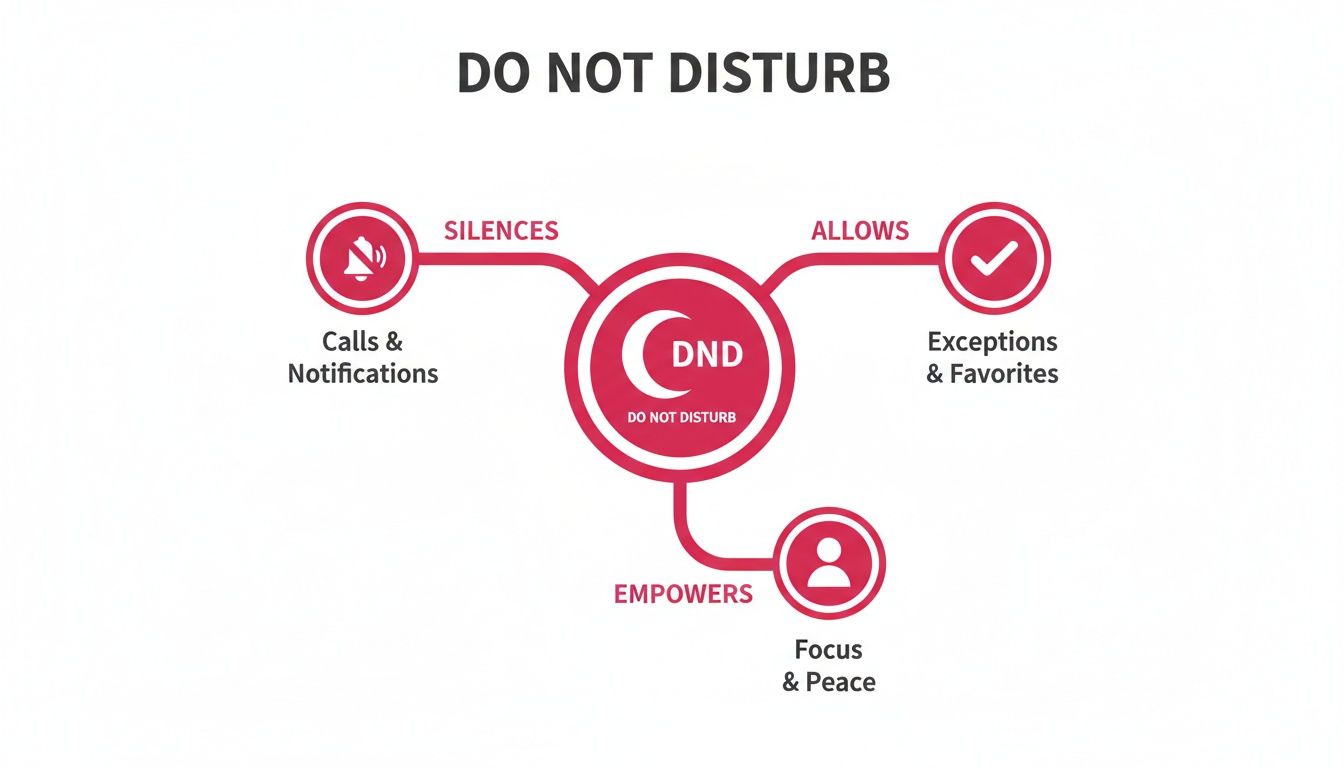
As you can see, DND isn’t just about muting alerts; it’s a powerful tool for users to manage their attention. Understanding the different ways you can reach a customer is crucial. For a deeper dive, check out our guide comparing SMS vs. push notifications.
Let’s break down exactly what DND does on most phones with a quick table.
Do Not Disturb Mode At a Glance
This table gives you a simple overview of what DND typically silences and what it might still let through.
| Feature | What It Silences | What It Allows (Typically) |
|---|---|---|
| Calls | Rings and vibrations from most incoming calls. | Calls from “Favorite” contacts. |
| Repeated calls from the same number within a few minutes. | ||
| SMS/MMS | Sounds, vibrations, and screen-on alerts for new texts. | Messages from “Favorite” or pre-approved contacts. |
| App Alerts | All push notifications from apps (social media, news, etc.). | Emergency alerts (e.g., Amber Alerts). |
| Alarms and timers set by the user. |
While the specifics can vary between Android and iOS, the core idea is the same: create an interruption-free zone for the user.
For marketers, DND is not an obstacle to be bulldozed. It’s a clear signal from your customer. Respecting these boundaries is the first step to building trust and ensuring your messages are welcomed, not just tolerated.
Ignoring this signal is risky. It can lead to far more than just a missed sale—think customer frustration, unsubscribes, and a tarnished brand reputation. By learning to work with DND, not against it, you can turn this potential challenge into a competitive advantage that increases customer lifetime value.
How Your Customers Actually Use DND on iOS and Android
To maximize your campaign ROI, you need to understand your customer’s behavior. Knowing how they use Do Not Disturb gives you a massive advantage, showing you exactly when your messages will drive sales—and when they’ll be silenced. Both iOS and Android give users powerful, customizable controls that are a part of their daily routine.
While both platforms aim for the same goal—uninterrupted peace—they get there in slightly different ways. Apple folds DND into its “Focus” system, while Android offers more granular, rule-based customization. Knowing these differences helps you build a smarter, more profitable marketing strategy.
The iOS Approach: It’s All About Focus Modes
On iPhones, Do Not Disturb is a key part of a bigger feature called Focus. This system lets users create custom profiles for different parts of their day, like “Work,” “Sleep,” or “Personal,” each with its own set of notification rules.
Here’s how a typical iPhone user might set up a Focus mode, and how it impacts your marketing:
- Schedule Quiet Hours: They can set DND to automatically activate from 10 PM to 7 AM. Any marketing text you send overnight is guaranteed to be muted.
- Allow Specific Contacts: A user can choose to only receive calls and texts from their “Favorites” list. This means your brand’s SMS won’t make a sound.
- Permit Certain Apps: They might silence notifications from social media but allow alerts from a food delivery app, clearly signaling their priorities.
This is what the iOS Focus settings screen looks like, where users build out these custom profiles to filter out the noise.
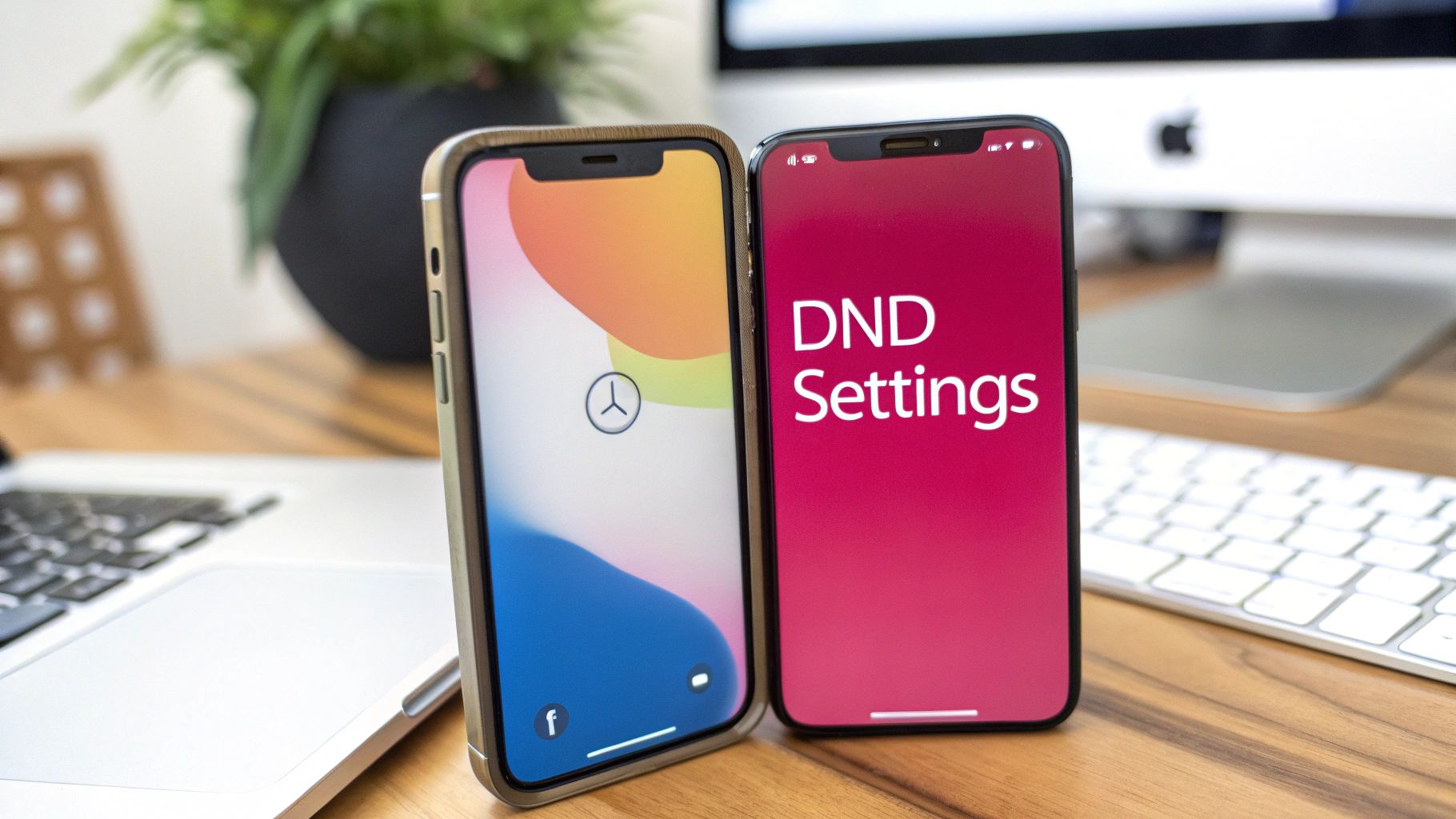
This level of control shows just how easily users can tailor their notification environment. A one-size-fits-all message blast no longer works. For marketers, this proves that timing is everything, a topic we cover in our guide on how to send a timed text message.
Android’s Granular DND Controls
Android users have a similar toolbox, but it often comes with even more detailed controls. They can create schedules, but the real power lies in the specific rules they can set.
For example, an Android user can configure DND to automatically switch on during any event marked as “Busy” in their Google Calendar. This means your perfectly crafted flash sale SMS could land silently right as your customer walks into a meeting.
This is a huge deal for marketers. It’s not just about silencing buzzes; it’s about users taking complete control over their digital space. By silencing SMS previews and alerts, they can also block spam and phishing attempts—a key benefit for security-conscious shoppers. This user-driven control is why respecting digital boundaries is essential for building trust and sustainable growth for your e-commerce brand.
The Real Reason Your Customers Use DND Mode
Do Not Disturb mode isn’t just a technical setting; it’s a direct response to notification fatigue—the constant stream of pings and buzzes that shatters focus and interrupts their day. Activating DND is a conscious choice to set boundaries and regain control.
For store owners, this is a clear signal. Think of DND not as a marketing roadblock, but as direct feedback from your audience. They’re saying, “Reach out when it’s right for me, not just when it’s convenient for you.”

The Rise of Digital Wellness
The movement toward digital wellness is gaining serious momentum. Consumers are now curating their digital spaces as carefully as their physical ones.
- Key Data Point: A recent survey found that DND mode usage among young adults shot up from 16% to 27% in just one year—a massive 69% increase.
- Best Practice: This spike is part of a larger digital detox trend where people prioritize focus and sleep over being constantly available. You can dig into the full findings on DND mode adoption to see how widespread this has become.
This shift leaves your brand with two clear choices:
- Ignore the signal: Keep blasting messages at all hours, leading to annoyance, high unsubscribe rates, and a negative brand reputation.
- Respect the boundary: Adjust your strategy to communicate at times when your customers are actually receptive to hearing from you.
Respecting this “quiet time” is more than just good manners—it’s a smart business strategy. It helps you build a customer-first brand that earns long-term loyalty and increases revenue.
When you understand the why behind DND, you can build a communication strategy that feels helpful, not intrusive. This approach also aligns with today’s expectations around data privacy, a crucial factor in earning customer trust. For a deeper dive, check out our guide on personal text message privacy laws.
How DND Silently Kills Your Campaign ROI
Ignoring Do Not Disturb mode isn’t a small oversight—it’s a direct hit to your bottom line. When a customer’s phone is set to DND, your SMS is delivered silently. No sound, no vibration, and no lock screen pop-up. Your urgent flash sale alert or time-sensitive abandoned cart text becomes invisible, losing all its power until the user checks their phone hours later.
This delay is devastating for campaigns that depend on urgency. A “2-hour flash sale” notification seen five hours late creates a frustrating customer experience. For abandoned cart recovery, the critical window to win back a sale is often within the first hour. If your message sits unseen, that revenue is likely lost forever.
The Cost of a Silent Notification
The financial impact of these missed messages adds up shockingly fast. The average person checks their phone 85 times a day, so DND mode is an essential tool for them to manage their day. Research shows it can take over 23 minutes to refocus after just one interruption, which is exactly why people use DND.
Let’s run the numbers. A single, well-timed SMS can recover a $100 cart. If DND silences just 10 of those messages a day, that’s a potential $1,000 in lost revenue daily. Over a month, that silent feature could be costing your business $30,000.
This proves that just sending a message isn’t enough; you must ensure it gets seen. Getting your delivery timing right has a direct impact on your campaign performance. For a closer look at the numbers, check out our guide on how to calculate your marketing ROI.
DND and Your Acquisition Costs
When your carefully crafted SMS campaigns are muted by DND, their effectiveness craters, making every new customer more expensive to acquire. Since DND can cripple your marketing efforts, it’s vital to learn how to reduce customer acquisition costs to protect your budget.
Here’s how ignoring DND directly hurts your wallet:
- Wasted Ad Spend: You pay for a lead, but the final conversion text—like an abandoned cart reminder—goes unheard.
- Lower Conversion Rates: Your time-sensitive offers expire before customers see them, directly tanking your sales.
- Reduced Customer Lifetime Value (CLV): A bad first impression from a late or irrelevant message can convince a customer not to shop with you again.
Ultimately, understanding what Do Not Disturb mode is isn’t just a technical detail—it’s fundamental to protecting your campaign ROI. By failing to adapt, you’re letting a simple phone setting quietly drain your marketing budget and stunt your store’s growth.
Smarter SMS Strategies for a DND World
Navigating a world where DND is standard requires a smarter, more respectful approach to SMS marketing. It’s no longer about blasting messages and hoping for the best. The goal is to time your communications so they arrive when your customers are actually ready to engage. This simple shift can turn a potential annoyance into a welcome notification that boosts conversions.
The strategy boils down to proving your brand respects customer boundaries. This isn’t just about avoiding unsubscribes; it’s about building genuine trust, which is the fuel for higher engagement and, ultimately, more sales.
Step 1: Respect Quiet Hours
The absolute first step is to respect legally mandated quiet hours. Regulations like the TCPA in the U.S. strictly forbid sending marketing texts before 8 AM or after 9 PM in the recipient’s local time zone. Violating this can lead to hefty fines and do serious damage to your brand’s reputation.
But this isn’t just about legal compliance—it’s common sense. A text message that wakes up a customer is a guaranteed way to lose them forever. Honoring these quiet windows is the baseline for any professional SMS strategy.
Step 2: Use a DND-Friendly SMS Marketing Checklist
To put this into practice, here’s a straightforward checklist. Following these steps will help ensure your SMS campaigns are both effective and respectful of your customers’ time and attention.
| Action Item | Why It Matters for Your Store | How to Implement |
|---|---|---|
| Segment by Time Zone | Sending a message at 5 PM your time could be 2 AM for your customer, killing a potential sale. | Use an SMS platform that automatically detects and segments your subscribers based on their local time zone. |
| Set Clear Expectations | Customers who know when to expect texts are more likely to engage and less likely to unsubscribe. | Clearly state your messaging frequency (e.g., “Get 2-3 texts/month with exclusive deals”) on all your opt-in forms. |
| Send at Optimal Times | Avoid common DND periods like overnight, early mornings, and standard work hours to maximize visibility and open rates. | Schedule campaigns for times when people are more receptive, like lunch breaks (12-2 PM) or evening commutes (5-7 PM). |
| Automate Compliance | Manually tracking quiet hours across dozens of time zones is impossible and risks costly errors. | Use a tool with a built-in Do-Not-Disturb feature that automatically pauses sends during restricted hours. |
By implementing these steps, you’re aligning your marketing efforts with how modern customers live and use their phones. For more in-depth guidance on building campaigns that get results, check out these SMS marketing best practices to level up your strategy.
Ultimately, when you work with DND mode, you transform your SMS channel from a potential annoyance into a reliable revenue driver, ensuring your messages are seen as helpful reminders, not unwelcome interruptions.
Send Messages at the Perfect Time Automatically
Trying to manually track every customer’s time zone and local quiet hours is a recipe for disaster. It’s not scalable and risks costly compliance mistakes. One error can annoy a customer, damage your brand, and even lead to hefty fines.
The only reliable solution is automation. Technology removes the guesswork and human error, ensuring you always get the timing right. This is where smart tools become non-negotiable for serious e-commerce marketers.
Let Autopilot Handle the Timing
The best systems are the ones you set and forget, knowing they’re working to increase your revenue in the background.
For example, CartBoss’s Automatic Do-Not-Disturb feature is built to do just this. It intelligently schedules your abandoned cart messages to send outside of typical quiet hours for every single customer, no matter where they are in the world.
This means you can focus on growing your business, confident that your messages are always landing at a respectful—and effective—time. It’s a simple way to protect your brand from sending annoying late-night texts while maximizing the chance your message will be seen and acted on, directly improving your conversion rates.
By automatically respecting customer quiet times, you directly improve your SMS open rates and campaign ROAS. This isn’t just a compliance feature—it’s a powerful optimization tool that builds a better customer experience and drives more revenue on autopilot.
At the end of the day, automation is the key to scaling a respectful and profitable SMS marketing strategy. It ensures every message you send has the best possible shot at converting.
Frequently Asked Questions
When you’re diving into SMS marketing, a few questions about Do Not Disturb mode always pop up. Let’s clear up some of the common ones so you can build a smarter, more profitable texting strategy.
Will My SMS Message Still Be Delivered If DND Is On?
Yes, the message is delivered to their phone, but it arrives silently. There’s no sound, no vibration, and no lock screen notification to grab their attention.
The customer will only see your message once they unlock their phone and manually check their texts. This kills the urgency of a time-sensitive offer, which is why timing is so critical for campaign success.
Is It Illegal to Send SMS Messages During DND Hours?
While Do Not Disturb is a personal setting, sending marketing texts during certain hours is restricted by law.
The Telephone Consumer Protection Act (TCPA) in the U.S. is the big one. It prohibits marketing messages before 8 AM or after 9 PM, based on the recipient’s local time. Sticking to these legally required quiet hours isn’t just good practice—it’s essential for compliance.
How Can I Know My Customer’s Personal DND Schedule?
The short answer: you can’t, and you don’t need to. A customer’s personal DND schedule is private.
The best practice is to avoid sending messages during hours that are universally considered off-limits, like late nights and early mornings, based on your customer’s local time zone.
This is where platforms like CartBoss are invaluable. The system handles this automatically. You don’t have to juggle time zones or worry about waking someone up. Your messages go out at the right time to maximize conversions, every time.
Ready to stop your abandoned cart texts from getting lost in the silence? CartBoss automatically sends your messages at the perfect moment, respecting customer quiet hours worldwide. Turn Abandoned Carts into Profit with SMS on Autopilot.
