


Think of opt-in as a customer raising their hand and saying, “Yep, I want to hear from you.” It’s that simple. When someone gives you their clear, enthusiastic permission to send them marketing messages, that’s an opt-in.
This permission-first approach is the bedrock of building trust and keeping your marketing above board.
What Opt-In Really Means for Your Store
At its heart, “opt-in” is about shifting from interruption marketing to permission marketing. Instead of just dumping every new customer onto a list, you give them a genuine choice to join. This isn’t just being polite; it’s a strategic move that completely changes the dynamic you have with your audience.
When a customer opts in, they’re handing you more than just a phone number or email. They’re signaling real interest in your brand and what you sell. That explicit “yes” is what turns a marketing message from a potential annoyance into something they actually welcome.
It’s the difference between a cold call and a scheduled meeting. One feels like an intrusion, while the other is an invited conversation.
This is a huge deal for a few key reasons:
- It Builds Real Customer Trust: When people feel they have control over the messages they get from you, they trust your brand more. Simple as that.
- Engagement Skyrockets: An opted-in list is full of people who want to hear from you. That means better open rates, more clicks, and, ultimately, more sales.
- It Keeps You Compliant: Laws like the TCPA and GDPR don’t mess around. They require explicit consent. Getting a proper opt-in protects your business from massive fines. Our detailed guide on creating a compliant SMS opt-in is a great resource to make sure you’re covered.
Focusing on permission isn’t just about following rules. You’re building a higher-quality audience that is far more likely to buy from you. An opt-in is a powerful signal of purchase intent.
So, what makes an opt-in valid? It needs to be clear, specific, and freely given. No tricks, no fine print.
Let’s break down exactly what that means for your store.
The Core Components of a Compliant Opt-In
This table quickly summarizes the non-negotiables for getting customer consent the right way.
| Component | What It Means for Your Business | Why It Matters |
|---|---|---|
| Clear and Unambiguous | Your request for consent needs to be dead simple to understand. Use plain language, not confusing jargon or hidden clauses. | This prevents you from misleading customers and ensures their consent is fully informed, which is a legal must-have. |
| Specific and Granular | You have to state exactly what they’re signing up for (e.g., “weekly deals via SMS” or “cart reminder texts”). | This gives customers control and transparency, which reduces the chances they’ll get annoyed and unsubscribe later. |
| Freely Given | Consent can’t be a condition of buying something or buried in your terms and conditions. It has to be a real, separate choice. | This protects consumer rights and proves the relationship is built on mutual agreement, not a forced transaction. |
Getting these components right ensures your marketing efforts start on the right foot, building a foundation of trust that pays off in the long run.
Single Opt-In vs. Double Opt-In Explained
Getting consent from a customer isn’t a one-size-fits-all process. When someone decides to join your list, their journey usually follows one of two paths: single opt-in or double opt-in. Understanding the difference is crucial for building a high-quality, engaged list of subscribers who actually want to hear from you.
Think of single opt-in as a quick, informal greeting. A customer types their phone number or email into your form, hits the “subscribe” button, and bam—they’re on your list. It’s a single step. This method is all about speed and simplicity, designed to grow your list as fast as possible with minimal friction.
Double opt-in, on the other hand, is more like a firm, digital handshake. After that initial sign-up, the customer gets an automated message asking them to confirm their subscription. This is usually done by clicking a link or replying with a specific word. This second step is a powerful verification that they own the email or phone number and genuinely want to be contacted.
Choosing Your Opt-In Strategy
The single opt-in approach is great if your main goal is rapid list growth. By removing extra steps, you make it incredibly easy for people to sign up. The downside? That speed can sometimes sacrifice quality. You might end up with more typos, fake email addresses, or even sign-ups from bots.
In contrast, double opt-in is all about quality over quantity. That extra confirmation step acts as a filter, weeding out bad contacts and ensuring every single subscriber is genuinely interested. Your list might grow a little slower, but the audience you build will be far more valuable and engaged. To make this step effective, you need a compelling message, and our guide on crafting the perfect opt-in message can show you how.
This flowchart breaks down the essential checkpoints for getting valid consent, which is the foundation for both methods.
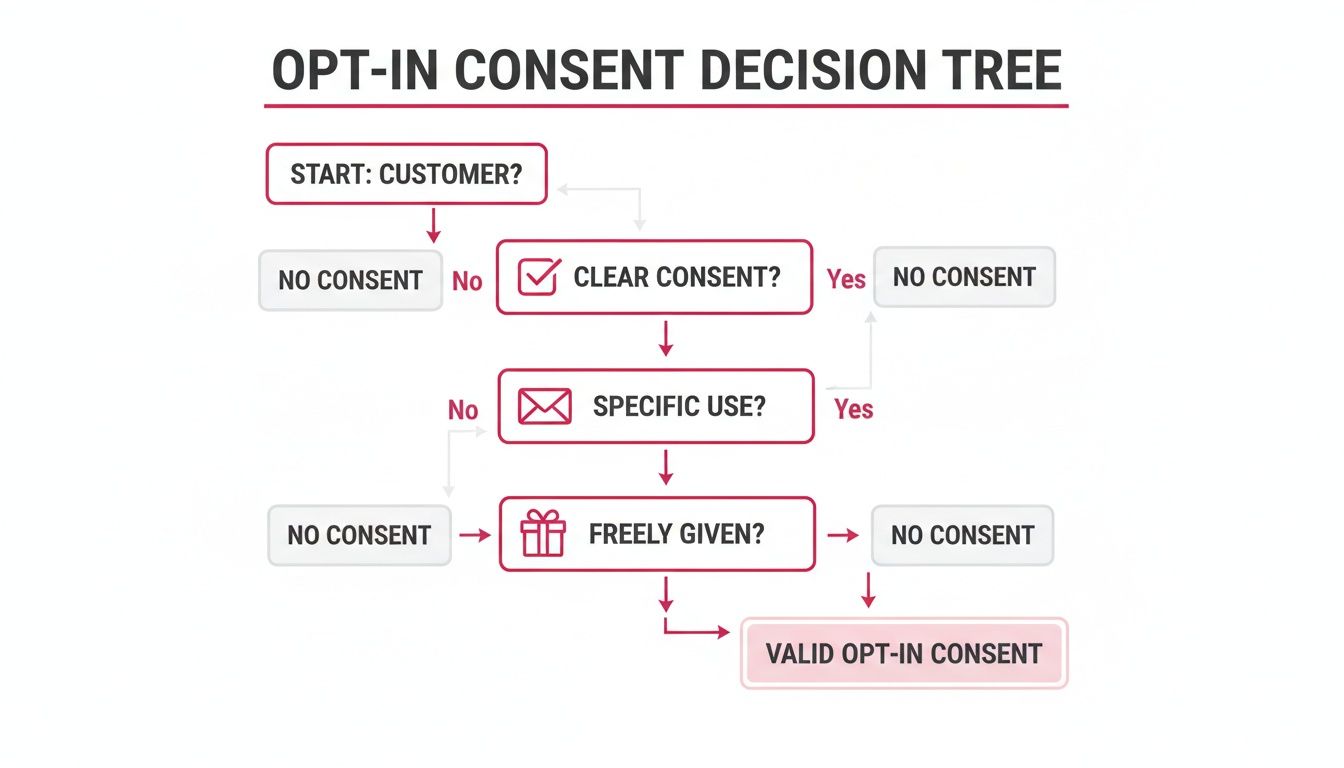
As you can see, real consent isn’t just about getting a click; it’s a process that ensures permission is clear, specific, and freely given.
Why Quality Trumps Quantity
While both strategies have their uses, double opt-in offers much better long-term benefits, especially for SMS marketing where compliance and engagement are everything. It acts as a built-in qualifier, guaranteeing your messages only go to people with the highest intent.
A double opt-in process not only reduces your legal risk under regulations like GDPR but also cultivates a more loyal audience. Subscribers confirmed this way are signaling a strong, active interest in your brand.
This proactive confirmation directly translates to better marketing results. Lists built with double opt-in tend to retain subscribers 25% longer on average. And because every recipient has actively confirmed their interest, SMS unsubscribe rates often stay impressively low—typically below 5%. This high-intent foundation is exactly what allows powerful tools like CartBoss to achieve such incredible results with automated cart recovery.
Why Opt-In Is Non-Negotiable for SMS Marketing
When it comes to SMS marketing, permission isn’t just a good idea—it’s the entire foundation of a winning strategy. A customer’s phone is a deeply personal space. Blasting it with uninvited texts is one of the fastest ways to destroy brand trust and land your business in hot water with regulators like the TCPA and GDPR.
Think about it this way: an unexpected, unsolicited text feels like a rude interruption. But a message a customer asked to receive feels like a helpful update from a friend. That shift in perception is exactly what makes opt-in marketing so incredibly powerful. It turns a potentially annoying alert into a valuable, anticipated conversation.
This is especially true for cart recovery. A shopper who agrees to get SMS reminders is already telling you they’re interested. They are invested in your brand and far more likely to finish their purchase when they get that gentle nudge. You’re messaging a warm lead, not a cold stranger.
The Power of Permission-Based Marketing
Don’t think of the opt-in as a hurdle to clear. It’s actually a filter that hands you a list of your most engaged and valuable audience members.
While the average SMS opt-in rate for a website is around 1.8–3.2%, the subscribers you get are absolute gold. SMS campaigns have insane open rates of up to 98%, with click-through rates often hitting 18% to 28%. That’s easily 6 to 10 times higher than what you see with email. For e-commerce stores, SMS conversion rates can sit anywhere between 21% and 30%.
By getting a clear opt-in, you guarantee every single message you send lands with a receptive audience. This dramatically boosts your ROI and protects your brand’s hard-earned reputation.
Ensuring Legal and Lasting Connections
Beyond the killer engagement numbers, getting proper consent is a legal must. Failing to get and record expressed written consent can lead to massive fines and torpedo your ability to market to customers. It’s why platforms like CartBoss are built with compliance at their core, automatically handling consent records so you can focus on building relationships. You can learn more in our detailed guide on expressed written consent.
This focus on consent also builds a much more loyal customer base. The data shows that 90% of customers stick around on SMS lists for at least three months. This gives you a long-term channel for loyalty campaigns, new product announcements, and win-back offers.
How to Craft High-Converting Opt-In Forms
Knowing what “opt-in” means is the first step. The real challenge? Turning that knowledge into forms that people actually want to fill out. A great opt-in form does more than just tick a legal box—it kicks off a positive, compelling interaction with your brand. The goal is to make signing up feel like a no-brainer, not a chore.
The words you choose are your most powerful tool here. Ditch the generic “Subscribe” button and frame your call-to-action around a clear benefit. This simple switch changes the customer’s perspective entirely. They’re no longer just giving up their contact info; they’re getting something valuable in return.

Key Elements of a Winning Form
A successful opt-in form is always clear, concise, and focused on value. Every single element, from the headline to the button, should work together to build trust and make signing up an easy decision.
- Compelling Headline: You need to grab their attention immediately. Instead of a bland “Newsletter,” try something that screams value, like “Get 15% Off Your First Order.“
- Clear Value Proposition: In one short sentence, tell them what’s in it for them. Think: “Be the first to know about new drops and exclusive sales.“
- Simple Fields: Only ask for what you absolutely need. For SMS, that’s just a phone number. Every extra field you add is another reason for them to walk away.
- Strong Call-to-Action (CTA) Button: Use action-packed text that reminds them of the benefit. “Unlock My Discount” or “Get Early Access” works way better than “Submit.”
This consent-first approach is especially powerful for SMS. When you have a list of people who want to hear from you, the results are incredible. SMS response rates can hit around 45%, blowing email’s 6% out of the water. An engaged, opted-in list is a direct line to more revenue.
Globally, nearly 50 million people have opted-in for business texts, and pairing your sign-up with an offer is a proven winner—42% of US mobile users subscribe specifically to get discounts.
Designing Your Opt-In Form Do’s and Don’ts
Building a form that actually converts comes down to the details. Getting these small things right can make a huge difference in how many people choose to join your list. Here’s a quick breakdown of what to do—and what to avoid—to create forms that are both effective and compliant.
| Element | Do | Don’t |
|---|---|---|
| Checkbox | Use a clear, unticked checkbox for explicit consent. Let the user actively check it. | Pre-tick the checkbox. This is not considered valid consent under regulations like GDPR. |
| Wording | Use simple, direct language like, “Sign up for SMS offers and cart reminders.” | Use vague or confusing legal jargon that customers might not understand. |
| Privacy Policy | Include a visible link directly next to the opt-in text for transparency. | Hide the link in the footer or make it difficult for users to find. |
| Incentive | Clearly state the offer (e.g., “15% off”) right in the opt-in form. | Promise a vague “special offer” without specifying what it is. |
A great opt-in form isn’t just a tool for collecting data. It’s the first real step in building a relationship based on trust. Keep it clear, valuable, and always respectful of your customer’s choice.
By following these best practices, you’ll design an experience that feels welcoming and genuinely beneficial. This doesn’t just grow your list; it fills it with high-intent subscribers who are actually excited about your brand. To see these principles in action, check out our guide on how to create compelling text sign-up forms.
Managing Consent and Staying Compliant
Getting a customer’s consent is just the start of the journey. Once they’ve said yes, the real work begins. It’s on you to manage that permission correctly, not just because it’s good for business, but because it’s a legal must-have that keeps you out of hot water.
Think of each opt-in as a digital handshake. You need to be able to prove exactly when, where, and how a customer gave you the nod to send them messages. This means keeping a clean, timestamped record for every single person. Without that proof, you’re leaving your business wide open to complaints and costly legal fights.
The Lifecycle of Customer Consent
Proper consent management isn’t a one-and-done deal. It follows the entire customer relationship, from the moment they sign up to the day they might decide to leave. The two biggest pieces of this puzzle are keeping perfect records and making it incredibly simple for people to change their minds.
That second part—handling opt-outs—is huge. The process to unsubscribe has to be instant and dead simple. For SMS, that usually means a customer can just reply with a single word like “STOP”. If you make it a hassle to opt out, you’re not just breaking the rules; you’re torching any trust you’ve built.
Managing consent isn’t about trapping customers. It’s about respecting their choice at every turn. Do that, and you’ll find they trust your brand more and are far more likely to stick around.
For instance, when someone texts “STOP,” your system needs to pull them from all marketing lists for that channel right away. No “we’ll get to it in 24 hours.” This shows you respect their decision and keeps you compliant with laws like the TCPA, which demand you honor opt-out requests immediately.
Automating Compliance for Peace of Mind
Let’s be real: manually tracking consent and opt-outs for thousands of customers is a recipe for disaster. It’s just not practical, and the risk of mistakes is way too high. This is where automation becomes your best friend. Platforms like CartBoss are built with compliance baked right in, handling the entire consent lifecycle for you automatically.
These tools make staying on the right side of the law easy by:
- Recording Everything: They automatically log the exact time, date, and source of every opt-in, so you have a perfect paper trail.
- Processing Opt-Outs Instantly: They immediately recognize keywords like “STOP” and update the customer’s status without you lifting a finger.
- Maintaining Suppression Lists: Once a customer opts out, they’re added to a list that ensures they are never accidentally messaged again.
This kind of automation frees you up from sweating the legal details. To make sure your store is buttoned up, it’s a good idea to understand how to create a privacy policy. You can also dive deeper with our guide to SMS marketing compliance.
By leaning on a compliant tool, you can get back to what you do best—crafting great marketing campaigns—knowing that all the consent management stuff is being handled the right way.
Turning Customer Consent into Recovered Sales
At the end of the day, understanding what does opt in mean is about way more than just checking a legal box. It’s about building a profitable relationship with your customers based on trust.
Think about it: a list of subscribers who willingly gave you their phone numbers isn’t just a bunch of data. It’s high-octane fuel for your cart recovery engine.
Every step you’ve taken—from designing a clear opt-in form to managing consent—all leads to this moment. When a customer explicitly says “yes” to hearing from you, they’re giving you a massive signal of interest and trust. This directly translates into better engagement and higher deliverability for your messages, guaranteeing a powerful return on your efforts.
From Abandoned Cart to Loyal Customer
Let’s walk through a quick story to see this in action. Picture a customer, Sarah, browsing your store. She finds a pair of sneakers she loves, adds them to her cart, but then her dog starts barking and she gets distracted, leaving your site.
Because she checked a clear opt-in box during a previous visit, your system can legally and effectively send her a friendly SMS reminder an hour later. The message pops up, feels like a helpful nudge rather than an intrusion, and includes a direct link right back to her cart. Sarah clicks, completes her purchase, and feels like your brand actually looks out for her.
That recovered sale wasn’t luck. It was the direct result of a smart opt-in strategy that respected her choice from the very start. To really squeeze the most value out of customer consent, you’ll want to dig into strategies in ecommerce marketing automation.
Opt-in isn’t a legal chore you have to get through. It’s the foundational agreement that turns a potential annoyance into a welcome reminder, transforming lost revenue into a completed sale and building a stronger customer connection.
This simple, permission-based interaction is the key to unlocking the full power of tools like CartBoss. It turns those frustrating abandoned carts into a consistent and reliable stream of profit for your store, proving that respecting your customer’s choice is the best sales strategy you’ve got.
Common Questions About Opt-In Marketing
Even when you’ve got the basics down, some practical questions always pop up. Let’s tackle a few of the most common ones we hear from e-commerce owners trying to get their consent-based marketing just right.
Can I Add Customers to My SMS List After a Purchase?
No, you can’t. This is a big one. Even if someone buys from you, that transaction isn’t a green light for marketing texts. Think of it like this: buying a coffee doesn’t mean you’ve subscribed to the café’s newsletter.
You need separate, explicit permission for any marketing communications. That means your customers have to actively check a box or sign up through a form that is clearly for marketing. The purchase and the marketing sign-up are two completely different agreements.
What’s the Minimum I Need on My Opt-In Form?
To keep things above board and stay compliant, every single one of your opt-in forms needs to have a few key elements. No cutting corners here.
At the bare minimum, you absolutely must include:
- A clear statement explaining what they’re signing up for. Something like, “Get SMS cart reminders and special offers from us!” works great.
- A link to your Privacy Policy and Terms of Service. This is non-negotiable.
- An unticked checkbox that the person has to physically click themselves. Pre-checked boxes are a major no-go.
How Long Do I Need to Keep Proof of Consent?
Think of your consent records as your business’s insurance policy. You need to hold onto proof of every customer’s opt-in for as long as they’re on your list, and then some.
Laws like the TCPA in the U.S. have a statute of limitations of up to four years. So, keeping those records safe and accessible for at least that long is crucial for protecting your brand if any questions ever come up.
The Bottom Line: Treat consent like a living agreement. It needs to be given freely from the start, be easy for the customer to manage, and simple for them to take back whenever they want. This isn’t just about following rules—it’s about building the kind of trust that turns one-time buyers into loyal fans.
Ready to turn those abandoned carts into guaranteed profit? CartBoss uses a fully compliant, automated SMS system to bring customers back and boost your sales by up to 50%. See how it works at https://www.cartboss.io.
