


A drip campaign is basically your store’s automated conversation starter. It’s a series of pre-written messages sent out to customers automatically, making sure the right message hits them at the right time based on what they do—or don’t do—on your site.
What Exactly Is a Drip Campaign
Imagine a helpful salesperson who notices a customer eyeing a specific product. Instead of letting that moment pass, they follow up a day later. Not with a pushy sales pitch, but with a gentle reminder or a useful tip. That’s the simple idea behind a drip campaign. It swaps out manual, one-off messages for a smart, automated sequence that builds a relationship with your leads and customers.
This “set it and forget it” approach is a massive time-saver, but more importantly, it helps you build stronger connections. Every message feels personal because it’s a direct response to a customer’s own actions.
The Magic Is in the Triggers
Unlike a generic newsletter blast that goes out to everyone at once, a drip campaign is all about perfect timing and relevance. These automated sequences only kick off when a customer does something specific, which means the content always makes sense in that moment.
Here are a few common triggers:
- Someone subscribes: This can trigger a welcome series to introduce your brand story and values.
- A cart is abandoned: You can automatically send a sequence of reminders to help recover that lost sale.
- A customer makes their first purchase: This is the perfect time to start an onboarding or thank-you campaign.
- A customer goes quiet: If someone hasn’t purchased in a while, you can launch a re-engagement sequence to win them back.
This event-driven model makes your marketing feel less like an interruption and more like a genuinely helpful conversation. To really get a handle on the mechanics, it’s worth checking out this deep dive into What Is a Drip Email Campaign.
The results speak for themselves. Marketing data consistently shows that 80% of marketers who use drip campaigns see a big jump in lead generation, and 77% report higher conversion rates. These aren’t small numbers; they show why this strategy has become so essential. It’s also useful to know how this strategy differs from others—we break that down in our comparison of a drip campaign vs a nurture campaign.
The Smart Triggers That Automate Your Marketing
The magic behind any great drip campaign isn’t just the messages themselves—it’s the triggers. These are the specific customer actions that kick your automated messages into gear. This isn’t about blasting out messages on a rigid schedule; it’s about reacting to what your customers do, the moment they do it.
Think of it like a digital tripwire. When a customer takes a certain action, they set off a sequence of messages perfectly tailored to that situation. It makes every text or email feel relevant and timely, turning your marketing from a one-way street into a real conversation.
Common Triggers in E-commerce
For any online store, some customer actions are just screaming for a follow-up. These triggers are your best shot at creating a personalized experience because they sync your message with what the customer is already thinking about.
Here are a few of the heaviest hitters:
- Subscribing to a newsletter: This is your green light to roll out the welcome mat. A welcome series can introduce your brand and show new subscribers what to expect.
- Abandoning a shopping cart: This is the big one for e-commerce. It triggers a sequence laser-focused on bringing that customer back to complete their purchase and recovering a potentially lost sale.
- Making a first purchase: A great opportunity to start a post-purchase campaign. You can send order updates, ask for a review, or even slip them a discount for their next order.
- Viewing a specific product multiple times: This person is clearly interested. A well-timed message with more info or a special offer on that exact item can be incredibly effective.
Ultimately, the best drip campaigns are built on user actions that signal real intent. For online stores, nothing signals intent louder than a customer leaving a full cart behind. This is where automated follow-ups become a direct path to reclaiming lost revenue. By mastering these triggers, you can build a more effective marketing automation workflow.
Powerful Drip Campaign Examples for E-Commerce
Alright, enough with the theory. Let’s see how these campaigns actually work in the wild with some real-world examples you can start using today. Seeing a drip campaign in action is the best way to understand just how valuable they are for any e-commerce store. Think of them as your secret weapon for connecting with customers at every single stage of their journey.
We’re going to focus on SMS here. Why? Because text messages are immediate and have sky-high engagement rates, making them perfect for situations that need a quick response. And there’s no situation more critical for an online store than a customer ditching their cart. A well-timed text can easily be the difference between a lost sale and a recovered order.
Abandoned Cart Recovery SMS Drip
This is the bread and butter for most e-commerce shops. The goal is to send a sequence of texts that gently—but persuasively—nudge a customer back to finish their purchase. Each message has a specific job, from a soft reminder to a final, can’t-miss offer.
- Message 1 (Sent after 1 hour): The first message should feel like helpful customer service, not a hard sell. They might have just gotten distracted.
- Template: “Hey [Name]! Looks like you left some great items in your cart at [Store Name]. Did you have any questions? Finish your order here: [Link]”
- Message 2 (Sent after 24 hours): Now we turn up the heat just a little. A little urgency goes a long way. Mentioning that their items are popular or might sell out is a classic move for a reason—it works.
- Template: “Hi [Name], your cart at [Store Name] is about to expire! Your items are selling fast. Grab them before they’re gone: [Link]”
This simple two-step automation can make a huge impact on your recovery rates. To see how these messages fit into a larger plan, it’s worth exploring different ecommerce growth strategies that blend revenue recovery with long-term retention.
Customer Welcome and Re-Engagement
Drip campaigns are about more than just chasing lost sales; they’re fantastic for building relationships. A welcome series, for instance, is your chance to make a great first impression and introduce your brand story to new subscribers. On the flip side, a re-engagement campaign can be the perfect way to win back customers who’ve gone quiet.
Key Takeaway: A drip campaign isn’t a one-trick pony. It’s a flexible framework you can mold to fit different goals, whether that’s clawing back lost revenue or building a loyal customer base that keeps coming back. For a deeper look into a variety of sequences, check out these powerful drip campaign examples.
The Metrics That Truly Matter for Drip Campaigns
Defining a drip campaign is one thing, but proving its value comes down to tracking the right numbers. It’s easy to get distracted by metrics like open rates, but they don’t really tell you the whole story. To truly get a feel for your campaign’s impact, you need to focus on the key performance indicators (KPIs) that connect directly to your store’s growth.
These are the bottom-line metrics. They go way beyond simple engagement and measure what actually happened—did people buy something? They show you exactly how your automated messages are turning subscribers into paying customers, transforming your marketing from a cost into a profit-generating machine. By focusing on these, you can confidently tweak your campaigns for the best possible return.
Core Growth Metrics to Watch
To measure success, you need to zoom in on the data that reflects revenue and customer acquisition. This simple shift in focus moves you away from vanity stats and toward actionable insights that can shape your entire strategy.
Here are the top three metrics that really matter:
- Conversion Rate: This is the big one. It’s the percentage of people who received a message and then completed the action you wanted, like making a purchase. A high conversion rate means your message is hitting the mark and your timing is perfect.
- Revenue Per Recipient (RPR): This cuts straight to the chase. To figure it out, just divide the total revenue a campaign generated by the number of people who received it. This metric gives you a crystal-clear picture of the direct financial impact of your drips.
- List Growth Rate: A healthy drip campaign should do more than just sell; it should also attract and keep subscribers. Tracking how quickly your list is growing is a great indicator of the overall health of your marketing funnel.
The return on investment (ROI) for brands using drip campaign automation can be massive. One study found that brands saw a 700% increase in ROI after implementing advanced platforms, showing just how effective these campaigns are at driving real revenue. You can read the full research on drip campaign ROI to see the data for yourself.
Keeping a close eye on these numbers lets you fine-tune your approach, making sure every message sent is contributing directly to your bottom line. You can explore even more essential e-commerce metrics to track in our detailed guide.
Your Action Plan for Launching a Drip Campaign
Alright, enough with the theory. Let’s get our hands dirty and put this into action. Launching your first drip campaign isn’t nearly as intimidating as it sounds, especially when you break it down into a simple, step-by-step checklist. This is your roadmap from idea to execution.
Think of this as your pre-flight check before you let your automations take off. Each step builds on the last, giving you a clear path forward and making sure you don’t miss any of the essentials.
Your Drip Campaign Launch Checklist
Follow these seven steps to build a rock-solid foundation for your automated messages. This isn’t just a list; it’s how you actually put the concept of a drip campaign into practice.
- Pinpoint Your Primary Goal: First things first, what are you trying to accomplish? Are you looking to recover abandoned carts, welcome brand-new subscribers, or maybe wake up some old customers who haven’t shopped in a while? Your goal is your north star—it dictates every decision you make from here on out.
- Identify Your Target Audience: Who, exactly, are you talking to? You wouldn’t send the same message to a first-time visitor as you would to a loyal customer. Segment your audience based on their actions to make sure your messages hit home.
- Choose a Specific Trigger: What’s the one thing that has to happen to kick off this sequence? It could be anything—a customer abandoning their cart, someone signing up for your newsletter, or a person making their very first purchase. This single action is what starts the magic.
- Map Your Message Sequence and Timing: How many messages are you sending, and how far apart? For cart recovery, a sequence of 2-3 messages spaced out over 48 hours is a proven winner. Don’t overdo it, but don’t let them forget you either.
- Craft Compelling Content: Now for the fun part—writing your SMS or email copy. Keep your messages short, clear, and laser-focused on the goal you set in step one. Every word counts.
- Select the Right Automation Tool: You need a platform that makes this easy. A tool like CartBoss handles the heavy lifting so you can focus on strategy. If you want to dive deeper, we have a whole guide on how to set up marketing automation.
- Launch, Monitor, and Optimize: Time to go live! But your job isn’t done. Keep a close eye on your key metrics and be ready to tweak things. A small change in timing or copy can make a huge difference in your results.
Common Drip Campaign Questions Answered
Even with a solid plan, a few questions always seem to pop up when you’re setting up your first drip campaign. Let’s tackle some of the most common ones so you can move forward and get your marketing on autopilot.
Drip Campaign vs. Newsletter: What’s the Difference?
Think of a newsletter as a town crier—it’s one message broadcast to your entire list at the same time. It’s great for general announcements or weekly updates.
A drip campaign, on the other hand, is like a personal conversation. It’s a series of automated messages sent to one person based on their specific actions. A drip is triggered and personal; a newsletter is scheduled and general.
How Many Messages Should I Send?
There’s no single magic number here; it all comes down to your goal.
For urgent campaigns like cart recovery, a quick sequence of 2-3 messages sent over 24-48 hours is incredibly effective. For longer nurturing sequences, like a welcome series that introduces your brand, you might send 4-6 messages over a few weeks.
This visual breaks down the basic flow for launching any drip campaign, from defining the goal to mapping out the sequence.
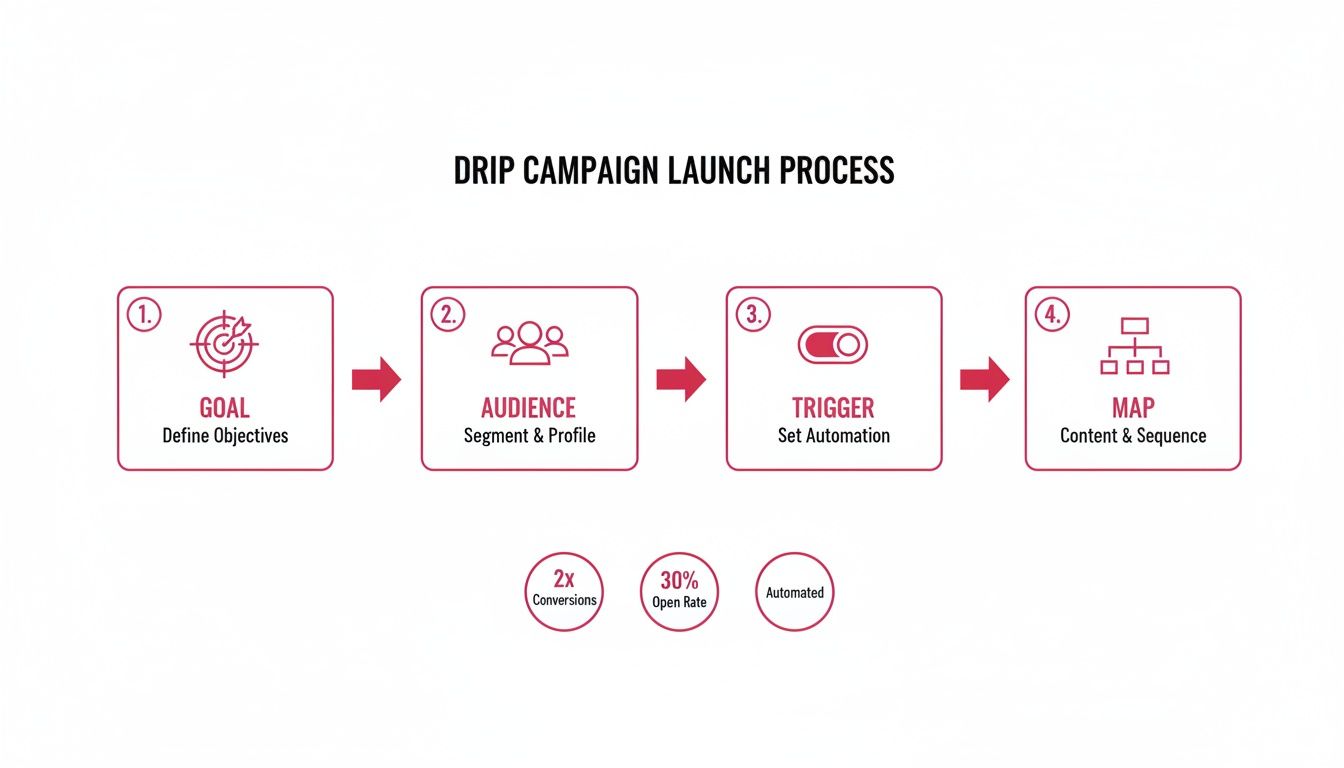
The key is that every successful campaign starts with a clear purpose, a specific audience, and a defined trigger. Once you have those, the number of messages becomes much clearer.
Can I Use Both Email and SMS?
Absolutely—in fact, you should! Using both email and SMS is called an omnichannel approach, and it lets you play to the strengths of each channel.
SMS is perfect for immediate, can’t-miss alerts like cart recovery reminders. Email is your go-to for longer content like brand stories, detailed product guides, or onboarding information. Together, they create a much more powerful customer experience.
Ready to turn abandoned carts into automatic profit? With CartBoss, you can launch powerful SMS drip campaigns in minutes and start recovering lost sales on autopilot. Start for free on cartboss.io and see your revenue grow.