


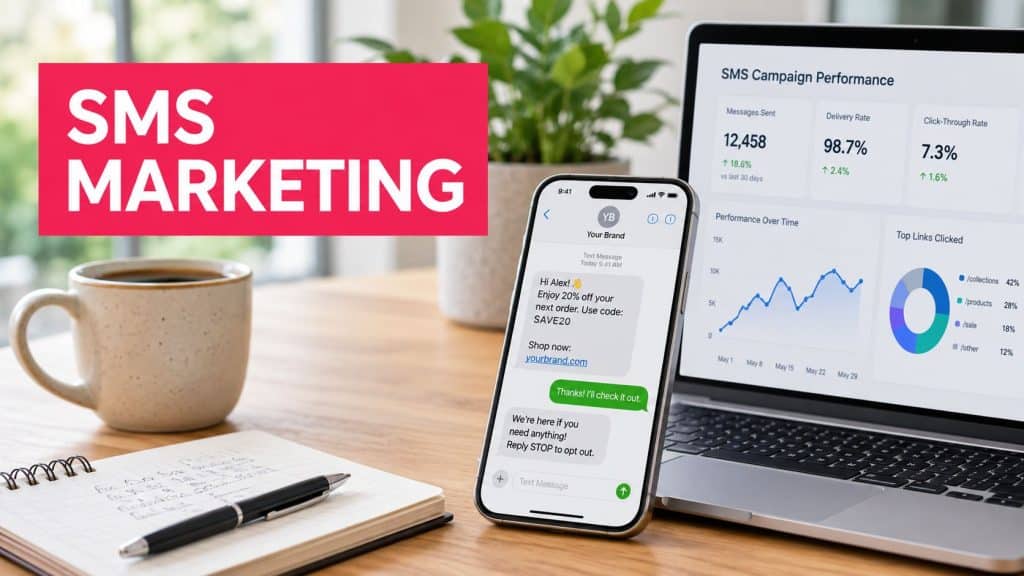
98% open rates look impressive until you ask the only question that matters, did the text create incremental revenue without burning the list? That’s where SMS marketing effectiveness gets misunderstood. A message can be opened almost instantly and still fail if it reaches the wrong person, at the wrong time, with the wrong offer.

The practical view is simple. Effective SMS drives a desired action, protects list health, and produces revenue that survives attribution scrutiny. That usually means you care less about vanity visibility and more about incremental lift, revenue per message, and whether the channel still performs after the first few sends.
What SMS Marketing Effectiveness Really Means in 2026
SMS is effective when it changes buyer behavior, not when it only gets attention. A text that is read in minutes but doesn’t move someone closer to purchase is noise, even if the dashboard looks healthy. The core mistake is treating a high open rate as the end of the analysis instead of the beginning.
The best mental model is to measure three things at once. First, did people see and engage with the message. Second, did the message create attributable revenue. Third, did that revenue come from a send that added value instead of cannibalizing email, push, or organic conversion. That third point is where incremental lift comes in, which just means the extra revenue created because of the SMS, not revenue that would’ve happened anyway.
A channel can be visible and still underperform. Broad sends often inflate engagement without building a stronger business. Triggered sends, by contrast, reach people when intent is already active, so the same channel can look mediocre in a campaign blast and excellent in a cart-recovery flow.
Practical rule: if a text gets opened but doesn’t change timing, urgency, or conversion behavior, it’s not an effective revenue message.
For eCommerce teams, this is the right lens because SMS sits inside a larger lifecycle. Abandoned cart, browse abandonment, welcome flows, and back-in-stock alerts behave very differently from a weekend promo to the whole list. The rest of this guide uses that distinction to separate real performance from headline numbers.
Key Metrics That Define SMS Marketing Effectiveness
The dashboard can get messy fast, so I keep the scorecard small. Open rate tells you whether the message got seen. Click-through rate tells you whether the copy and offer earned curiosity. Conversion rate tells you whether the click was good enough to create revenue. Revenue per message tells you whether the send was worth the list pressure. Opt-out rate tells you whether your cadence is damaging the audience. ROAS tells you whether the spend paid back, but it can be misleading if the attribution model is too generous.
Healthy SMS Marketing Benchmarks
| Metric | Healthy Range | What It Tells You |
|---|---|---|
| Open rate | Around 98% in industry roundups and performance benchmarks | The message reached attention quickly, not that it sold anything |
| Response rate | Roughly 45% in SMS benchmarks, versus about 6% for email Sakari benchmark data | People acted on the text far more often than they do in inbox campaigns |
| Flow share of sends | 7.6% of sends in Klaviyo’s 2026 benchmarks | SMS is often a small part of volume even when it drives a large part of revenue |
| Flow revenue share | 45.2% of total SMS revenue in Klaviyo’s 2026 benchmarks | Triggered messages are doing the heavy lifting |
| Flow click rate | Near 10% on average, with top performers above 16% in Klaviyo’s 2026 benchmarks | The message and timing are aligned with intent |
| Opt-out rate | Keep it below the warning zone of roughly 2% to 3% | Audience fatigue is starting to outweigh revenue |
A strong open rate is useful, but it’s the easiest number to fake into looking healthy. Broad blasts can open well because SMS is visible, yet still convert weakly if they’re too frequent or too generic. That’s why click-through rate and conversion rate matter more for day-to-day decision-making.
If your SMS dashboard celebrates opens but ignores opt-outs and revenue per message, you’re probably managing for activity, not profit.
One more trap is overvaluing ROAS without checking whether the text owned the sale. High headline ROAS can coexist with list churn if the same people get pinged too often or if the discount is doing all the work. When you review a campaign, ask whether the message created a new sale, pulled forward an existing one, or just shifted credit from another channel.
For store owners who want a clean starting point, the most useful internal resource is the CartBoss guide on SMS campaign analytics. It’s a good fit for teams trying to connect send-level data to actual revenue.
Triggered SMS vs Promotional Blasts

The biggest performance gap in SMS comes from timing. Triggered SMS lands after a customer action, like cart abandonment or a browse event, while promotional blasts go to a broad list regardless of what anyone just did. The second approach can still work for announcements, but it rarely matches the efficiency of a behavior-triggered flow.
Klaviyo’s 2026 benchmarks show that SMS flows are only 7.6% of sends but generate 45.2% of total SMS revenue. That’s the clearest sign that the channel works best when it’s attached to intent, not volume. Flow-based click rates sit near 10% on average, with top performers above 16%, which tells you the right timing can matter more than the biggest list.
Where trigger-based SMS wins
- Cart abandonment: the shopper already showed intent, so the message is a recovery tool, not a cold offer.
- Browse abandonment: interest exists, but the person still needs a nudge and a reason to return.
- Post-purchase: texts can reduce uncertainty, improve trust, and open the door to the next action.
- Back-in-stock: urgency is built into the moment, so the text feels useful instead of intrusive.
Where broad blasts struggle
- Generic discount drops: the list sees the same offer at the same time, which can train people to wait.
- Unsegmented promos: people who already bought get the same message as people who are still deciding.
- Cadence without context: sends happen because the calendar says so, not because the customer is ready.
A behavior-triggered program also reduces the chance that SMS becomes a noisy broadcast channel. That matters because aggressive follow-up can recover short-term sales while steadily weakening list quality if frequency isn’t controlled.
If you want a concrete comparison of lifecycle channels, the CartBoss article on SMS vs push notification helps frame where SMS should sit relative to other mobile touchpoints.
SMS Compared to Email and Push Notifications
SMS isn’t automatically the strongest channel. A Gettysburg study challenged that assumption by finding email outperformed SMS on both consumer engagement and purchasing behavior in some scenarios, which is a good reminder that channel strength depends on the moment, not the medium alone. That’s why “SMS or email?” is the wrong question. The better question is which channel should own which trigger.
SMS still wins on speed and immediacy. Industry benchmarks consistently show very fast consumption, which makes texting strong for time-sensitive workflows. Email can still win on depth, sequencing, and lower interruption, especially when the buyer needs more context before clicking.
Channel choice by job to be done
| Channel | Best Use Case | Strength | Weakness |
|---|---|---|---|
| SMS | Time-sensitive recovery and urgent alerts | Fast attention and direct action | Can feel intrusive if overused |
| Nurture, education, and richer storytelling | More room for explanation and merchandising | Slower response in urgent moments | |
| Push notifications | App-centric engagement | Lightweight, immediate, and native to apps | Only useful when the shopper has the app |
The practical rule is to assign the channel to the trigger it handles best. Use SMS when delay hurts conversion probability, use email when the buyer needs more context, and use push when the customer already lives inside your app experience. That keeps your attribution cleaner and makes incremental lift easier to defend.
Decision rule: if a customer is likely to act now, SMS deserves consideration. If the customer needs persuasion, sequencing, or content depth, email usually has the better role.
For measurement, the key is to stop judging all channels by the same vanity metric. A channel that gets opened fast isn’t necessarily the one that should receive the credit. A basic multi-touch framework helps you see overlap instead of pretending the last click was the whole story, and the CartBoss piece on multi-touch attribution is a useful companion to that process.
How to Measure and Attribute ROI From SMS
A text should be easy to send and hard to over-credit. That means you need clean tracking from the first message, especially when email, paid social, and onsite behavior are happening at the same time. The simplest setup starts with UTM tagging, unique landing pages where possible, and coupon codes that isolate the SMS offer from other channels.
In practice, abandoned-cart SMS is the easiest place to see attribution noise. A shopper gets an email first, then a text, then buys. If you only look at the last touch, SMS gets full credit even if email did the heavy lifting. That’s why incremental ROAS matters more than gross ROAS. Gross ROAS tells you what happened after the send. Incremental ROAS asks what happened because of the send.
A clean way to think about it is this:
- Tag every SMS link so traffic is identifiable in analytics.
- Use one code path for SMS-specific offers so redemption is easier to isolate.
- Run holdout testing on part of the audience so you can compare buyers who got the text with buyers who didn’t.
- Compare overlap windows when a customer receives both email and SMS before converting.
- Review revenue per recipient, not just clicks, because clicks don’t always represent added sales.
For a practical template on marketing ROI, Polaris Marketing Solutions’ Fort Myers expertise is a solid reference point if you want to sanity-check your reporting process. The same logic applies whether you’re in Shopify or WooCommerce. You don’t need enterprise tooling to start, you just need disciplined naming, consistent tags, and a willingness to leave some credit unclaimed.
A welcome series and a flash sale behave differently, but the attribution rule stays the same. If the SMS is just harvesting a sale another channel would’ve captured, it’s support, not incremental growth. If the send changes timing, channel mix, or purchase behavior, it deserves the credit.
Real-World Examples of SMS Campaigns That Worked
The most reliable wins in SMS usually look boring from the outside. An abandoned-cart sequence hits shortly after the shopper leaves, the message is short, the incentive is clear, and the checkout path is frictionless. CartBoss frames its abandoned-cart recovery around an average 4,500% ROAS, which is a strong reminder that recovery flows can outperform broad promotional texting when they’re built around intent instead of volume.
A welcome series can also perform well when it respects context. The first text should confirm value fast, not dump the entire brand story into one send. When that message lands right after opt-in, the shopper already expects contact, so the job is to convert curiosity into the first click.
What the stronger campaigns usually have in common
- Timing first: the first recovery text arrives while the buying moment is still warm.
- One job per message: the text asks for one action, not three.
- Simple offer logic: discounts work best when they remove friction, not when they create dependence.
- Segmented recipients: repeat buyers, first-time visitors, and high-intent browsers shouldn’t receive the same pressure.
Flash sale broadcasts can still drive same-day revenue, but they’re not the core of a durable SMS program. They work best when the list is healthy and the offer is time-bound. The more often you lean on them, the more likely you are to condition subscribers to wait for the next deal instead of buying at full price.
The internal guide on powerful SMS campaign examples is useful if you want to map those patterns to your own store. Keep the playbook grounded: send less often, target harder, and measure the downstream order, not just the tap.
Optimization Tactics That Lift SMS Performance
The quickest wins usually come from restraint and precision, not clever wording. Copy length matters because the first few words do most of the work. Send-time windows matter because texts feel more relevant when they arrive during active browsing or local waking hours. Segmentation matters because a returning customer and a first-time cart abandoner do not need the same message.

Here’s the working checklist I’d use on a live store:
- Copy Length & First-Words Design: lead with the reason to act, not the brand introduction.
- Send-Time Windows: match the text to local time and the shopper’s likely activity window.
- Segmentation by Lifecycle Stage: separate cart abandoners, buyers, browsers, and VIPs.
- A/B Testing Message Variations: test one change at a time, like offer framing or urgency.
- Personalization & Dynamic Content: reference the product, category, or incentive that matters to that segment.
Frequency caps are the other lever many ignore until opt-outs rise. Industry guidance flags opt-out rates above roughly 2% to 3% as a warning sign, so if your unsubscribe rate starts climbing, pause and simplify. That’s especially important in cart recovery, where it’s tempting to stack reminders too tightly.
Compliance is part of the optimization stack, not a separate legal chore. Clear consent, obvious opt-out language, and quiet-hour logic keep the list healthy and protect performance. CartBoss includes SMS automation features for recovery use cases, but the broader lesson applies to any tool you choose, the workflow has to respect timing, consent, and message fatigue.
Compliance and List Health as Performance Levers
A clean list almost always outperforms a bloated one. That’s not because compliance is magical, it’s because consent, relevance, and cadence usually travel together. When subscribers opt in knowingly and can opt out easily, the audience is more responsive and less likely to churn after a few aggressive sends.
The basic rules are straightforward. Honor GDPR and CCPA expectations, use clear consent capture, and suppress unsubscribed numbers immediately. Quiet-hour controls matter too, especially in major markets where sending at the wrong local time hurts both trust and response. CartBoss has a SMS marketing compliance resource that’s useful if you’re tightening the operational side of the program.
Compliance isn’t just about avoiding problems. It keeps the list usable long enough for the channel to remain profitable.
A strong SMS program also treats do-not-disturb logic as a performance feature. If a customer has already converted, or if they’ve ignored several messages in a row, the smart move is to back off. That preserves future engagement and keeps recovery flows from becoming background noise.
The rule of thumb is simple. Capture consent cleanly, respect quiet hours, cap frequency, and stop sending to people who signal fatigue. That’s how SMS stays a revenue channel instead of turning into list erosion with a nice open rate.
CartBoss helps eCommerce stores recover abandoned carts with automated SMS flows, localized messages, and checkout recovery logic built for Shopify and WooCommerce. If you want to measure SMS by revenue, not vanity metrics, visit CartBoss and see how cart recovery automation can fit into your lifecycle strategy.