


A procurement manager has a parts supplier waiting on cash, while the buyer is still weeks away from the invoice due date. An e-commerce marketer faces the same tension in a different form: a shopper wants a better price now, but the store wants to protect margin and avoid training customers to wait for promotions. In both cases, speed has a price.
Dynamic discounting solutions turn that trade-off into a controlled decision. In procurement, a supplier accepts a lower invoice value in exchange for earlier payment. In e-commerce, a shopper may receive a time-sensitive offer because completing the purchase now is more valuable than waiting. The mechanics differ, but the logic is closely related: set the price according to when the other party acts.
Table of Contents
- The Speed-for-Price Trade-Off at the Heart of Dynamic Discounting
- How Dynamic Discounting Solutions Actually Work
- From Niche Treasury Tool to Mainstream Software Market
- Benefits, Costs, and the Net-Value Question
- Where Dynamic Discounting Logic Shows Up in E-Commerce
- Choosing a Dynamic Discounting Vendor That Fits
- Putting Dynamic Discounting to Work in Your Business
The Speed-for-Price Trade-Off at the Heart of Dynamic Discounting
A mid-sized manufacturer owes a parts supplier $100,000 on net-60 terms. The supplier has received a rush order and needs cash this week to buy materials. The buyer can wait nearly two months, but that delay creates pressure for the supplier.
The buyer offers to pay on Friday. The supplier agrees to receive $97,000 instead of the full invoice value. The buyer captures a discount, and the supplier gets cash quickly enough to fill the rush order. Neither side receives everything it could have received under the original terms, yet both may gain more than they would from following the standard schedule alone.
You already understand this exchange from everyday purchasing. Next-day delivery costs more than standard shipping because the seller must provide speed. A customer who wants the product immediately pays for convenience, while a customer willing to wait accepts a lower service level. Dynamic discounting applies the same principle to money.
The word dynamic supplies the important distinction. A static arrangement might offer one fixed discount if the buyer pays within a defined early-payment window. A dynamic arrangement changes the discount according to the actual payment date. The sooner the buyer pays, the larger the discount can be. As the due date approaches, the discount generally becomes smaller.
Practical rule: A discount isn’t automatically valuable because it looks attractive. The buyer must compare the implied return with the cost of using cash, while the supplier must compare the reduced invoice value with the cost of obtaining liquidity elsewhere.
The concept has roots in the early 2000s, when Xign Corporation invented and later patented the method, according to the historical overview of dynamic discounting. Today, software connects invoices, approvals, payment timing, discount curves, and reconciliation in one workflow.
The same mental model helps explain why time-sensitive e-commerce offers work. A customer who completes checkout now may receive a better price than someone who waits, just as a supplier accepting earlier payment may receive a lower invoice value. You can see a related urgency pattern in price-drop notification campaigns, where timing influences the customer’s decision.
How Dynamic Discounting Solutions Actually Work
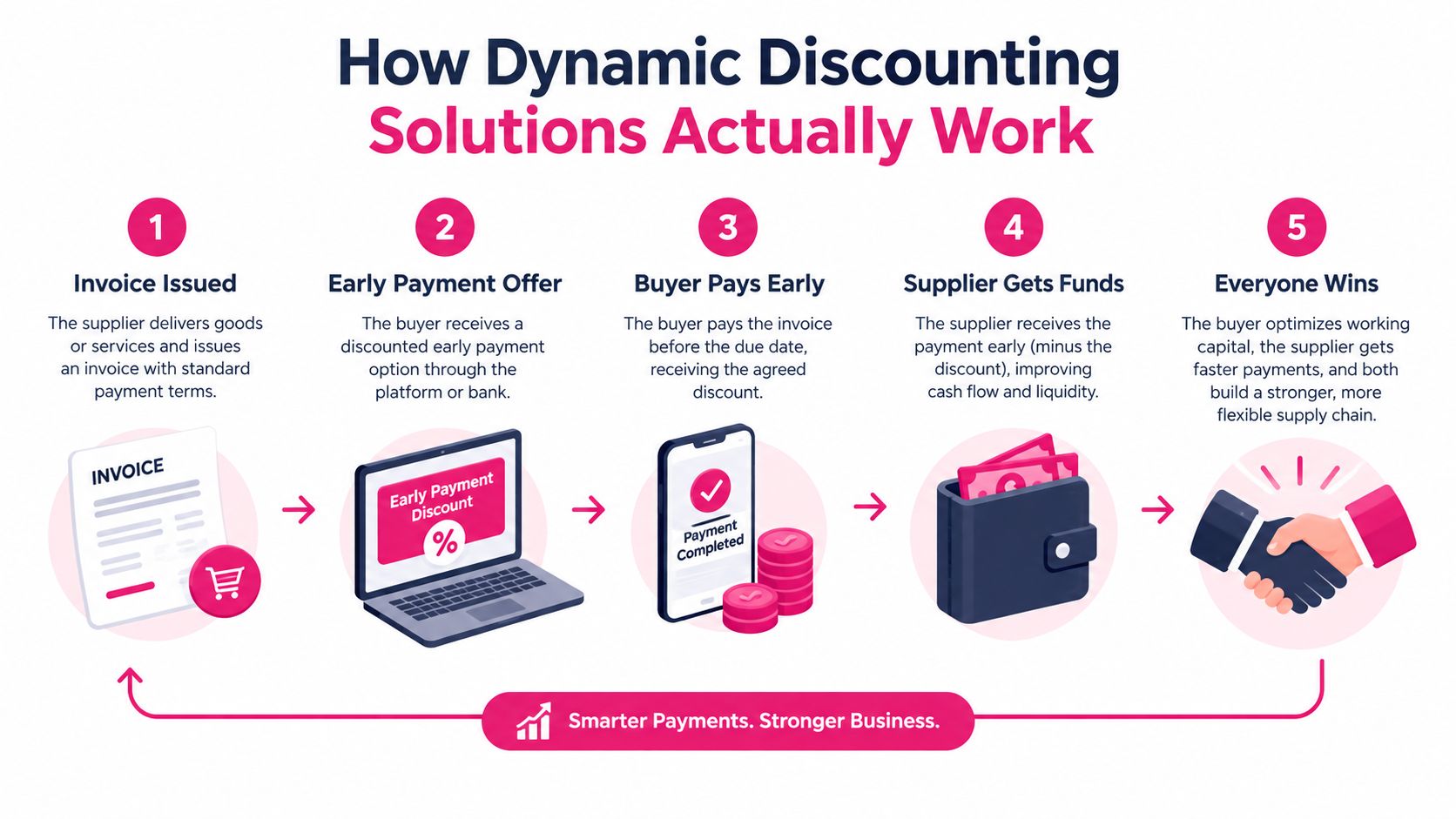
Think of an invoice as having a price tag that updates with time. Paying earlier removes more value from the invoice, while paying closer to the original due date removes less. The platform doesn’t need the accounts-payable team to negotiate every invoice manually.
The five-step invoice workflow
-
The supplier issues an invoice. The invoice carries net-60 terms, so the buyer can pay on the agreed due date.
-
The platform publishes a discount curve. For illustration, the buyer might offer 2.3% for payment in 10 days, 1.4% for payment in 30 days, or 0.5% for payment in 50 days. Those example rates are operating assumptions, not universal market terms. A real program should calculate offers according to liquidity, supplier economics, policy, and risk.
-
The buyer approves a payment run. Treasury and AP check that the invoice is valid, approved, undisputed, and eligible for early payment.
-
The supplier chooses how to participate. The supplier can accept the available offer, accept some invoices, or wait for payment under the original terms.
-
The platform settles and reconciles. It pays the discounted amount, records the discount, updates accounts payable and accounts receivable, and preserves an audit trail.
The formal definition is straightforward. Dynamic discounting is a software-enabled invoice early-payment mechanism in which the discount increases the earlier the buyer pays. Suppliers exchange part of the invoice value for faster cash, while buyers use available cash to capture the discount and automate payment execution. This mechanism is described in the academic explanation of supply-chain-finance dynamic discounting.
Who starts the offer
A buyer-initiated program uses the buyer’s cash and policy. The buyer decides which suppliers and invoices qualify, then publishes the available payment options.
A supplier-initiated program lets the supplier request earlier payment in exchange for a discount. This approach can suit suppliers with immediate liquidity needs, though the buyer still needs approval and control over the payment process.
A hybrid model combines both. The buyer establishes rules, while the supplier can request or select an offer. That structure gives treasury control without forcing every supplier into the same schedule.
Traditional 2/10 net-30 terms provide one fixed choice. Dynamic terms create a sliding scale, so a supplier that can’t accept payment on the earliest eligible date can still choose a later date and a smaller discount. For e-commerce teams, the comparable idea appears in dynamic coupon code workflows, where the offer can be generated and applied according to the shopper’s recovery context.
From Niche Treasury Tool to Mainstream Software Market
A procurement team once needed treasury expertise, spreadsheet models, and manual invoice uploads to offer suppliers earlier payment. Today, software can place those choices inside procure-to-pay workflows. The original purpose remains straightforward: buyers put available cash to work, while suppliers choose whether faster funding is worth a discount.
Adoption now spans manufacturing, retail, and services, where buyers and suppliers depend on reliable working-capital flows, according to this market overview of dynamic discounting. The category has also moved closer to everyday commerce. A buyer may pay a supplier sooner for a lower invoice value, while a shopper may receive a discount after abandoning a cart or responding to an SMS reminder. In both cases, speed has a price.
One independent market report estimates the global dynamic discounting solutions market reached USD 4.2 billion in 2024, with projected growth at a 17.5% CAGR from 2025 to 2033 and a forecast of USD 17.1 billion by 2033. The AI-powered segment is smaller but faster-moving, projected to grow at a 24.5% CAGR through 2029, according to the AI-powered dynamic discounting market report. These figures are forecasts, not guaranteed results for a particular vendor or program.
Why software changed the operating model
Working-capital pressure makes early-payment economics more visible to finance teams. APIs connect ERP, invoice, payment, and supplier data, allowing a company to calculate and present offers without rebuilding the process for every transaction. AI pricing engines can assess supplier behavior, invoice details, payment timing, and available liquidity instead of applying one fixed rule.
The same event-driven design appears in e-commerce. A checkout system can offer a discount when a shopper hesitates, while an SMS recovery flow can tailor the offer to the cart and timing. These workflows reflect the growth of e-commerce automation tools, which respond to customer or transaction signals rather than waiting for a manual campaign decision.
Other market estimates use different scopes and methodologies. One AI-powered dynamic discounting outlook places the AI segment at $1.15 billion in 2024 and projects $4.21 billion by 2030, while another estimate covers the broader market at $3.2 billion in 2025 and a possible $7.8 billion by 2034. Compare definitions before treating these forecasts as directly comparable.
Benefits, Costs, and the Net-Value Question
A dynamic discounting program can create value for both parties, but the value isn’t evenly distributed by default. The buyer receives a financial benefit from paying early. The supplier receives liquidity sooner and gives up part of the invoice value. That exchange works only when each side’s economics make sense.
For buyers, the potential benefits include:
- Return on available cash: The discount can produce a better use of surplus cash than leaving it idle, provided the buyer’s alternative uses and financing costs support early payment.
- Supplier stability: Faster payment can help suppliers manage payroll, materials, and urgent orders, which may strengthen continuity in the supply chain.
- Operational resilience: A supplier with dependable liquidity may be better positioned to respond to disruptions, although a discount program can’t replace broader supplier-risk management.
Buyers also carry costs. AP and treasury teams need rules, approvals, exception handling, accounting treatment, and supplier communications. Paying early consumes cash that could fund inventory, marketing, hiring, debt reduction, or another investment. A working-capital analysis of dynamic discounting emphasizes that the economics depend on the relationship between buyer working-capital cost and supplier financing cost.
Suppliers gain faster working capital, more predictable cash forecasting, and a possible alternative to factoring or short-term borrowing. Their cost is clear: every early-paid invoice produces a margin give-up. A supplier shouldn’t accept an offer merely because cash arrives sooner. It should compare the discount with its blended cost of short-term financing, operational need, and the value of preserving liquidity.
Buyer versus supplier comparison
| Dimension | Buyer (Payer) | Supplier (Receiver) |
|---|---|---|
| Primary benefit | Captures an early-payment discount | Receives cash before the original due date |
| Cash effect | Uses cash sooner and may improve yield | Improves liquidity and forecasting |
| Main risk | Opportunity cost and payment-control errors | Reduced margin on accepted invoices |
| Relationship effect | Can offer suppliers a flexible funding option | Gains a voluntary route to faster payment |
| Decision test | Compare implied return with cost of capital | Compare discount with financing alternatives |
| Program requirement | Accurate approval, funding, and reconciliation | Clear offers, choice, and reliable settlement |
A break-even example
Assume a $100,000 invoice, a 1.8% discount, and payment on day 7. The supplier receives $98,200, so the buyer saves $1,800.
To annualize the discount, divide the discount by the amount paid, then compare that return with the time accelerated. If the original due date is day 60, the buyer has accelerated payment by 53 days. The simple annualized calculation is:
$1,800 ÷ $98,200 × 365 ÷ 53 = approximately 12.6%
That figure is an APR-equivalent approximation, not a guarantee. The buyer should accept the offer only if the return exceeds its cost of capital and the supplier’s blended short-term financing cost. The payback period analysis guide provides a useful framework for testing whether a cash outlay earns its way back.
The right question isn’t “How large is the discount?” It’s “Who creates value from this timing change, and does each party receive enough of it?”
Where Dynamic Discounting Logic Shows Up in E-Commerce
A shopper leaves a $180 order in the cart. The store sends a reminder after 1 hour, offers 5% off after 24 hours, and increases the offer to 10% after 48 hours if the cart remains incomplete. This is the same speed-for-price trade-off used in B2B procurement: the customer receives a better price for acting sooner, while the seller receives cash sooner or recovers a sale that might otherwise disappear. For a step-by-step setup, see the Shopify abandoned cart discount guide.
Checkout-level offers
At checkout, a billing or personalization engine can identify a returning shopper who has compared the same product more than once. It may present a personalized 10% code to encourage completion. That example illustrates decision logic, not a universal recommendation. The offer should account for predicted lifetime value, gross margin, inventory position, and the likelihood that the shopper would have purchased without an incentive.
A practical workflow has five steps:
- Identify the shopper and current cart.
- Assess purchase intent and margin limits.
- Select the appropriate discount tier.
- Apply a single-use code.
- Measure completed revenue, contribution margin, and later purchases.
The discount sequence should remain a policy that the store tests. A low-margin product may support only a small incentive, while a high-margin product may tolerate a deeper one. The store should compare recovered contribution margin with the revenue that would likely have arrived without a discount.
Abandoned-cart SMS recovery
Cart abandonment creates a significant recovery opportunity. Industry reporting places average cart abandonment at about 70.22%, meaning roughly seven out of ten shoppers leave without completing a purchase, according to industry reporting on SMS marketing for e-commerce.
SMS fits this workflow because shoppers often see messages quickly. One source reports a 98% open rate, while another says 90% of people open a text within three minutes, as documented in SMS marketing statistics from TrueDialog. Track clicks, opt-outs, and revenue per send alongside opens.
One benchmark reports abandoned-cart SMS sequences recovering USD 3.07 to USD 10.78 per message sent, although results vary with audience, offer, consent quality, and product economics. The SMS performance benchmark discussion provides context for interpreting that range.
AI-driven pricing
AI pricing engines can adjust inventory prices using demand signals, competitor moves, remaining stock, and purchase behavior. Dynamic discounting acts as the promotional control inside that system. The engine may protect margin when demand is strong, then increase urgency or discount depth as inventory becomes harder to sell.
The B2B and consumer applications share one structure: act sooner, receive a known price benefit, and move cash faster. Stores should cap discount depth, prevent code reuse, honor consent requirements, and test whether the recovered margin justifies the offer.
Choosing a Dynamic Discounting Vendor That Fits
Vendor evaluation should start with workflow control, not a glossy pricing page. A suitable platform needs to calculate several discount levels, connect to the systems that hold invoice truth, and show whether the program produces an acceptable return.
Capabilities to verify
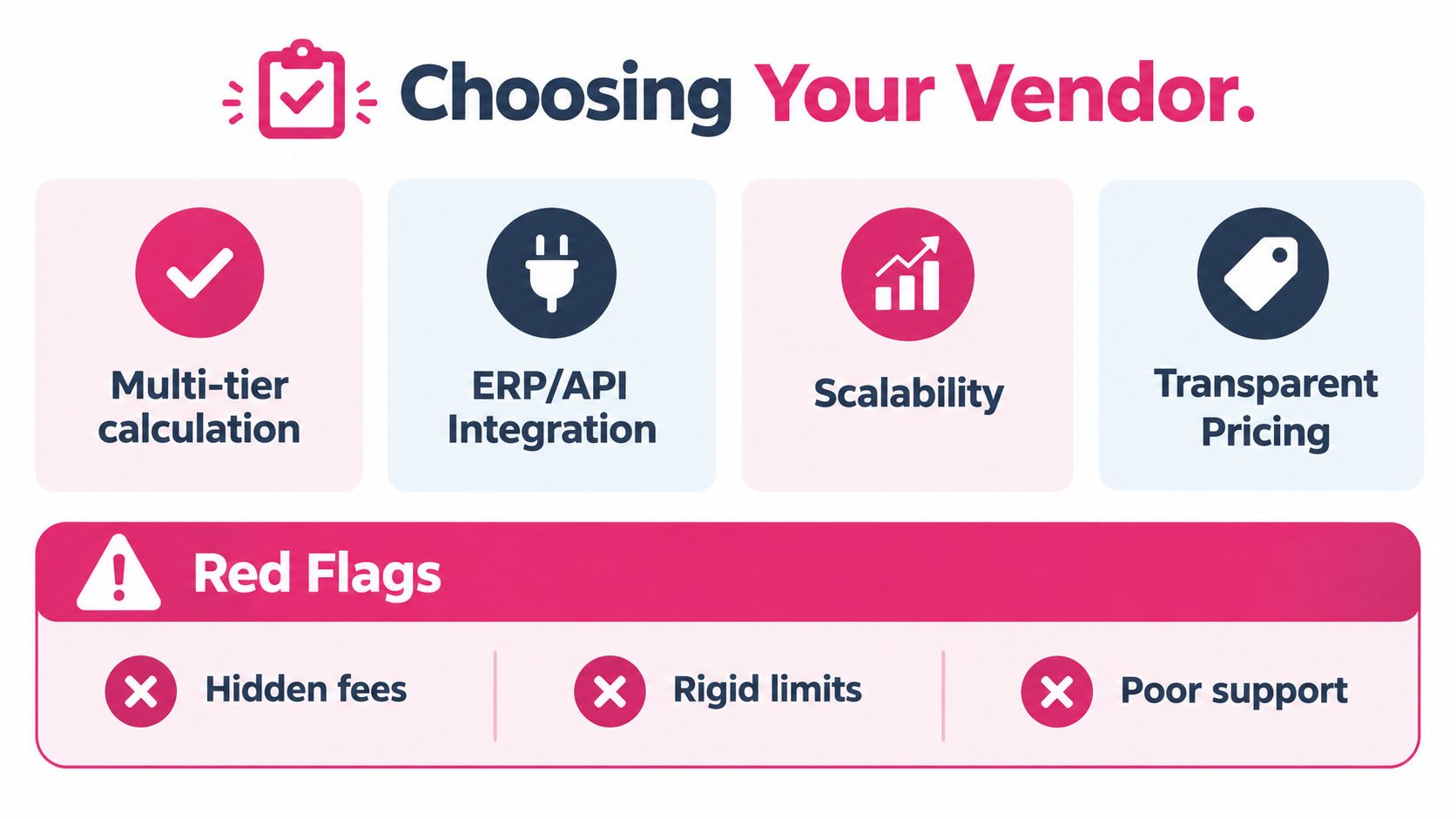
- Multi-tier calculation: The system should support a discount curve rather than one flat early-payment rate.
- Real-time ERP and AP connectivity: Approved invoices, eligibility, payment status, and settlement data should move through integrations or APIs.
- Supplier self-service: A supplier portal should explain offers, enrollment, payment dates, and acceptance choices without requiring AP staff to manage every interaction.
- Yield and ROI analytics: Dashboards should show discount value, annualized yield, supplier participation, exceptions, and program costs.
Prioritize integrations in the order your finance team depends on them. Start with ERP and accounting systems such as SAP, Oracle, NetSuite, and QuickBooks. Then assess bank and treasury payment rails, supplier-network or procure-to-pay platforms such as Coupa, Ariba, and SAP Business Network, followed by identity management and SSO.
A vendor that supports e-commerce recovery may need a different integration set. CartBoss, for example, supports automated SMS campaigns that can generate a unique single-use discount code for an abandoned cart and apply it in a pre-filled checkout flow. Treat that as a consumer recovery capability, not as a replacement for enterprise AP discounting.
Red flags during evaluation
- Opaque pricing tiers: You shouldn’t need a calculator and a private explanation to understand platform fees.
- Manual invoice uploads: Manual work introduces delays and undermines the speed the program is designed to capture.
- Weak security evidence: Ask for SOC 2 or equivalent security certifications, access controls, audit logs, and data-retention policies.
Score shortlisted vendors against your actual implementation risk. Weight integration depth at 30%, analytics at 25%, supplier adoption tools at 20%, security at 15%, and total cost at 10%. Shortlist two or three vendors for a paid pilot, then compare settlement accuracy, supplier participation, approval effort, and measured yield.
Putting Dynamic Discounting to Work in Your Business
Dynamic discounting works best when you treat it as a speed-versus-price decision, not as a campaign to maximize discounts. The buyer wants a worthwhile return on cash. The supplier or customer wants a meaningful benefit for acting sooner. Your measurement system must show whether the exchange creates net value.
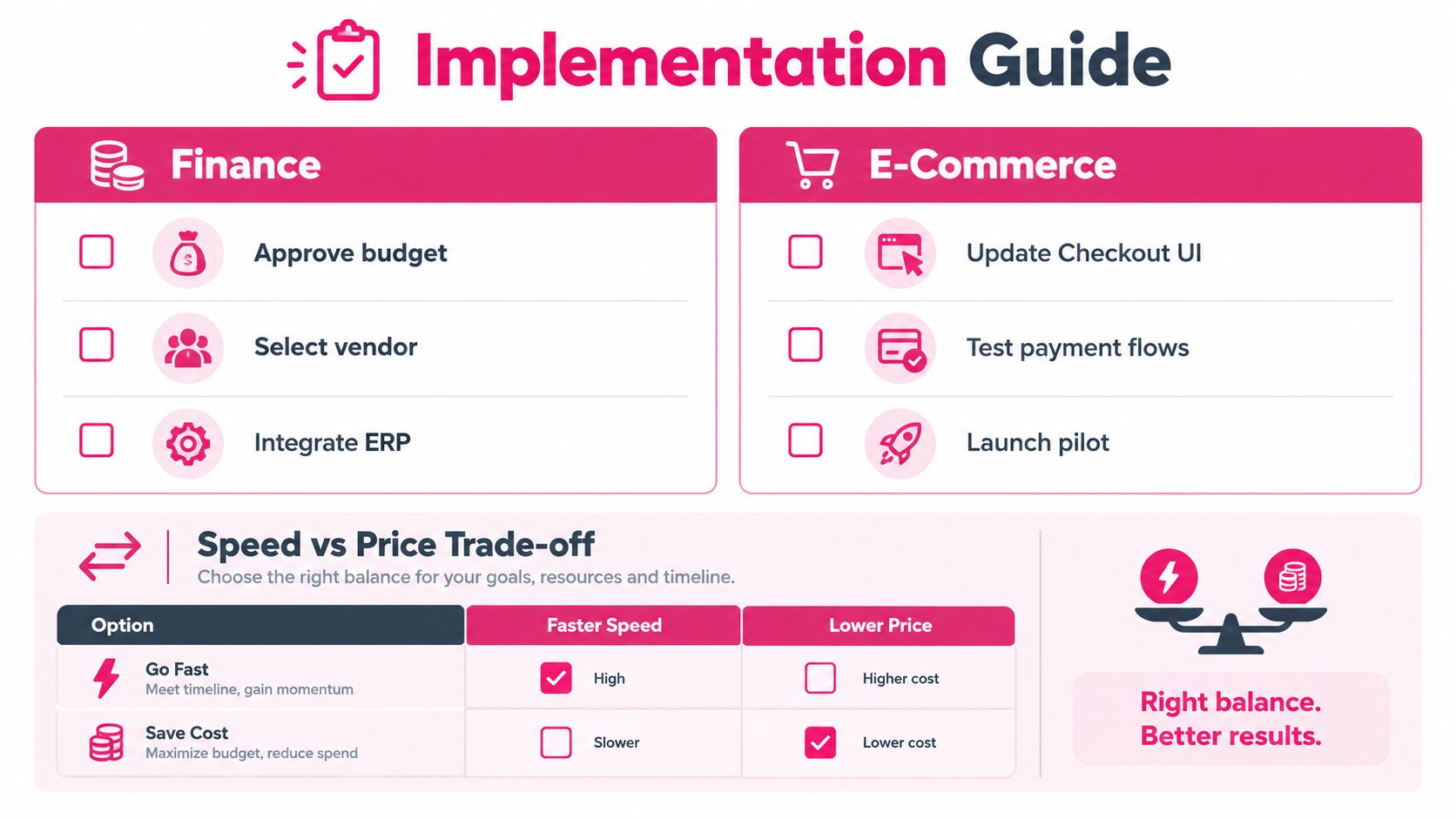
For procurement and treasury teams
- Pull a 12-month invoice-aging report and identify invoices that were approved, undisputed, and paid on time.
- Rank suppliers by spend, liquidity importance, and willingness to participate.
- Model a payment window of 7 to 15 days, then test several discount curves.
- Invite two or three willing suppliers into a controlled pilot.
- Reconcile every payment and compare the realized return with the buyer’s cost of capital.
For e-commerce operators
Apply the same discipline to checkout incentives, exit-intent offers, and SMS recovery sequences. Set rules for timing, discount depth, customer lifetime value, margin, consent, and code reuse before launching. Track recovered revenue, contribution margin, click-through rate, opt-out rate, and revenue per send rather than relying on open rate alone.
A practical rollout can follow a 30-60-90 day rhythm. Use the first phase to audit data and define economics, the second to integrate and test with a limited audience, and the third to scale only the flows that improve profitable cash conversion. The objective isn’t deeper discounts. It’s better timing.
CartBoss helps e-commerce teams automate abandoned-cart SMS recovery, generate dynamic discount codes, and send shoppers into pre-filled checkout flows, so you can test timing and offer depth without managing each reminder manually. Visit CartBoss to connect SMS recovery with a measurable dynamic-discounting strategy for your store.