


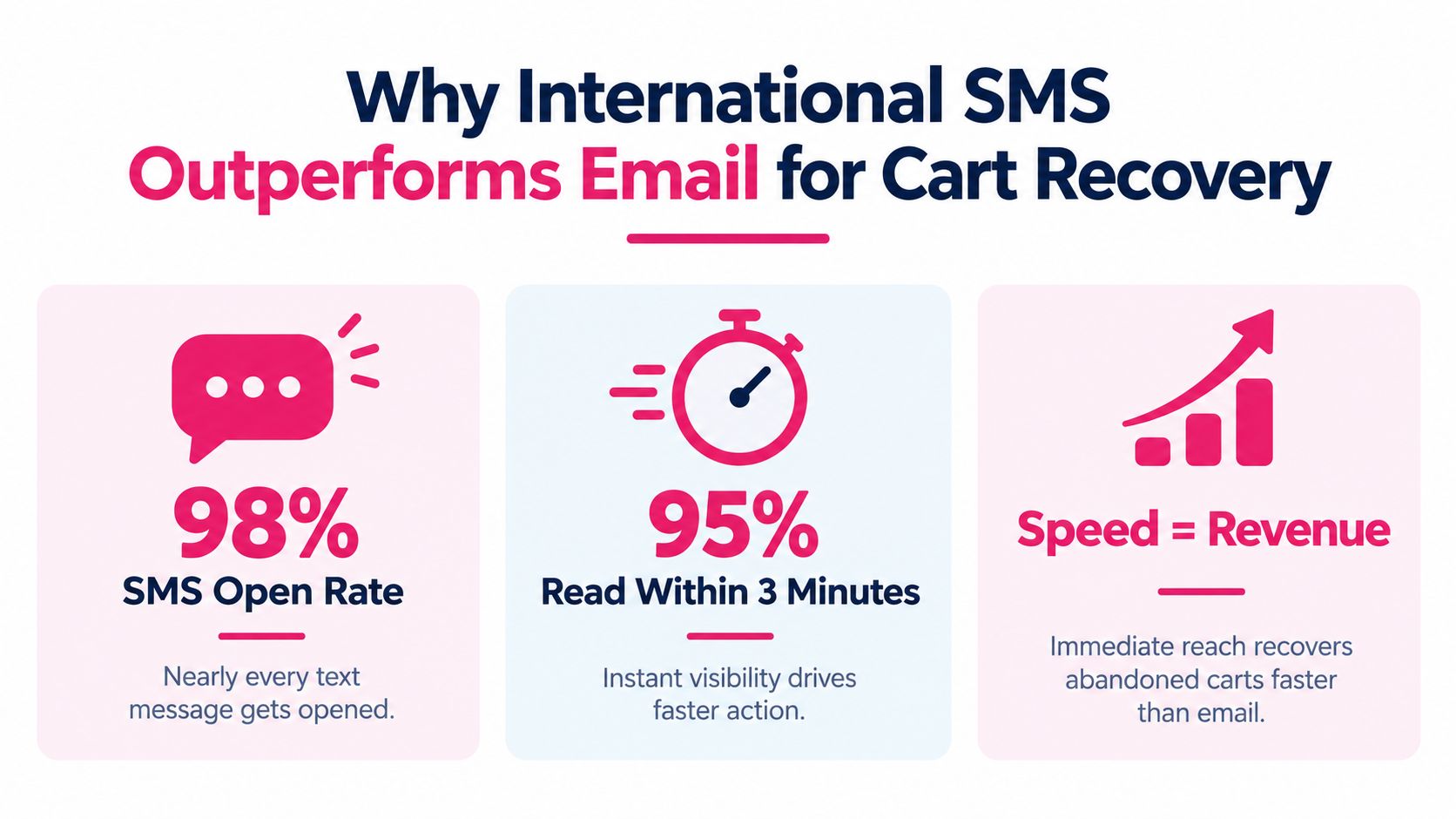
SMS open rates average around 98%, and roughly 95% of messages are read within three minutes, far outpacing email. For international ecommerce, that speed can determine whether a shopper completes a purchase or loses intent before your reminder reaches them.
That advantage comes with a condition: international SMS is not just a matter of translating one message and pressing send. Each destination can apply different consent requirements, sender-ID rules, URL restrictions, registration processes, delivery windows, and carrier filters. A campaign that performs well in one market can underdeliver in another without any obvious problem in the message itself.
The practical approach is to treat SMS for international ecommerce as a market-by-market delivery operation. You need fast cart triggers, localized copy, compliant opt-ins, approved sender identities, and reporting that separates results by country. The sections below focus on the decisions that protect revenue rather than just increasing send volume.
Table of Contents
- Why International SMS Outperforms Email for Cart Recovery
- How International SMS Delivery Works Behind the Scenes
- Navigating Global Compliance and Sender ID Rules
- Understanding International SMS Pricing and ROI
- Real-World Examples of Global Cart Recovery Success
- Getting Started with International SMS Recovery
Why International SMS Outperforms Email for Cart Recovery
The central advantage is speed. Industry benchmarks commonly place average SMS open rates at around 98%, with roughly 95% of messages read within three minutes of delivery, while email’s typical open rate is around 20% according to Mailchimp’s SMS open-rate guide. For a shopper who abandoned a cart moments ago, immediate visibility is more valuable than a beautifully designed message that sits unopened in an inbox.
Email remains useful for product education, detailed offers, and longer purchase journeys. It isn’t as dependable for a time-sensitive recovery prompt. A text can appear while the customer still remembers the product, delivery estimate, and checkout hesitation. That makes SMS a high-velocity revenue channel, especially for stores serving customers across time zones.
Speed must be connected to intent
A cart-recovery message works best when it removes friction, not when it merely announces that a cart exists. The customer should be able to return directly to a checkout that preserves relevant details, see the product clearly, and understand the next action without navigating a generic homepage.
A useful first message is short and functional:
Your cart is waiting. Complete your order here: [checkout link]
The wording should change by market and brand voice, but the structure is consistent. Identify the store, remind the shopper what they started, provide one clear link, and make opting out straightforward where required.
The difference between SMS and email isn’t only the open rate. It’s the time between abandonment and exposure. If the customer receives the reminder while purchase intent is active, the message can recover a sale that would otherwise disappear into later browsing. For a broader channel comparison, see text messages versus emails for ecommerce.
Treat the benchmark as a planning signal
The benchmark doesn’t guarantee a conversion. A message can be opened and still fail because the link is blocked, the sender is unfamiliar, the checkout doesn’t work locally, or the offer doesn’t match the destination market. International performance depends on the complete chain from consent capture to carrier delivery to checkout completion.
That changes how teams should evaluate SMS. Don’t ask only whether the campaign was sent. Track delivery, clicks, recovered orders, opt-outs, and revenue by destination. A high open rate with weak clicks often indicates a checkout or message problem. A weak delivery rate points to routing, registration, sender identity, content, or carrier filtering.
How International SMS Delivery Works Behind the Scenes
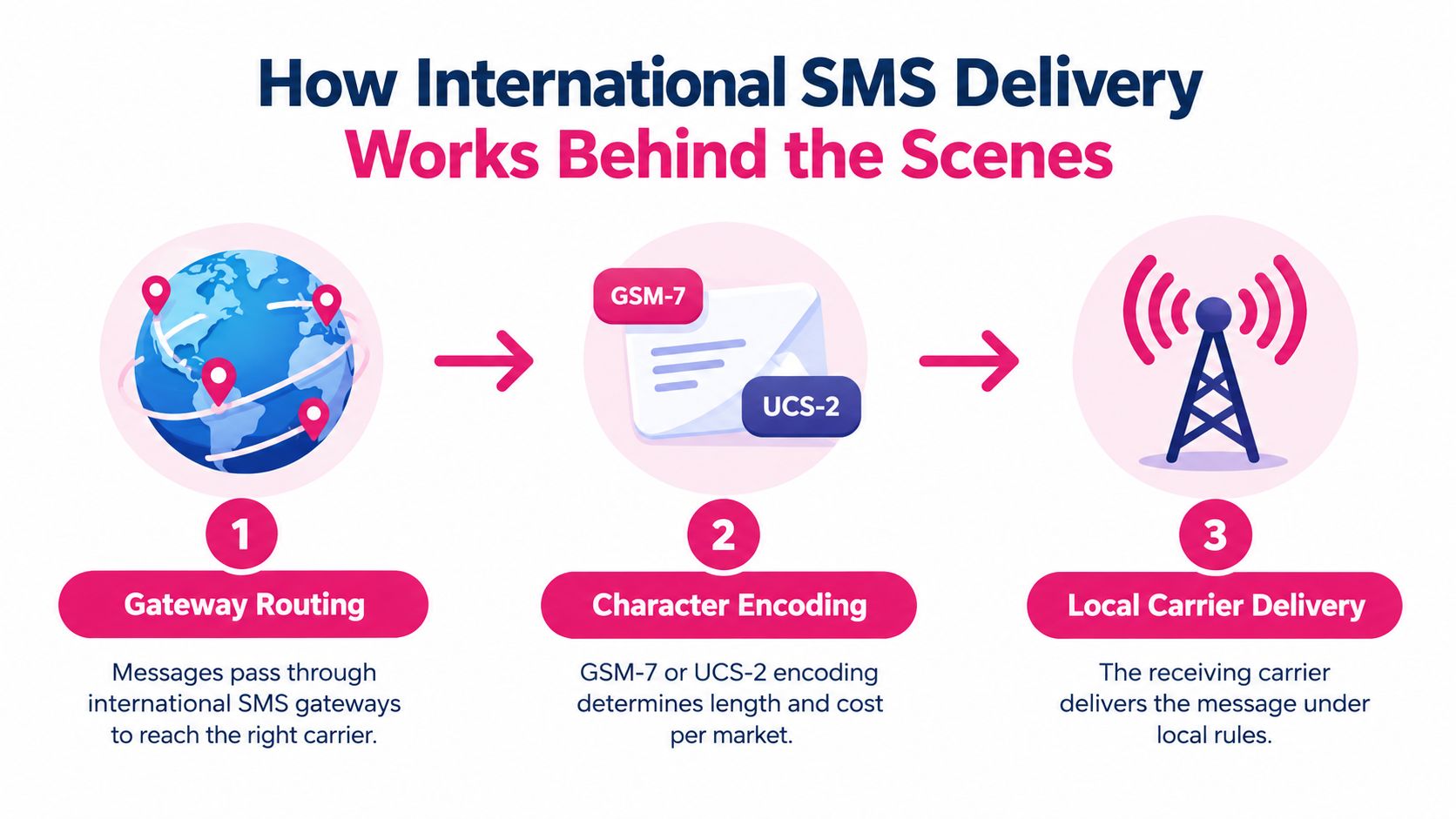
A cross-border text passes through several systems before it reaches a customer’s phone. Your ecommerce platform creates the trigger, an SMS provider or aggregator routes the message, and the destination carrier applies local technical and policy controls. Translation is only one part of that path.
Step one is gateway routing
The provider decides how to reach the recipient’s network. Routes can differ by country, carrier, originator type, and message purpose. A route that works for a transactional notification may not be appropriate for promotional cart recovery, and a shared international originator may not preserve your preferred brand identity.
Start with a country matrix containing:
- Destination market: Record the customer’s country from the phone number and checkout data.
- Originator type: Note whether the route uses a long code, toll-free number, short code, or alphanumeric sender ID.
- Message purpose: Separate cart recovery, promotions, order updates, and support replies.
- Delivery result: Store delivered, failed, rejected, and unknown outcomes by market.
This structure helps you distinguish a copy problem from a network problem. It also lets you protect SMS deliverability rates by monitoring sender reputation and investigating repeated failures instead of repeatedly resending the same content.
Encoding affects length and economics
SMS text uses character encoding. GSM-7 can carry a different number of characters from UCS-2, which is commonly needed for many non-Latin scripts and special characters. Accented characters, emoji, and some punctuation can change the encoding, split a message into multiple parts, and increase the effective cost.
Keep international recovery messages compact. Avoid emoji unless you have verified how the final message is encoded, and test every translated template on the intended route. A translation that looks short in the content editor can become longer after encoding or concatenation.
Local carriers make the final decision
The receiving carrier can filter content, reject an unregistered sender, block links, or enforce local timing and frequency requirements. You need delivery reporting that exposes these outcomes, not just a platform status that says the request was accepted.
For a plain-language technical overview, how a text message works provides useful context. The operational lesson is simple: international delivery is a chain, and the weakest localized step can prevent the customer from seeing the recovery message.
Navigating Global Compliance and Sender ID Rules
Consent is the first control layer, but it isn’t the only one. International commercial SMS is governed by overlapping requirements covering privacy, content, sender identity, registration, and delivery timing. In the EU, commercial SMS generally requires prior, specific, informed, and freely given consent under GDPR and ePrivacy, with only a narrow soft opt-in exception, as summarized in the 2026 A2P SMS compliance guide.
A compliant opt-in record should identify the phone number, consent language, timestamp, collection source, and purpose. Don’t assume that consent for order notifications automatically covers promotional cart recovery. Separate transactional and marketing permissions where the market requires it, and provide a clear unsubscribe path in the customer’s language.
Country rules can change the technical setup
India requires DLT registration for commercial A2P traffic. Australia requires alphanumeric Sender ID registration as of July 1, 2026, and Turkey blocked international A2P URLs and shortened links starting April 1, 2026, according to Telnyx’s international SMS compliance documentation. These aren’t copy-editing details. They can determine whether a message is accepted, modified, or blocked.
For U.S.-bound business SMS, A2P 10DLC registration is required for all companies sending application-to-person traffic, including bulk campaigns and occasional transactional messages to U.S. phone numbers using 10-digit long-code numbers. Approved registration is required before sending, as explained in Close’s A2P 10DLC guide.
Use a compliance register with one row per destination. Include:
- Consent standard: What permission is required, and how is it stored?
- Sender requirement: Is registration or a local sender identity needed?
- Content policy: Are discounts, product categories, or URLs restricted?
- Timing rule: Which local delivery windows and frequency limits apply?
- Opt-out method: How can the recipient stop marketing messages?
Practical rule: Never use one global sender and one global template until each priority market has passed a compliance review.
Sender identity also affects trust. A branded alphanumeric sender can be recognizable, but some destinations require registration or replace unsupported senders. A numeric originator may support replies in some markets but create a less consistent brand experience. Review SMS sender ID options before choosing an originator strategy.
Compliance affects revenue because blocked messages cannot recover carts. It also protects the list from avoidable complaints and opt-outs, which can weaken future deliverability.
A short explainer can help stakeholders understand why legal and technical decisions belong in the same workflow.
Understanding International SMS Pricing and ROI
International SMS pricing changes by destination, carrier, route, sender type, and message length. Cross-border messages can cost a few cents to well over $0.50 per message, while broad A2P benchmarks place average global costs around $0.01 to $0.05, according to Sent’s international SMS pricing overview. These ranges make one global ROI assumption unreliable. For a detailed breakdown of destination-based costs, see our guide to bulk SMS pricing.
A store can recover profitable orders in one market and lose margin in another if it uses the same discount, message length, and sending frequency everywhere. Destination repricing updates in July 2026 affected Algeria, India, Italy, Mexico, the Philippines, and Portugal. Assign an owner to the pricing sheet and set a review schedule, especially before scaling cart-recovery traffic.
Build the calculation per destination
Use a contribution-margin model for each market:
- Estimate recovered order value. Use average contribution margin rather than gross order value.
- Subtract message cost. Count every message part created by encoding and length.
- Subtract incentives. A discount can improve conversion while reducing profit per order.
- Subtract provider or platform costs. Keep these separate from carrier charges.
- Compare net contribution with total campaign spend.
The useful question is whether a destination produces enough incremental contribution to justify its route. A low unit price has no value if sender registration, filtering, or carrier restrictions reduce delivered messages and recovered carts.
Compare route choices before scaling
Local-market routing can cost more to set up, yet provide stronger sender consistency and delivery performance. A shared international originator may suit an initial test, but it might not support replies, preserve branding, or meet local registration requirements. Volume discounts can reduce costs, but they should not decide the route when messages fail to arrive.
CartBoss lists automated campaigns, translated messages, pre-filled checkout forms, dynamic discounts, branded sender IDs, analytics, and Shopify and WooCommerce integrations. Its publisher also states that customers can sell up to 50% more and cites a 4,500% average ROAS on its site. Validate those claims against destination-level margin, delivered-message data, and recovered-order reporting before using them in a forecast.
Start with a small market test. Measure delivered messages, conversion, incentive cost, and recovered contribution, then expand only where the economics stay positive. Optimize for profitable delivered messages, not the lowest quoted rate.
Real-World Examples of Global Cart Recovery Success
A strong international flow begins with the market, not the translation file. Consider a store selling clothing in several countries. A shopper abandons a cart in one market, and the system identifies the destination from the phone number and checkout details. The store then selects the approved sender, applies the local language template, and sends a short link to a checkout with the shopper’s information preserved.
The flow doesn’t need elaborate copy:
Still interested in these items? Your checkout is ready: [localized checkout link]
What matters is operational consistency. The link should open correctly on a mobile device, the currency and delivery information should match the shopper’s market, and the sender should be recognizable. If the destination blocks the link format or the sender isn’t registered, a well-written message won’t help.
Example one is a language and checkout problem
A home-goods retailer has customers who browse in multiple languages. Its old recovery email sends everyone to the homepage, where shoppers must search again, switch currencies, and rebuild the cart. A localized SMS flow can reduce those steps by detecting the customer’s language, restoring the cart, and applying a relevant offer only when the margin supports it.
The retailer should test the complete journey, not just the text. A native reviewer can check tone and product terminology, while a local tester verifies the link, checkout, currency, and delivery promise. This prevents a common failure where the message feels local but the landing experience doesn’t.
Example two is a sender and timing problem
A marketplace launches the same cart campaign across India and Australia. The copy is approved, but the team hasn’t completed India’s DLT registration or Australia’s Sender ID registration. Delivery falls unevenly by market, and the dashboard reports a campaign-level result that hides the difference.
The corrective action is to split reporting and deployment. Register the necessary originators, send a controlled test to each destination, and compare accepted, delivered, rejected, clicked, and opted-out messages. A 2026 benchmark cited by Telnyx reported average delivery rates ranging from 84.1% in India to 96.1% in Canada, with 91.4% across Europe, showing why a global average can conceal market-specific weaknesses.
Example three is a timing and margin decision
An electronics store sends a reminder soon after abandonment, followed by a later message only where local rules and customer consent allow it. The first message uses no discount, while the second introduces an incentive only for carts whose contribution margin can absorb it.
CartBoss can support this type of workflow through Shopify and WooCommerce integrations, automatic language detection, pre-written translated messages, pre-filled checkout forms, and dynamic discount application. Those features reduce manual setup, but the merchant still needs to validate consent, sender registration, links, timing, and destination economics before activating each market.
Getting Started with International SMS Recovery
Launch market by market. A controlled rollout gives you cleaner evidence than activating every country with one template and one sender.
1. Choose a priority market
Start with a destination where you already have meaningful traffic, clear consent records, and a checkout that works locally. Document the currency, language, delivery promise, tax treatment, sender requirement, URL policy, and permitted delivery windows.
2. Audit the opt-in
Separate promotional permission from transactional communication. Store the consent source and wording, and make the unsubscribe process visible. Remove contacts whose consent state is unclear rather than trying to recover them through repeated messages.
3. Prepare the originator
Confirm whether the market accepts your sender type. Complete registration before launch where required, and test whether the sender is preserved on the recipient’s device. For the U.S., complete A2P 10DLC registration before sending to 10-digit long-code destinations.
4. Build the recovery sequence
Use a short initial reminder that links directly to the saved checkout. Translate the message for the market, check encoding, remove unnecessary punctuation, and test the final rendered text. Add a discount only when the expected contribution justifies it.
5. Test the entire customer path
Send test messages to local devices. Check delivery, language, sender display, link behavior, checkout fields, currency, discount logic, and opt-out handling. Don’t approve a campaign based only on the provider’s accepted status.
6. Monitor by country
Review delivery, rejection reasons, clicks, recovered orders, opt-outs, and contribution margin separately for every destination. Pause a market when delivery degrades or complaints rise, then investigate routing, registration, content, and timing before increasing volume.
CartBoss offers automated SMS cart-recovery campaigns, Shopify and WooCommerce integrations, pre-translated messages, automatic language detection, pre-filled checkout forms, dynamic discounts, branded sender IDs, compliance features, do-not-disturb controls, and campaign reporting. Use those capabilities to reduce manual work, but keep market-level compliance ownership with your team.
Learn how to text an international number before expanding beyond your first destination. A disciplined rollout turns international SMS from a broad broadcasting tool into a measurable recovery channel.
CartBoss helps ecommerce stores recover abandoned carts with automated, localized SMS campaigns, pre-filled checkouts, dynamic discounts, and market-aware controls for Shopify and WooCommerce. Visit CartBoss to connect your store and build an international recovery flow that prioritizes compliant delivery and profitable conversions.