



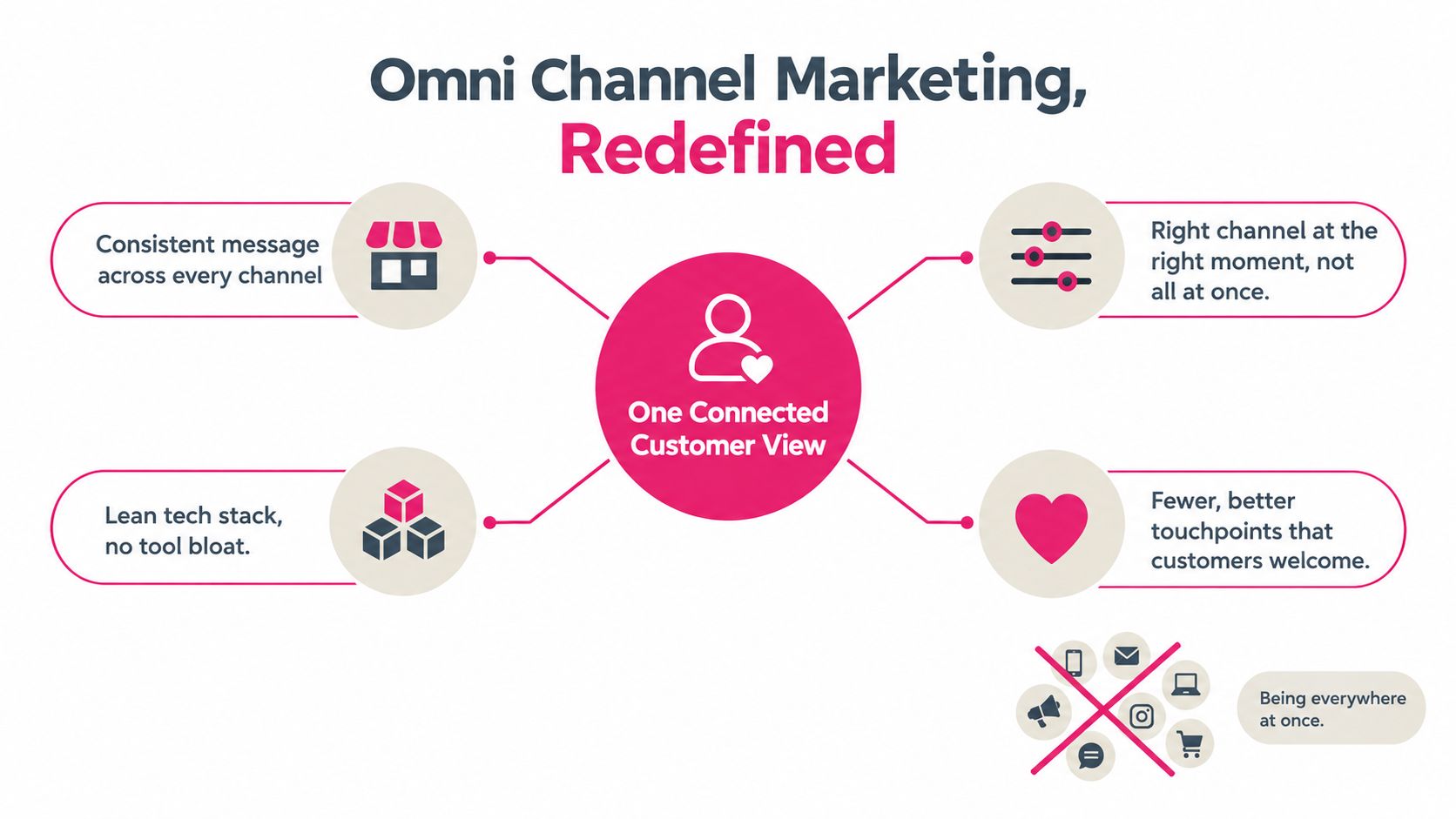
Being everywhere at once isn’t an omnichannel strategy. It’s often an expensive way to send the same shopper conflicting messages through disconnected tools.
For e-commerce, omni channel marketing works when each touchpoint carries forward the customer’s context. A shopper who browses on mobile, receives an email, and gets an SMS reminder should experience one coherent journey, not three unrelated campaigns. The commercial opportunity is strongest at high-intent moments, especially abandoned carts, where a well-timed message can recover revenue without creating message fatigue.
Table of Contents
- Understanding Omni Channel Marketing for E-commerce
- The Revenue Impact of Connected Customer Journeys
- Comparing Multichannel and Omnichannel Marketing Strategies
- Orchestrating SMS and Email for Cart Recovery
- Navigating Compliance and Consent Across Channels
- Measuring Omnichannel Performance and Attribution
- Building Your First Omnichannel Recovery Workflow
Understanding Omni Channel Marketing for E-commerce
Omnichannel marketing connects the channels a customer uses, including your storefront, mobile experience, email, SMS, social platforms, and customer service. The defining feature isn’t the number of channels. It’s whether those channels share identity, intent, consent, timing, and relevant product context.
A multichannel store might send an email, run social retargeting, and trigger an SMS independently. An omnichannel store knows which interaction happened first, suppresses irrelevant follow-ups, and chooses the next channel based on what the shopper has done. The customer doesn’t need to repeat a search, re-enter information, or decipher contradictory offers.
The customer view comes first
A connected customer view typically combines:
- Identity: A known email address, phone number, account, or consented browser signal.
- Behavior: Product views, cart contents, checkout progress, purchases, and support interactions.
- Preferences: Language, communication permissions, unsubscribe status, and preferred contact method.
- Availability: Current product, price, promotion, and fulfillment information.
- Journey state: Whether the shopper is browsing, evaluating, abandoning, purchasing, or returning.
Without those signals, automation becomes guesswork. A customer may receive a cart reminder after buying the product, a discount for an item they already returned, or an SMS after opting out. More touchpoints won’t solve those failures. Better orchestration will.
Research on omnichannel shoppers defines them as customers who use at least two channels from the same retailer during a journey. It also found that purchase intention is influenced strongly by personal innovativeness, effort expectancy, and performance expectancy, which reinforces a practical principle: integration must make the shopping task easier, not merely give the brand more places to speak. The Frontiers in Psychology study on omnichannel purchase intention provides useful context for evaluating that friction.
Fewer touchpoints can perform better
Channel expansion makes sense only when it removes a customer problem. Add email when it gives the shopper more useful product context. Add SMS when immediacy matters and consent is clear. Add chat when customers regularly need help before purchase.
A useful operational reference is this omnichannel customer service guide 2026, particularly for connecting marketing context with service conversations.
For store owners, the first implementation should usually focus on the journey with the clearest commercial intent. In many stores, that means connecting cart detection, email, SMS, checkout, and order status before adding more channels.
Start with the practical distinction explained in CartBoss’s overview of omnichannel strategy. The objective isn’t to maximize channel count. It’s to make every next interaction feel like a continuation of the last one.
The Revenue Impact of Connected Customer Journeys
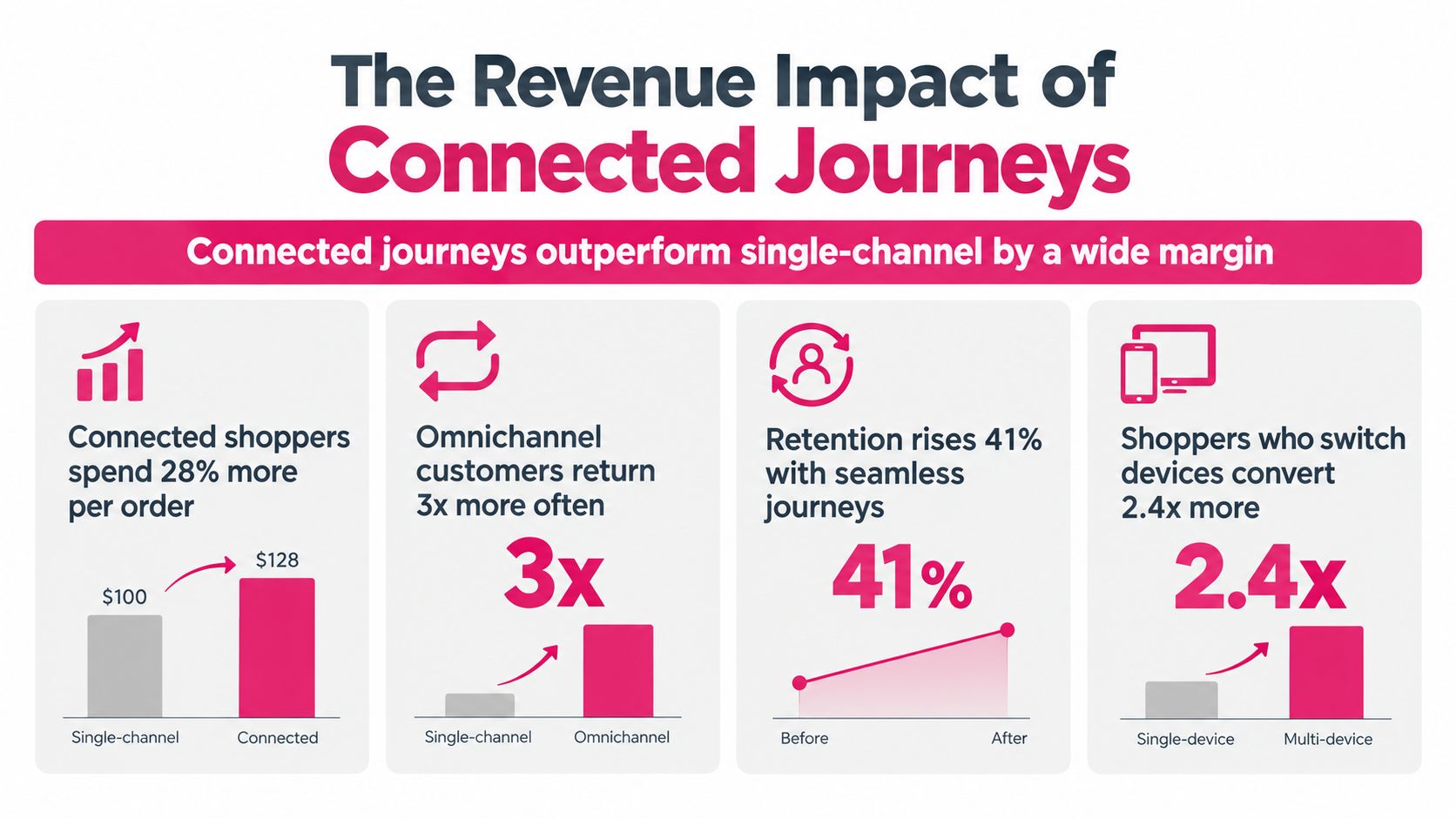
Connected journeys have a stronger business case than a vague promise of “better experiences.” The available market data links coordinated channel use with order value, retention, and commercial performance.
One retail summary reports that 73% of consumers use multiple channels during their shopping journey. It also reports that omnichannel customers spend 16% more per order and have a 30% higher lifetime value than single-channel buyers. The same summary says brands with strong omnichannel engagement retain 89% of customers, compared with 33% for brands with weak strategies. The retail omnichannel statistics summary supplies the source for these figures.
What those figures mean for an e-commerce operator
The numbers don’t mean every store should launch every channel. They show why disconnected journeys can leave value on the table when shoppers naturally move between devices and touchpoints.
A customer might discover a product through social content, compare specifications on a mobile site, open an email later, and return to checkout from a desktop device. If each channel treats that person as a new prospect, the store pays repeatedly for attention it has already earned. If the channels share context, the brand can spend its next message on the remaining objection, such as shipping, sizing, price, or urgency.
Another 2026 market summary reports that 60% of online shoppers use three or more channels before completing a purchase, while multichannel campaigns can generate a 494% higher order rate than single-channel campaigns. The same source projects multichannel e-commerce sales at $892.4 billion in 2026 and estimates the omnichannel retailing market at $11.57 billion in 2026, forecasting $29.30 billion by 2033 at a 14.2% CAGR. These are market-level figures, not a guarantee for an individual store. The cited omnichannel market summary contains the referenced estimates.
Protect acquisition cost through retention
The retention difference matters because acquisition costs don’t end at the first order. A coordinated journey can help a store convert existing intent, support repeat purchasing, and reduce the need to reacquire the same customer through paid media.
The operating question for stakeholders should be concrete:
- Which customer actions indicate purchase intent?
- Which channel can respond without adding friction?
- Which message should be suppressed after another channel succeeds?
- Which revenue and retention outcomes will prove the workflow works?
This shifts the discussion from “Should we be on more channels?” to “Where does connected context create profitable action?”
Comparing Multichannel and Omnichannel Marketing Strategies
Adding channels does not automatically improve revenue. Multichannel marketing gives a store several ways to reach shoppers, while omnichannel marketing connects those channels to the same customer journey. The difference is operational: one distributes campaigns; the other coordinates decisions across touchpoints.
A multichannel program can produce strong email, SMS, advertising, or marketplace campaigns individually. Problems appear when the shopper moves between them. Email may repeat an SMS reminder, an ad may continue after purchase, and product availability or promotional terms may differ between the website and another sales environment. The shopper has to restart the conversation each time.
| Area | Multichannel approach | Omnichannel approach |
|---|---|---|
| Customer identity | Separate profiles or partial matching | Unified view across approved touchpoints |
| Messaging | Planned by channel | Sequenced by customer state |
| Product context | Inventory, price, and offers can drift | Shared product, promotion, and availability data |
| Measurement | Platforms report separately | Events are evaluated across the journey |
| Contact control | Frequency limits managed separately | Suppression and limits apply across channels |
| Technology | Tools can operate independently | Integrations, identity resolution, consent, and orchestration are required |
Omnichannel coordination also has a cost. Integrations need maintenance, identity matching can fail, and consent rules must be applied consistently. For cart recovery, that work is easier to justify than a broad channel rollout because the shopper has already shown purchase intent. A connected email and SMS sequence can recover revenue while avoiding duplicate contact.
Audit the journey before adding tools
Follow one customer from product view through checkout and order confirmation. Record every ad, email, SMS, form, checkout event, and support interaction. Then check whether each system can receive the events that occurred elsewhere.
The most useful audit findings are concrete:
- Duplicate reminders: Email and SMS fire without checking the other channel.
- Stale cart status: A recovery message sends after the order is complete.
- Offer mismatch: A discount conflicts with the checkout experience.
- Identity gaps: A known email cannot be connected to a consented phone number.
- Reporting gaps: One platform claims the sale even though another channel created the original intent.
Teams managing campaigns independently can also review this guide to stopping operational chaos in ad management.
Start with one connected workflow
Do not wait for every system to share data. Begin with the fields required for one high-value recovery flow: cart status, contact details, consent, product information, order status, and message events. Set clear suppression rules before adding another channel.
For terminology and planning criteria, CartBoss’s guide to multi-channel marketing distinguishes channel presence from connected execution. Use that distinction to decide whether the next investment should add reach or improve coordination.
Orchestrating SMS and Email for Cart Recovery
More touchpoints do not automatically recover more carts. A tightly timed email and SMS sequence can outperform a broad campaign that repeats the same message across every available channel. Cart recovery works best when each contact responds to shopper intent, consent, and the latest order status.
SMS can reach shoppers quickly, but performance depends on permission, timing, list quality, the offer, the product, and implementation. A 2026 cart-abandonment benchmark reports a 98% open rate and conversion of 15% to 20% per message, with some sequences reaching 25% to 40% recovery. See Contentsquare’s cart-abandonment statistics guide for the reported figures and their context.
Build the sequence around intent
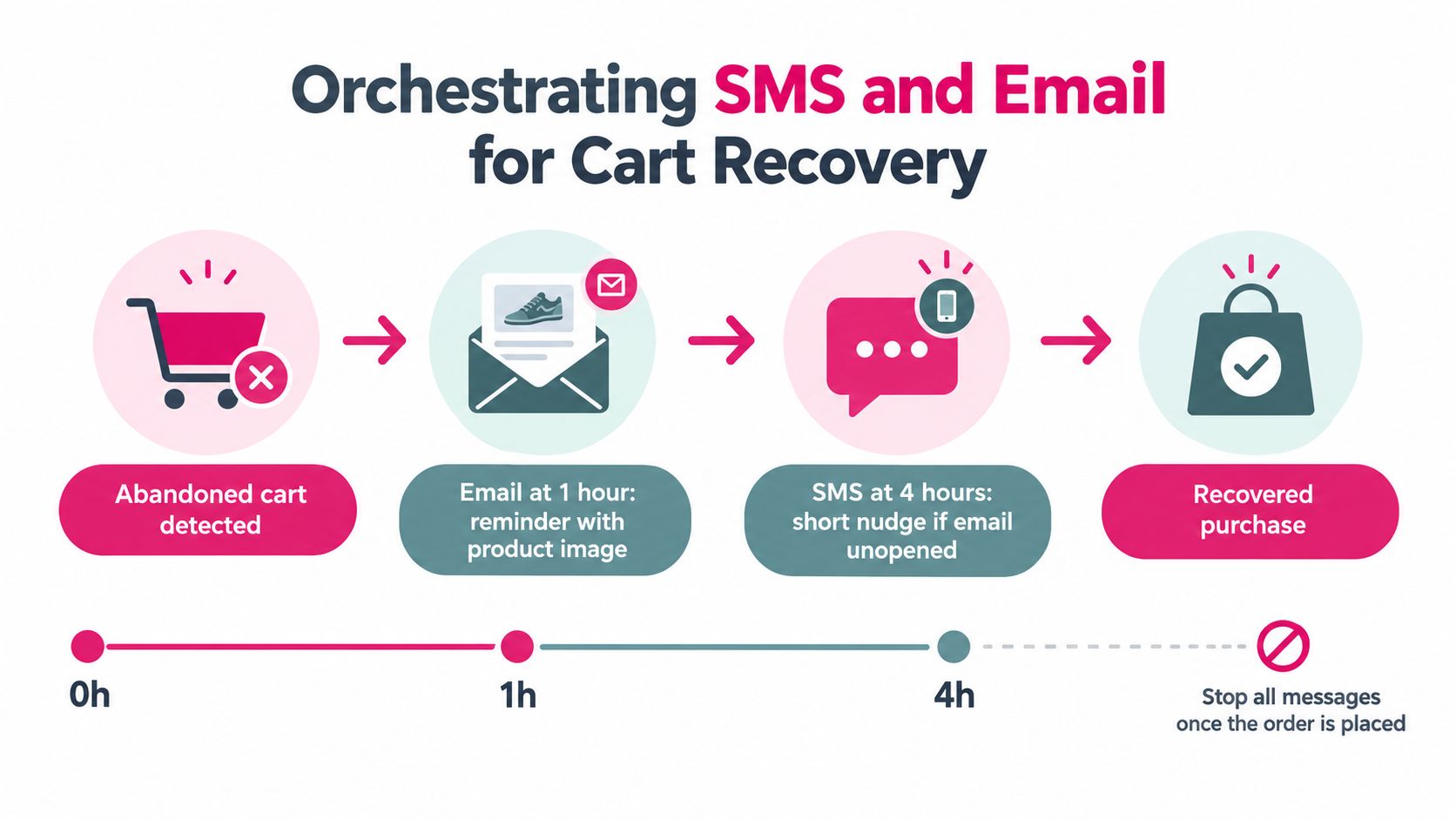
Start by confirming that the shopper reached the cart or checkout stage and has not completed the order. Send an email at one hour with the product image, cart contents, price, and a direct checkout link. Address a likely hesitation, such as product details or delivery information, instead of repeating a generic slogan.
The next decision should use engagement data. If the shopper opened or clicked the email, avoid sending the same reminder by SMS automatically. If email produced no response, an SMS at four hours may provide a useful prompt, provided the shopper has given the required permission.
Keep the text short. Identify the store, reference the cart, and offer one clear action. SMS creates immediacy. It is a poor place for a long product explanation.
Suppress the entire recovery sequence as soon as the order is completed. A confirmation event should stop queued email and SMS messages, including messages already scheduled in separate platforms.
Practical rule: Each message should add context, not repeat the previous message in a louder channel.
The one-hour and four-hour timings are starting points. Test them against consideration time, local time, consent conditions, and offer urgency. More frequent contact may increase short-term reach while also increasing opt-outs and fatigue, so judge the sequence by recovered revenue and list health, not message volume alone.
Remove checkout friction
The recovery link should reopen the correct cart, preserve product selections, and reduce data entry. Pre-filled forms can remove unnecessary steps. Dynamic discount application can support an approved offer, but repeated discounts can teach shoppers to abandon carts while waiting for a code.
Global stores can match approved recovery copy to the shopper’s language. Translation improves clarity, but it does not replace local consent rules, time controls, or accurate product and shipping information.
Email placement affects the sequence. Before evaluating email results, use how to check if emails are going to spam to investigate delivery and sending quality. For practical guidance on coordinating both channels, review CartBoss’s SMS and email guide.
Navigating Compliance and Consent Across Channels
More channels do not automatically produce more recovery revenue. A connected customer profile helps only when each channel respects its own permission. Email consent isn’t automatically SMS consent, and a phone number captured at checkout does not by itself establish permission for promotional recovery messages.
SMS recovery depends on both a phone number and opt-in consent. Campaigns must also account for TCPA and GDPR compliance, along with clear sender identification, unsubscribe handling, and documented permission. ShopLabs’ discussion of cart-abandonment behavior signals reinforces the need for consent checks and compliant recovery flows.
Make permission usable at send time
Record consent as an event, including its source, timestamp, channel, and the wording shown to the shopper. Keep email subscriptions and SMS permissions in separate fields, then expose those states to every system that can trigger a message.
Before sending, confirm:
- Was SMS consent collected: If not, exclude the number from promotional recovery.
- Did the shopper opt out: Suppress future SMS immediately and sync that status across connected tools.
- Does the message identify the sender: State the business clearly.
- Can the recipient unsubscribe: Provide a simple, functioning opt-out path.
- Is the timing appropriate: Apply local time windows and quiet periods.
A consent record is useful only if trigger logic, segmentation, templates, and reporting can act on it.
Treat suppression as part of the customer experience
Suppression rules prevent avoidable contact. Stop recovery messages after an order is placed, stop SMS after an unsubscribe, and pause promotional reminders when an open service issue changes the purchase context.
International campaigns also require automatic do-not-disturb controls and time-window limits. These settings reduce fatigue and help prevent a technically successful workflow from creating a complaint or damaging trust.
For a focused reference on TCPA compliance for SMS programs, store owners can review CartBoss’s guide. Legal review should still reflect the markets served and the store’s specific data collection and messaging practices. A narrow, permission-aware sequence across high-intent email and SMS is usually easier to control than an indiscriminate channel expansion.
Measuring Omnichannel Performance and Attribution
Last-click reporting is easy to read and often incomplete. It tends to reward the final click while hiding the earlier product view, email visit, paid impression, or support interaction that created readiness.
A useful measurement system starts with a journey-level event record. Track the cart creation, recovery eligibility, email delivery, email engagement, SMS delivery, SMS engagement, checkout return, purchase, unsubscribe, and suppression events. Then evaluate both the direct result and the effect on the broader customer relationship.
Use a scorecard that exposes trade-offs
| Measurement area | What to track | What it tells you |
|---|---|---|
| Recovery | Recovered orders and recovered revenue | Whether the workflow creates commercial value |
| Incrementality | Holdout or comparison groups where appropriate | Whether messages caused additional purchases |
| Sequence behavior | Email and SMS engagement by step | Which message earns the next interaction |
| Friction | Checkout return and completion behavior | Whether the recovery link helps shoppers finish |
| Fatigue | Unsubscribes, opt-outs, complaints, and repeated exposure | Whether frequency is damaging trust |
| Customer value | Repeat purchase and lifetime value by consented journey | Whether recovery supports retention |
| Operations | Delivery failures, stale carts, and suppression accuracy | Whether the automation can be trusted |
Omnichannel attribution should assign value across assists rather than treating the final touchpoint as the entire explanation. The relevant model depends on your data quality and sales cycle, but every model should make assumptions visible.
For implementation ideas, see CartBoss’s multi-touch attribution guide. Use it to create a reporting view that connects channel interactions with order outcomes instead of reading each platform in isolation.
Optimize one variable at a time
Start with timing. If delivery is reliable, test message content. Then test the offer, landing experience, language, or suppression rule. Keep the audience definition stable while you change one meaningful variable, otherwise you won’t know what caused the result.
Watch negative signals as closely as revenue. A sequence that recovers orders but drives opt-outs may be extracting short-term value from a list you’ll struggle to use later. Sustainable performance combines recovered revenue, customer permission, clean delivery, and a checkout experience that earns completion.
Building Your First Omnichannel Recovery Workflow
The fastest path to a useful omnichannel program is a narrow workflow with clear ownership. Connect only the systems needed to detect intent, send approved messages, return the shopper to checkout, and report the outcome.
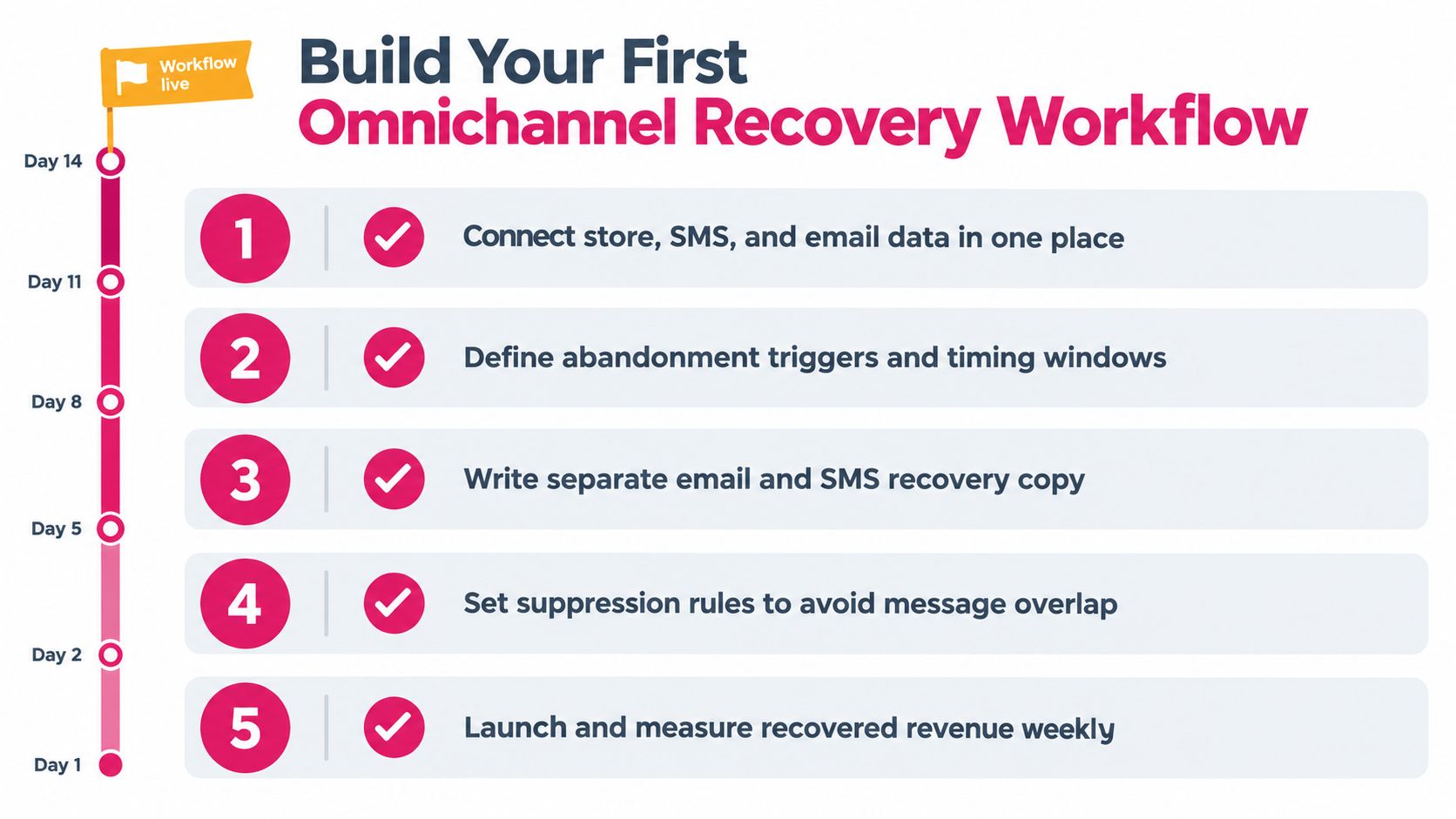
A launch checklist for store owners
-
Connect the store and customer data. Link your Shopify store or WooCommerce installation to the recovery tools that manage cart, order, email, SMS, and consent events. Verify that a completed order immediately updates the cart state.
-
Define the abandonment trigger. Decide what counts as an abandoned cart, which customers qualify, and how long the cart remains eligible. Exclude customers without the required permission for the intended channel.
-
Write channel-specific copy. Give email room for product context and checkout reassurance. Give SMS a concise reminder, store identification, and one action. Don’t paste the email into a text message.
-
Set the timing windows. Use the one-hour email and four-hour SMS sequence as a starting framework, then adjust for product consideration, customer location, and local quiet periods.
-
Configure the recovery experience. Test pre-filled checkout forms, dynamic discount application, branded sender ID, automatic language detection, translated messages, and the return-to-cart link. Every element should work on a real mobile device.
-
Apply suppression rules. Stop all recovery messages after purchase. Suppress SMS after opt-out, prevent duplicate channel sends when the shopper has already engaged, and enforce do-not-disturb periods.
-
Test before activation. Run test carts for new and returning customers, different languages, different devices, and each consent state. Check the actual received message, not just the preview.
-
Review the first reports weekly. Compare recovered revenue with delivery, engagement, checkout completion, opt-outs, and suppression accuracy. Fix broken states before expanding the workflow.
CartBoss is one option for this focused recovery layer. It supports Shopify and WooCommerce, automated SMS campaigns, pre-written and translated messages, automatic language detection, pre-filled checkout forms, dynamic discount application, branded sender IDs, GDPR and CCPA compliance features, automatic do-not-disturb mode, and analytics and reporting. Treat those capabilities as parts of the workflow, not substitutes for consent design, message testing, or attribution.
The right starting point isn’t a broad campaign across every available channel. It’s one connected recovery journey where email and SMS have distinct jobs, customer permissions control eligibility, and every purchase shuts the sequence down.
CartBoss helps store owners coordinate automated SMS cart recovery with email, consent controls, localized messages, and a lower-friction return to checkout. Visit CartBoss to connect your store and build a measured recovery workflow without turning every abandoned cart into a multi-channel message blast.