



In eCommerce, the difference between a browse and a buy often comes down to a single, perfectly timed nudge. With SMS open rates soaring past 98%, text messages offer a direct and powerful channel to re-engage customers, recover lost sales, and build lasting loyalty. But what does a winning text message actually look like? This guide moves beyond generic templates to provide a strategic breakdown of high-impact text message examples for every stage of the customer journey.
We will dissect real-world examples that work, covering everything from urgent abandoned cart reminders to engaging promotional campaigns. Each example includes a detailed analysis of the specific tactics used, why they are effective, and actionable takeaways you can implement immediately. You will learn the behind-the-scenes strategy for crafting messages that drive clicks and conversions.
This resource is designed for e-commerce businesses and marketing professionals ready to transform their SMS strategy from a simple notification system into a revenue-generating powerhouse. We’ll explore templates for promotions, shipping updates, customer support, and more, providing the insights needed to create compelling, high-converting campaigns. Get ready to master the art of the perfect text and unlock significant growth for your online store.
1. Abandoned Cart Recovery: The Revenue-Saving Nudge
Abandoned cart messages are the frontline soldiers of eCommerce revenue recovery. Sent to shoppers who’ve left items in their cart without completing a purchase, these texts aim to gently remind, incentivize, and guide them back to the checkout. A successful abandoned cart SMS combines a friendly tone with a clear call-to-action and a sense of urgency, turning hesitation into a completed sale.
This is where specialized tools like CartBoss excel, automating the entire process with pre-written, language-detected messages and pre-filled checkouts to create a frictionless recovery experience. These automated text message examples are designed not just to remind, but to convert.
Example and Strategic Breakdown
Let’s dissect a high-performing abandoned cart text message to see what makes it effective.
Example Text:
Hey [CustomerName]! Did you forget something? Your items at [StoreName] are waiting for you. Complete your order before it’s too late: [ShortLink]
Analysis of Key Elements
- Personalization: Using the customer’s name (
[CustomerName]) immediately grabs attention and makes the message feel personal, not like a generic blast. - Friendly Reminder: The phrase “Did you forget something?” is conversational and non-aggressive. It frames the reminder as helpful rather than pushy.
- Urgency: “Complete your order before it’s too late” introduces a subtle sense of scarcity, encouraging immediate action without being overly dramatic.
- Direct Call-to-Action (CTA): The short link (
[ShortLink]) is the most crucial part. It takes the customer directly back to their pre-filled cart, removing any friction that might prevent them from finishing the purchase.
Actionable Takeaways for Your Strategy
- Time it Right: Send the first message within 30-60 minutes of cart abandonment to catch the customer while your brand is still top of mind.
- Keep it Simple: Avoid overwhelming the customer. State the purpose, provide the link, and let them take the next step.
- Remove Friction: Ensure the link leads to a pre-populated cart. Forcing a customer to re-add items is a guaranteed way to lose the sale.
While SMS is a powerful channel, it’s just one piece of the puzzle. Exploring a full suite of strategies for abandoned cart recovery, including unique payment options or exit-intent pop-ups, can further boost your revenue-saving efforts.
2. Two-Factor Authentication (2FA) SMS: The Digital Gatekeeper
Two-Factor Authentication (2FA) messages are the bedrock of modern account security. These automated texts are sent to a user’s phone to verify their identity during login or other sensitive actions, like password resets or large transactions. By requiring a temporary code sent to a trusted device, 2FA adds a critical layer of protection against unauthorized access, making it significantly harder for bad actors to compromise accounts even if they have stolen a password.
These security-focused text message examples are not about marketing but about building trust and protecting your customers. A reliable 2FA system demonstrates a commitment to user security, which is a powerful retention tool in itself. Ensuring these messages are delivered instantly and clearly is paramount to maintaining a secure and seamless user experience.
Example and Strategic Breakdown
Let’s analyze a standard yet highly effective 2FA verification message to understand its core components.
Example Text:
Your [AppName] verification code is: 842109. This code will expire in 10 minutes. Don’t share this code with anyone.
Analysis of Key Elements
- Clear Sender Identification: Starting with
[AppName]immediately tells the user who the message is from, reducing confusion and the risk of phishing. - Prominent Code: Making the code itself (
**842109**) bold and prominent is crucial. The user needs to find and use this piece of information quickly. - Sense of Urgency: “This code will expire in 10 minutes” creates a necessary time constraint that enhances security by invalidating the code after a short period.
- Security Warning: The simple instruction, “Don’t share this code with anyone,” educates the user on best security practices and reinforces the confidential nature of the code.
Actionable Takeaways for Your Strategy
- Prioritize Speed: 2FA messages must be delivered almost instantly. Delays can frustrate users and cause them to abandon the login or transaction process.
- Keep it Purely Transactional: Do not mix marketing content with security messages. The sole purpose of a 2FA text is to deliver a verification code securely and efficiently.
- Comply with Regulations: Transactional messages like 2FA are treated differently from marketing texts. It’s crucial to understand the legal landscape; you can find more information about TCPA compliance for text messages to ensure you are following the rules.
While transactional SMS is vital for security, you can also explore innovative ways of engaging users in other areas. For instance, considering options like launching marketing campaigns with Web3 rewards can create new avenues for building loyalty and driving results.
3. Appointment Reminder SMS: The No-Show Reducer
Appointment reminder messages are a critical operational tool for any service-based business. Sent to clients or patients ahead of a scheduled booking, these texts are designed to drastically reduce no-shows, streamline scheduling, and improve overall operational efficiency. An effective appointment reminder is concise, contains all essential details, and provides a simple way for the recipient to confirm or adjust their plans, preventing lost revenue and wasted time slots.
This is a prime example of how automated text message examples can solve a costly business problem. Platforms like Calendly and Square have integrated this functionality deeply into their systems, recognizing that a simple, well-timed text can save businesses thousands of dollars annually in missed appointments.

Example and Strategic Breakdown
Let’s analyze a standard yet highly effective appointment reminder to understand its core components.
Example Text:
Hi [ClientName], this is a friendly reminder of your appointment with [ServiceProvider] tomorrow, [Date], at [Time]. Please reply YES to confirm or call us at [PhoneNumber] to reschedule.
Analysis of Key Elements
- Personalization: Using the client’s name (
[ClientName]) and specific appointment details ([Date],[Time]) confirms the message is for them and contains legitimate, expected information. - Clarity and Conciseness: The message gets straight to the point. It clearly states the purpose (reminder), the provider, and the specific time and date, leaving no room for confusion.
- Simple Confirmation: The “Reply YES to confirm” instruction is a low-friction action. It requires minimal effort from the client, which significantly increases the confirmation rate.
- Clear Reschedule Path: Providing a direct phone number (
[PhoneNumber]) gives clients an immediate and simple way to reschedule if needed. This proactive approach helps you fill the slot instead of just marking it as a no-show.
Actionable Takeaways for Your Strategy
- Optimal Timing: Send the initial reminder 24-48 hours in advance. This gives the client enough time to reschedule if necessary but is close enough to the appointment to remain top-of-mind. A second, shorter reminder 1-2 hours before can also be effective.
- Include Only Essentials: Resist the urge to add marketing fluff. Stick to the client’s name, provider’s name, date, time, and location (if applicable). Simplicity is key to ensuring the core message is received and acted upon.
- Empower the User: Always provide easy options to both confirm and reschedule. Making the process difficult will lead to clients simply not showing up.
While this template is a great starting point, different businesses have unique needs. For more specialized scenarios, explore these powerful appointment reminder text message templates to find the perfect fit for your service.
4. Emergency Alert SMS: The Life-Saving Communication
Emergency Alert SMS are critical, high-priority messages sent to inform recipients of immediate threats, safety instructions, or urgent public updates. Unlike marketing texts, their purpose is not to sell but to protect. These messages are characterized by their directness, clarity, and speed, designed for rapid mass dissemination when every second counts.
This form of communication is a cornerstone of public safety, used by government agencies like FEMA and local law enforcement to issue AMBER alerts, severe weather warnings, and evacuation orders. The goal is to provide clear, actionable information to help people stay safe during a crisis, making it one of the most vital text message examples in use today.
Example and Strategic Breakdown
Let’s dissect a typical emergency alert text to understand its core components and effectiveness.
Example Text:
National Weather Service: TORNADO WARNING in this area until 7:30 PM. Take shelter now. Go to a basement or an interior room on the lowest floor of a sturdy building. Avoid windows.
Analysis of Key Elements
- Authoritative Source: Leading with “National Weather Service” immediately establishes credibility and commands attention. Recipients know the information is trustworthy.
- Clear Hazard Identification: The message uses all caps for “TORNADO WARNING” to convey extreme urgency and ensure the nature of the threat is understood instantly.
- Specific Instructions: Phrases like “Take shelter now,” “Go to a basement,” and “Avoid windows” provide simple, direct, and life-saving actions for the recipient to follow.
- Concise and Direct: There is no filler or jargon. Every word is chosen for maximum impact and clarity, ensuring the message is understood quickly during a high-stress situation.
Actionable Takeaways for Your Strategy
- Prioritize Clarity Above All: Use simple, direct language. The message must be understandable by everyone, regardless of their technical knowledge or state of panic.
- State the Source Immediately: Always begin by identifying your organization. This builds instant trust and helps recipients verify the alert’s authenticity.
- Provide Actionable Steps: Don’t just announce the problem; tell people exactly what to do. Whether it’s “Evacuate now via Route 30” or “Boil water before use,” specific guidance is crucial.
- Leverage Geo-Targeting: Ensure alerts are sent only to those in the affected area. This prevents unnecessary panic and reduces the likelihood of people ignoring future critical messages.
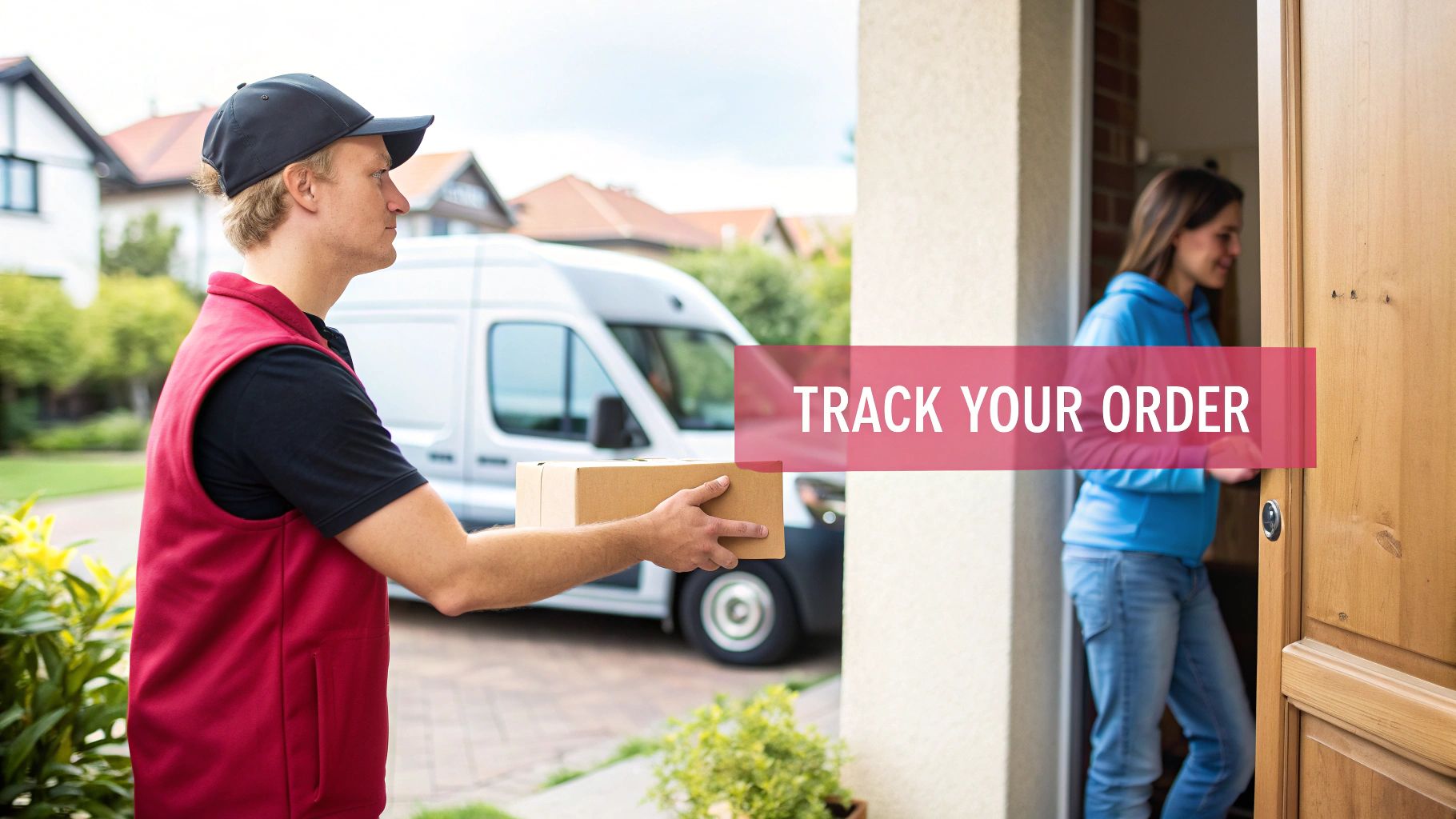
5. Order Status and Shipping SMS: The Trust-Building Touchpoint
Transactional SMS updates are a cornerstone of a modern customer experience, transforming post-purchase anxiety into anticipation and trust. These automated messages keep customers informed about their order’s journey, from the moment of confirmation to the final delivery. By proactively providing shipping updates, tracking links, and delivery notifications, brands can significantly reduce “Where is my order?” (WISMO) support inquiries and build lasting customer loyalty.
These text message examples are not about selling; they are about serving. They provide immediate value and reassurance, demonstrating a brand’s commitment to transparency and customer care. This proactive communication is a simple yet powerful way to enhance the overall purchase experience.
Example and Strategic Breakdown
Let’s break down a standard shipping confirmation text to understand its core components.
Example Text:
Great news, [CustomerName]! Your [StoreName] order #[OrderNumber] has shipped. Track its journey to you here: [TrackingLink]. Expected delivery: [Date].
Analysis of Key Elements
- Positive Framing: Starting with “Great news!” creates an immediate sense of excitement and positive association with your brand.
- Essential Information: Including the order number (
[OrderNumber]) helps the customer quickly identify the purchase, which is especially useful if they have multiple orders. - Direct Call-to-Action (CTA): The tracking link (
[TrackingLink]) is the most important element. It empowers the customer by giving them direct access to real-time information, reducing their need to contact support. - Managed Expectations: Providing an estimated delivery date (
[Date]) gives the customer a clear timeframe to anticipate their package, further enhancing their experience.
Actionable Takeaways for Your Strategy
- Automate at Key Milestones: Trigger messages automatically for “Order Confirmed,” “Order Shipped,” “Out for Delivery,” and “Delivered” to cover the entire journey.
- Provide a Clear Tracking Link: Don’t just say it shipped; give customers the tool to watch its progress. This single element builds immense trust and reduces support tickets.
- Keep it Concise: Transactional messages should be purely informational. Avoid including promotional content, as this can dilute the message’s primary purpose and feel intrusive.
Implementing a solid post-purchase communication plan is critical for retention. Mastering these notifications is a key part of developing strong eCommerce shipping best practices that turn one-time buyers into repeat customers.
6. Customer Service and Support SMS: The Convenience Channel
Customer service via SMS transforms support from a waiting game into an instant, conversational experience. Instead of forcing customers to endure long hold times on the phone or wait hours for an email response, text-based support allows them to get help on their own terms. This approach leverages the immediacy and accessibility of texting to resolve issues, answer questions, and provide assistance directly, fostering a more positive and efficient customer relationship.
This method is particularly effective for straightforward inquiries, status updates, and initial troubleshooting steps. For businesses, it offers a scalable way to manage support tickets, allowing agents to handle multiple conversations simultaneously without sacrificing quality. These interactive text message examples show how support can be both personal and highly efficient.
Example and Strategic Breakdown
Let’s analyze a common support interaction text message to understand its effectiveness.
Example Text:
Hi [CustomerName], this is [AgentName] from [Company]. We received your request about your recent order #[OrderNumber]. I can help with that. Are you asking about the shipping status or a return?
Analysis of Key Elements
- Immediate Personalization: The message starts with both the customer’s and the agent’s names (
[CustomerName],[AgentName]), creating a direct, human-to-human connection from the outset. - Contextual Acknowledgment: Referencing the specific order number (
#[OrderNumber]) confirms that the agent has the customer’s information ready, which builds confidence and shows competence. - Proactive Guidance: Instead of a generic “How can I help?”, the agent provides two likely options (“shipping status or a return?”). This simplifies the process for the customer and speeds up the resolution time.
- Conversational Tone: The language is professional yet friendly and conversational, making the interaction feel less like a formal support ticket and more like a helpful chat.
Actionable Takeaways for Your Strategy
- Set Clear Expectations: Use an auto-response to acknowledge the customer’s message immediately and provide an estimated response time (e.g., “We’ll be with you within 15 minutes.”).
- Use Templates for Speed: Create pre-written templates for common questions (FAQs, order status, return policy) to ensure quick, consistent, and accurate responses.
- Establish an Escalation Path: Have a clear protocol for when an issue is too complex for SMS and needs to be escalated to a phone call or email, ensuring a seamless transition for the customer.
Integrating SMS into your support workflow is a powerful way to enhance customer satisfaction. For a deeper look into how to transform your customer communication with automation, consider how these principles can be applied across your entire messaging strategy.
7. Survey and Feedback SMS: The Voice of the Customer
Survey and feedback text messages are your direct line to understanding the customer experience. Sent after a key interaction, such as a purchase or customer service call, these texts invite customers to share their opinions. They are invaluable for gathering real-time data on product satisfaction, service quality, and overall brand perception, turning customer sentiment into actionable business intelligence.
By making it incredibly easy for a customer to respond, SMS feedback requests achieve much higher engagement rates than email. This quick, low-friction channel allows you to capture insights at the peak of relevance, right after the experience has occurred. These text message examples show how to effectively solicit this crucial feedback.
Example and Strategic Breakdown
Let’s break down an effective post-purchase feedback request to understand its strategic components.
Example Text:
Hi [CustomerName], thanks for your recent order from [StoreName]! On a scale of 1-10, how likely are you to recommend us to a friend? Just reply with a number.
Analysis of Key Elements
- Personalization: Addressing the customer by name (
[CustomerName]) and referencing their recent order makes the request feel relevant and personal, increasing the likelihood of a response. - Direct Question (NPS): The message jumps straight into a Net Promoter Score (NPS) question. This is a universally understood metric that is extremely easy for a customer to answer with a single number.
- Frictionless Response: The instruction “Just reply with a number” removes all barriers. The customer doesn’t need to click a link or fill out a form; they can engage directly within their messaging app.
- Clear Context: Mentioning the store name (
[StoreName]) immediately reminds the customer who is contacting them and why, preventing confusion.
Actionable Takeaways for Your Strategy
- Time it Perfectly: Send feedback requests shortly after the customer receives their product or concludes a service interaction. This ensures the experience is fresh in their mind.
- Keep it Simple: Start with one simple, high-impact question. You can always follow up with a link to a longer survey for those who respond positively.
- Act on the Data: Don’t just collect feedback; use it. Follow up immediately with customers who provide low scores to resolve their issues, and analyze high-level trends to improve your business.
A well-structured feedback loop is a cornerstone of customer retention. Integrating these texts into a complete customer feedback management system can help you systematically listen, analyze, and act on the voice of your customer to drive long-term loyalty and growth.
7 Types of SMS Messages Compared
| SMS Type | Implementation Complexity 🔄 | Resource Requirements ⚡ | Expected Outcomes 📊 | Ideal Use Cases 💡 | Key Advantages ⭐ |
|---|---|---|---|---|---|
| Marketing/Promotional SMS | Moderate – requires opt-in, timing | Low – basic SMS platform, content team | Increased sales, brand awareness, engagement | Retail promotions, events, flash sales | High open rates (98%), cost-effective |
| Two-Factor Authentication SMS | Low – automated code generation | Low – integration with auth system | Enhanced security, reduced fraud | Login verification, account recovery | Easy implementation, industry standard |
| Appointment Reminder SMS | Moderate – integration with scheduling | Moderate – calendar/scheduling systems | Reduced no-shows, improved scheduling | Medical, salons, legal, auto services | Saves staff time, cost-effective |
| Emergency Alert SMS | High – priority delivery, broadcasting | High – emergency infrastructure | Rapid mass notification, life-saving info | Public safety, weather, AMBER alerts | Reaches large audiences quickly |
| Order Status and Shipping SMS | Moderate – integration with logistics | Moderate – logistics & tracking systems | Improved customer satisfaction, trust | E-commerce, delivery tracking, order updates | Reduces service inquiries, builds trust |
| Customer Service and Support SMS | High – two-way convo, CRM integration | High – trained agents, CRM platforms | Faster issue resolution, customer convenience | Banking, telecom, insurance support | Lower operational costs, multitasking |
| Survey and Feedback SMS | Low – simple survey setup | Low – survey tools, incentives | Quick feedback, data for improvement | Post-purchase, event feedback, service quality | High response rates, cost-effective |
From Examples to Execution: Activating Your SMS Strategy
We have journeyed through a comprehensive collection of text message examples, spanning everything from urgent abandoned cart reminders to relationship-building customer feedback requests. These templates are far more than simple scripts; they are strategic blueprints designed to engage, convert, and retain customers in the most direct and personal digital channel available today.
The true power of these examples isn’t in a copy-and-paste approach. Instead, it lies in understanding the core principles behind their effectiveness. Each message, whether promotional, transactional, or supportive, is crafted with a specific goal, a clear call to action, and a tone that reflects a distinct brand identity. The most successful eCommerce businesses internalize these foundational strategies and adapt them to create authentic, high-impact communication that resonates with their unique audience.
Synthesizing Your SMS Blueprint
As you move from theory to practice, focus on three critical pillars that emerged from our analysis:
- Context is King: The timing and trigger for a message are just as important as the content. An abandoned cart text sent within the first hour is a helpful nudge; sent three days later, it might feel intrusive. Align your SMS sends with specific customer actions for maximum relevance and impact.
- Clarity Drives Action: Every message must have a singular, unambiguous goal. Whether you want a customer to complete a purchase, leave a review, or confirm an appointment, the path to that action must be frictionless. Use direct language and ensure any included link leads exactly where the customer expects.
- Personalization Breeds Loyalty: Moving beyond just using a customer’s first name is essential. Personalization means referencing their past purchases, acknowledging their loyalty, or tailoring offers based on their browsing history. This level of detail transforms a generic broadcast into a one-to-one conversation, fostering a much deeper brand connection.
Your Actionable Next Steps
Mastering SMS marketing is an iterative process of testing, learning, and refining. To begin implementing the strategies from the text message examples we’ve covered, prioritize these immediate actions:
- Audit Your Current Flows: Start with your highest-impact touchpoint, which for most eCommerce stores is abandoned cart recovery. Compare your existing messages against the examples provided. Are you creating urgency? Are you offering a clear incentive? Is the checkout link seamless?
- Segment and Personalize: Identify one or two key customer segments, such as first-time buyers or high-value VIPs. Craft a dedicated SMS campaign for each, using the templates in this article as a starting point. Measure the difference in engagement and conversion rates.
- Embrace Automation: Manually sending context-aware, personalized messages at scale is impossible. Implementing a robust SMS automation platform is not a luxury; it’s a necessity for executing a sophisticated strategy efficiently. This allows your system to handle the triggers and delivery, freeing you to focus on creative and strategic optimization.
By internalizing these strategic takeaways and taking decisive action, you can transform your SMS channel from a simple notification tool into a powerful engine for revenue growth and unparalleled customer engagement.
Ready to automate the powerful text message examples from this guide and turn them into a revenue-generating machine? CartBoss specializes in intelligent, automated SMS campaigns for eCommerce, from abandoned cart recovery with pre-filled checkouts to customer win-back flows. See how CartBoss can help you implement these proven strategies effortlessly and start converting more customers today.