


Customer touchpoints are every single interaction a person has with your brand, from the very first moment they hear about you to long after they’ve made a purchase. Think of them as the individual building blocks of the entire customer experience. Each one, whether it’s seeing a social media ad or unboxing a product, helps shape how they feel about your business. Getting these interactions right is everything.
What Are Customer Touchpoints and Why They Matter
Picture your customer’s path to purchase less like a straight line and more like a cross-country road trip. Every billboard they see (your ads), every friendly gas station attendant they meet (your customer support team), and every smooth stretch of highway (your website’s user experience) influences their trip. These are your touchpoints for customers, and each one is a chance to build trust and keep them moving forward.
But what happens when there’s a confusing road sign (a vague product description) or a sudden, bumpy detour (a clunky checkout process)? That’s friction. In a market this crowded, even one negative touchpoint can convince a customer to turn the car around, leaving you with an abandoned cart and a lost sale.
The Building Blocks of Experience
Each touchpoint adds up to create the customer’s overall perception of your brand. A string of positive, easy interactions doesn’t just lead to a single sale—it builds loyalty. It’s what turns a one-time buyer into a fan who comes back again and again. The real goal is to make their journey so great that they not only buy from you but also tell all their friends about the fantastic trip they had.
This is exactly why mapping out and improving these interactions is so important for building real, lasting relationships. By focusing on creating positive moments at every step, you can build effective customer retention strategies in e-commerce that keep paying off long after that first purchase.
A customer touchpoint is any moment a consumer interacts with your brand. These moments can be big or small, direct or indirect, but together they define the entire customer experience and ultimately determine whether a prospect converts into a loyal advocate.
Connecting Touchpoints to the Journey
No touchpoint exists on its own. They’re all connected, forming the larger customer journey. A potential buyer might see your ad on Instagram (touchpoint one), click over to a product page (touchpoint two), and then scroll through customer reviews (touchpoint three)—all before they even think about adding an item to their cart.
When you start mapping these connections, you get a powerful, real-world view of how customers actually experience your brand. This helps you spot the weak links, double down on what’s working, and strategically smooth out the entire path from discovery to purchase and beyond.
Mapping Your Customer Touchpoints From Start To Finish
Before you can really improve your customer’s journey, you have to see it through their eyes. The best way to do this is by creating a clear map of every single interaction they have with your brand, from the first glance to long after they’ve bought something.
Thinking about it this way, all those touch points for customers naturally fall into three critical stages.
This hierarchy diagram is a great way to visualize how the overall customer experience is built, one stage at a time.
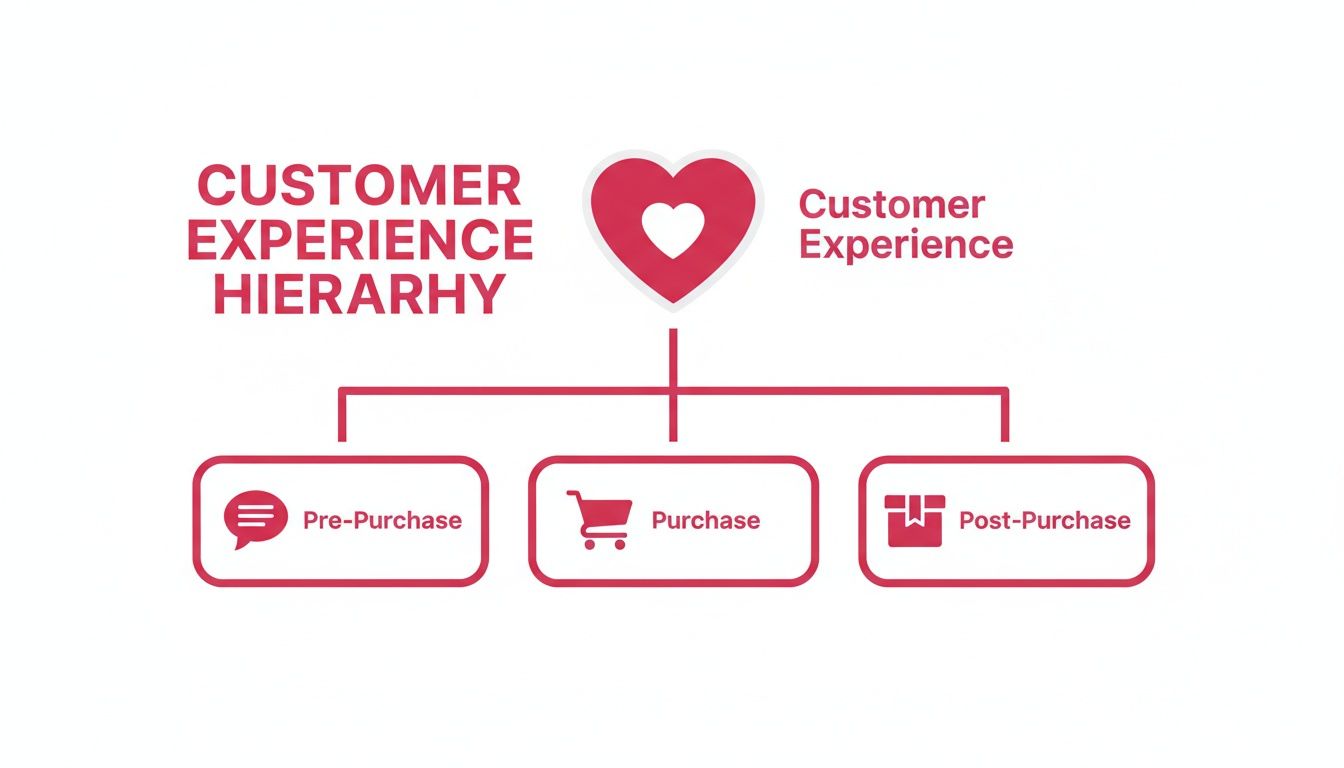
Breaking the journey down like this helps you organize your thoughts around the distinct phases of discovery, decision-making, and loyalty. By looking at them separately, you can zoom in and optimize each part of the experience much more effectively.
Let’s walk through some real-world examples you’ll find in almost any e-commerce store, organized by the three stages of the customer journey.
Customer Touchpoints Across The E-commerce Journey
This table breaks down common touchpoints you’ll encounter at each step.
| Pre-Purchase Stage | During Purchase Stage | Post-Purchase Stage |
|---|---|---|
| Social Media Posts | Website Homepage | Order Confirmation Email |
| Word-of-Mouth | Product Pages & Categories | Shipping Notification (SMS/Email) |
| Customer Reviews | Live Chat / Chatbots | “Thank You” Page |
| Blog Posts & SEO | The Shopping Cart | Product Delivery & Unboxing |
| Online Ads (PPC) | Checkout Process | Customer Support |
| Influencer Mentions | Cart Abandonment SMS (e.g. from CartBoss) | Follow-up Surveys & Review Requests |
| Community Forums | Promotional Pop-ups | Loyalty Programs |
Think of this table as a starting point. Your store will have its own unique set of interactions, but nearly all of them will fit into one of these three buckets.
The Pre-Purchase Stage
This is the “getting to know you” phase. It’s where a potential customer first discovers your brand and starts figuring out if you’re the right fit for what they need. Every interaction here is about building that initial spark of trust and showing your value, long before they’ve even thought about pulling out their wallet.
Think about these early moments:
- A targeted Facebook ad that catches their eye.
- Finding your blog through a Google search when looking for a solution.
- Reading what other people have to say about your products on a review site.
- Hearing about your brand from a friend who loves what you do.
These first impressions set the stage for everything that comes next. Get it right, and you’ve earned their attention.
The During-Purchase Stage
Once a visitor lands on your site ready to buy, a whole new set of interactions kicks in. This stage is all about making the path to purchase as smooth and painless as possible. Any friction here—a confusing product page, a clunky checkout—can send them running for the exit, leaving an abandoned cart behind.
Key touchpoints during the purchase include:
- Product pages with great photos, detailed descriptions, and clear pricing.
- A live chat window that offers a quick answer about shipping or sizing.
- The checkout process itself—every single step from entering their address to hitting “confirm.”
- A perfectly timed cart recovery SMS from a tool like CartBoss that nudges them to complete the order they started.
This is where the magic (and the sale) happens. Or doesn’t.
The Post-Purchase Stage
The journey isn’t over just because the payment went through. The post-purchase stage is where you turn a one-time buyer into a loyal fan who comes back again and again. These interactions are absolutely crucial for building long-term value and creating brand advocates.
Post-purchase touchpoints often involve:
- The order confirmation email that gives them immediate peace of mind.
- Shipping notifications that proactively tell them where their package is.
- A follow-up conversation with customer support about how to use the product.
Having a complete, 360-degree view of these stages is essential. Data shows that brands with strong omnichannel strategies—keeping the experience consistent across their website, SMS, and social media—retain an average of 89% of their customers.
Mapping these interactions out is your first step toward spotting weaknesses and finding opportunities. For a more hands-on approach, check out our customer journey mapping template guide and start visualizing your own process.
Visualizing the Customer Journey to Find Friction
Mapping out all your customer touchpoints is like putting on a new pair of glasses—suddenly, you can see your store exactly as your customers do. This isn’t about staring at spreadsheets; it’s about building empathy and walking a mile in their shoes, from the first “hello” to the final “thank you.”
This process, known as customer journey mapping, transforms abstract data into a clear, visual story of their experience. The main goal? To find the moments of friction—those little snags and frustrating roadblocks that cause confusion, doubt, and ultimately, lost sales.
Gathering Real-World Data
For your map to be worth anything, it has to be based on how real customers behave, not just how you think they behave. The key is to blend different data sources to get the full, unvarnished picture of their path.
Here are three practical ways to start pulling that data together:
- Dig into Website Analytics: Fire up tools like Google Analytics to see the literal paths people take through your site. Keep an eye out for pages with shockingly high exit rates or where visitors barely spend any time. These are red flags waving right at you.
- Run Customer Surveys: Sometimes, the easiest way to find friction is to just ask. Short, simple surveys right after a purchase—or even after they abandon a cart—can give you direct, honest feedback on what went right and what went wrong.
- Eavesdrop on Social Conversations: Pay attention to what people are saying about your brand on social media, in forums, and on review sites. These unfiltered comments are a goldmine for spotting common frustrations and even pleasant surprises you never knew existed.
From Data to a Powerful Map
Once you’ve collected this intel, you can start building your map. It’s important to remember that the average customer journey can involve anywhere from 20 to over 500 touchpoints, making every single interaction count.
For online stores battling cart abandonment rates that often creep up to 70%, understanding this entire path isn’t just a good idea—it’s essential for survival.
A customer journey map isn’t just a flowchart; it’s an empathy-building tool. It helps you pinpoint exactly where a confusing shipping policy or a slow-loading page is costing you sales, creating a clear business case for targeted improvements.
The map makes it painfully obvious where pain points are killing your revenue. For example, you might discover that a huge chunk of your mobile users bail at the payment screen. That’s not just a technical glitch; it’s a critical moment of friction that’s bleeding you dry and needs an immediate fix.
By visualizing their journey, you stop guessing and start making smart, data-driven decisions that genuinely improve their experience. To get even deeper into this, you should learn more about what is customer journey analytics and how it can help you refine your map.
Optimizing Key Touchpoints to Recover Lost Sales
Once you have a clear map of your customer journey, you can stop just observing and start taking action. It’s time to zero in on the specific touch points for customers that directly fatten your wallet. While a lot of interactions matter, one particular point of friction costs e-commerce stores more than any other: the abandoned cart.
This one negative touchpoint represents a customer who was literally ready to buy but hit some kind of roadblock. The good news? It’s also your single biggest opportunity for recovery. If you handle this moment the right way, you can flip a lost sale into a completed order.
Transforming Abandonment into Opportunity
Picture this: a customer finds products they love, adds them to their cart, and heads to checkout. Then, life happens. They get distracted, the shipping cost gives them pause, or they just get frustrated and leave. Traditionally, that revenue is gone for good. But modern tools can turn this negative experience into a positive, money-making one.
This is exactly where a solution like CartBoss comes into play. Instead of just letting that sale evaporate, it automatically sends a perfectly timed SMS reminder to the customer. This message isn’t some generic alert; it’s a carefully designed touchpoint built to smash through friction.
By including a pre-filled checkout link, you teleport the customer right back to their abandoned cart with all their info saved. This simple, smooth action eliminates the hassle of starting all over and makes finishing the purchase ridiculously easy.
By optimizing the abandoned cart touchpoint, you aren’t just fixing a problem—you are actively creating a new, positive interaction that directly recovers otherwise lost revenue. This turns your biggest point of friction into a powerful conversion tool.
The Power of a Well-Timed Nudge
Today’s buyers bounce between an average of 10 different channels on their path to purchase, and a whopping 79% of them expect the experience to feel consistent everywhere they go. When things feel disconnected, they get frustrated and leave. An SMS, with its nearly instant 99% open rate, slices through the digital noise way more effectively than a crowded email inbox ever could.
This immediate, personal touchpoint re-engages shoppers at the precise moment their buying intent is still hot. It’s an incredibly powerful way to bring them back and lock in the sale. You can learn more about how abandoned cart recovery text messages optimize the checkout experience.
Beyond Cart Recovery: Other High-Impact Optimizations
While tackling cart abandonment is priority number one, other touchpoints also offer huge opportunities for improvement. Fixing these spots helps create a smoother path to checkout right from the start.
Most stores face similar friction points that hurt conversions. The traditional way of dealing with them often involves complex, manual work or just hoping the customer figures it out. But a more optimized approach can make all the difference, especially when you can automate the solution.
High-Impact Touchpoint Optimization Strategies
| Friction Point (Touchpoint) | Traditional Approach | Optimized Solution (with CartBoss) |
|---|---|---|
| Complex Mobile Checkout | A long, multi-page form that’s hard to use on a small screen. | A clean, single-page checkout. If abandoned, an SMS with a direct, pre-filled link makes completion effortless. |
| Unclear Product Info | Vague descriptions that leave customers with unanswered questions. | Detailed product pages with clear images. Post-purchase, an SMS can confirm order details and build trust. |
| Confusing Calls-to-Action | Buttons with passive text like “Learn More” or “View Details.” | Strong, action-oriented CTAs like “Buy Now.” An SMS can reinforce this urgency with a time-sensitive offer. |
| Unexpected Shipping Costs | Surprising the customer with high shipping fees at the very end. | Being upfront about shipping costs. If abandonment occurs, an SMS can offer a free shipping code to seal the deal. |
By systematically identifying and refining these critical interactions, you create a frictionless experience that doesn’t just boost conversions—it builds lasting customer trust and loyalty.
Measuring the Impact of Your Touchpoint Strategy
Fixing up your touch points for customers is only half the battle. You’ve got to know if your changes are actually making a difference. This means looking past simple traffic numbers and focusing on the metrics that really tell the story of your customer experience and, most importantly, your profitability.
Think of it like driving a car. You wouldn’t just pay attention to the fact that you’re moving. You’d check your speed, fuel level, and engine lights. These metrics help you make smart decisions to keep the journey smooth. Without tracking the right data, you’re basically driving blind.
Key Metrics That Tell a Story
Certain numbers give you a direct window into how your touchpoint strategy is performing. Each one answers a critical question about your customer’s journey and where you might be leaving money on the table.
- Conversion Rate: This is your most direct measure of success. It asks, “Are my changes making it easier for people to buy?” If this number is climbing, it’s a good sign you’re removing friction from key spots like your product pages or checkout.
- Cart Abandonment Rate: This metric practically screams, “We have a problem here!” A high abandonment rate is a massive red flag that a touchpoint in your checkout process is broken. It could be anything from unexpected shipping costs to a confusing form or not enough payment options.
- Customer Lifetime Value (CLV): This one is all about the big picture. It asks, “Are my post-purchase touchpoints encouraging repeat business?” When your CLV is growing, it means your confirmation emails, support chats, and loyalty programs are doing their job and building real, long-term relationships.
Using Analytics to Make Informed Decisions
To actually keep an eye on these metrics, you need tools that deliver clear, actionable analytics. This is where a solution with built-in reporting, like CartBoss, becomes a game-changer. The dashboard gives you all the details on your SMS cart recovery campaigns, showing you exactly how many carts were recovered, the revenue you generated, and your overall return on investment.
By analyzing specific touchpoint data, you move from guessing what customers want to knowing what they need. A tool like CartBoss doesn’t just recover sales; it provides the insights required to continuously refine your entire customer journey for maximum profitability.
This data-first approach lets you make smart tweaks on the fly. For instance, if one SMS template is crushing it while another is falling flat, you can double down on what works. Getting a handle on these numbers is crucial, and you can learn more about how to calculate marketing ROI to sharpen your performance analysis.
Time to Put This All Into Action
Alright, we’ve covered a lot. You now know how to spot, map out, and measure all those crucial customer touchpoints that make or break the entire experience. But knowledge is one thing; turning it into action is what really counts.
Getting started doesn’t have to be some massive, complex project. It’s actually pretty straightforward:
- Define Your Touchpoints: First, just list out every single way a customer interacts with your brand. Think from the very first ad they see all the way to your post-purchase emails.
- Map the Journey: Get visual. Lay out those touchpoints to see the path your customers actually take. This is where you’ll spot the bumps in the road.
- Optimize High-Impact Moments: Don’t try to fix everything at once. You’ll just get bogged down. Go straight for the biggest leaks in your revenue bucket—for most stores, that’s the abandoned cart.
- Measure and Refine: Use your data to see what’s working. Keep an eye on the numbers and make small, continuous improvements.
Start with Your Biggest Win
Feeling overwhelmed by all the possibilities? Don’t be. The smartest move is to focus on the one touchpoint that can deliver the biggest financial win, right now: cart abandonment.
This is exactly where a tool like CartBoss shines. It gives you an immediate, measurable return by automatically sending SMS reminders to shoppers who bailed. What was once a major point of friction—and a huge revenue loss—becomes a smooth, automated recovery process. It turns lost sales into profit while you sleep.
While you’re at it, think about other friction points. For instance, if you have complex shipping rules, a clear explanation can prevent a negative experience. Creating some effective customer service scripts for explaining shipping restrictions can be a simple but powerful fix.
Look, there’s no “perfect” time to start. The best time is today. Go after your abandoned carts first. By using smart automation, you’ll build momentum, use the recovered cash to fund other improvements, and start building the kind of customer experience that creates fans for life.
Frequently Asked Questions
Got a few last questions kicking around about customer touchpoints? Let’s clear them up with some straight-to-the-point answers to help you get started.
What Is the Most Important Customer Touchpoint?
This is a tricky one. While every interaction adds up, you could argue the product page and checkout are the most critical—that’s where the money changes hands, after all.
But if we’re talking about the single biggest opportunity for most stores, it’s the abandoned cart. A shopper who bails at the last second has already told you exactly what they want. They were this close. Nudging them with a timely SMS reminder using a tool like CartBoss is often the highest-leverage move you can make, turning a lost sale into pure profit.
How Many Touchpoints Should I Optimize First?
Don’t try to boil the ocean. It’s a classic mistake. Pull out your journey map and find the 2-3 biggest leaks in your sales funnel. Where are you losing the most people? For almost every e-commerce store, the usual suspects are a clunky mobile checkout and, you guessed it, cart abandonment.
Start there. By focusing your energy on these high-impact problems—like setting up an automated SMS cart recovery system—you can get some big wins on the board fast. That success builds momentum and, more importantly, generates cash you can reinvest into fixing the next problem.
Can Digital Touchpoints Feel Personal?
Absolutely. In fact, they have to. These days, a thoughtful digital interaction is how you build a real connection with customers. When done right, it can feel just as personal—if not more so—than a face-to-face retail experience.
Think about it: a responsive live chat can solve a problem faster than hunting down a sales assistant in a massive store. A friendly, automated SMS order confirmation that hits your phone instantly provides a level of reassurance you just don’t get otherwise. These are the small, digital moments that build the trust you need to turn a one-time shopper into a repeat customer for life.
Ready to fix your most profitable touchpoint? CartBoss turns abandoned carts into sales with automated SMS reminders that customers actually appreciate. Start recovering lost revenue on autopilot today.