



At its core, two-way SMS messaging is exactly what it sounds like: a text message conversation between your business and a customer. It’s about moving beyond those one-way promotional blasts you’re used to seeing.
Think of it this way: one-way SMS is a megaphone. You shout out your message, but you can’t hear anything back. Two-way SMS turns that megaphone into a walkie-talkie, opening up a real conversation right inside your customer’s native messaging app.
What Is Two Way SMS Messaging?
Traditional one-way SMS is a monologue. A business sends a marketing alert, an appointment reminder, or a shipping notification, and that’s it. The communication is over. While it’s great for broadcasting information, it leaves customers hanging if they have a simple follow-up question. This one-sided approach feels a lot like a “do not reply” email—it gets the job done, but it’s impersonal and can be pretty frustrating.
Two-way SMS messaging completely flips that model on its head. It creates a direct, interactive channel where customers can reply to your messages or even start conversations on their own. This simple change from a monologue to a dialogue transforms a static notification into a powerful tool for customer service and sales. Instead of just announcing a sale, you can answer product questions. Instead of just sending an order confirmation, you can handle a last-minute address change right then and there.
The Shift from Announcement to Conversation
The real magic of this conversational approach is that it meets customers where they are. People today expect instant answers and convenient communication, and they’d much rather use the channels they’re already on every day.
Recent consumer surveys show this loud and clear: over 80% of consumers would rather text with a business than deal with phone calls or emails for simple interactions. It’s no surprise that nearly half of all businesses now see SMS as their most effective channel for engaging with customers.
This shift is happening for a few simple reasons:
- Immediacy: Text messages have an insane open rate of 98%, and most are read within three minutes. This guarantees your message is seen and makes a rapid back-and-forth conversation possible.
- Convenience: Your customers don’t need to download another app, log into a portal, or wait on hold. They can just text you from the same app they use to talk to friends and family.
- Personalization: It allows you to have tailored, one-on-one conversations that solve specific customer problems, whether it’s answering a question about a product or resolving a support ticket.
Why It Matters for E-commerce
For e-commerce brands, two-way SMS is a game-changer. It closes the distance between you and your buyers, creating genuine opportunities to build relationships and recover lost revenue at the most critical moments.
You can jump in to help when a customer abandons their cart, provide shipping updates in real-time, and get instant feedback right after a purchase. Each text is a chance to provide real value. That’s why it’s so important to get the details right, like understanding the standard SMS character limit, to make every message count.
By fostering a real dialogue, you stop being just another online store. You become a responsive, accessible brand that customers actually trust and want to buy from again. This conversational approach is the new standard for building real, lasting customer loyalty.
How Two-Way SMS Actually Works
So, how does a text message from a customer find its way to your support team and back again? It’s tempting to get lost in the technical jargon, but it helps to think of it like a lightning-fast digital mailroom. It all involves specific addresses (phone numbers), keywords that act like subject lines, and a sorting system that works in milliseconds.
Let’s break down the journey of a text message, from the customer’s phone to your business and back, without getting bogged down.
This whole process is a huge leap from the old days of simple, one-way message blasts. We’ve moved from a monologue to a genuine conversation.
This infographic shows the shift perfectly—from one-way SMS broadcasts (like a megaphone) to interactive two-way conversations (more like a walkie-talkie).
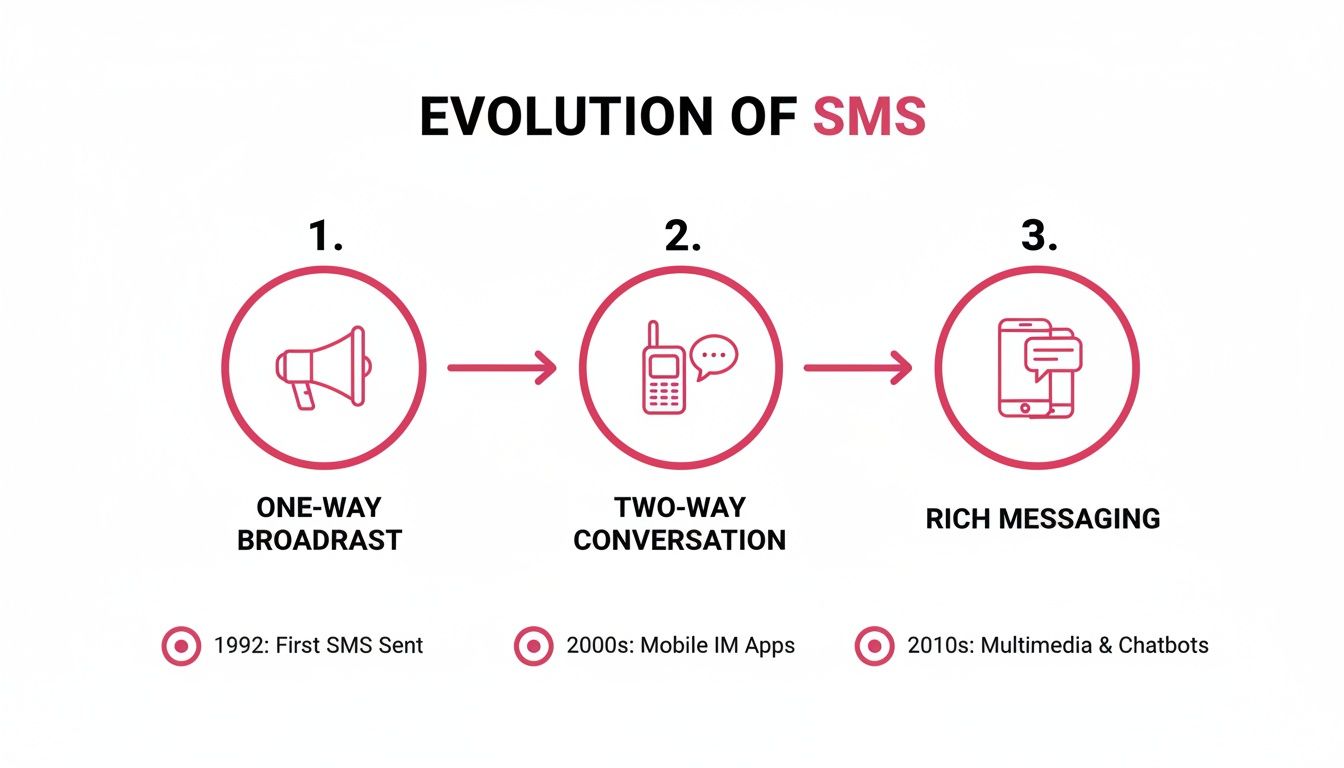
As you can see, modern SMS isn’t just about shouting into the void; it’s about creating a communication loop where you can listen and respond.
The Key Players: Phone Numbers and Keywords
Before any messages can fly back and forth, your business needs a phone number that’s built for these conversations. This isn’t your personal mobile number. Business texting relies on special numbers designed for high-volume communication.
You’ll mainly run into two types:
- Short Codes: These are the memorable 5 or 6-digit numbers you see from big brands (e.g., text “DEALS” to 25252). They’re fantastic for mass marketing campaigns.
- 10-Digit Long Codes (10DLC): These look just like regular phone numbers and are quickly becoming the standard for business-to-consumer texting. They feel more personal, which is perfect for support chats and sales conversations.
Next up are keywords. Think of these as the automated receptionists of your SMS system. They are specific words or phrases that trigger an action. When a customer texts “SUPPORT,” “STATUS,” or “RETURN” to your number, your SMS platform instantly recognizes it and kicks off the right workflow.
The Message Journey: From Customer to Agent
So, what really happens when a customer sends a text? It’s a seamless relay race connecting different technologies to create one smooth conversation.
- The Customer Kicks It Off: It all starts with the customer. They text a keyword, like “QUESTION,” to your company’s 10DLC number.
- The SMS Gateway Catches It: Their message doesn’t go straight to an agent’s phone. First, it hits an SMS Gateway—the bridge between mobile carrier networks and the internet. This gateway translates the mobile message into a format that software can understand.
- The Platform Takes Over: The gateway then forwards the message to your two-way SMS platform (like CartBoss). This software is the brains of the operation. It reads the message, spots the keyword “QUESTION,” and triggers a pre-set automated response.
- Automation Responds Instantly: An automated reply is sent back immediately, something like, “Thanks for reaching out! What can we help you with today?” This lets the customer know their message was received and keeps them engaged.
- The Human Handover: If the customer’s next question is too complex for automation (e.g., “Do you have this shirt in blue in a size medium?”), the platform routes the entire conversation history to a live agent’s dashboard.
- The Conversation Continues: The agent sees the full context and can reply directly from their computer. Their message travels back through the platform and gateway to the customer’s phone, continuing the conversation without a hitch.
At its core, the technology is built to intelligently sort, automate, and escalate. The goal is to let automation handle the routine stuff while ensuring complex issues are seamlessly handed off to a human. This creates an experience that’s both efficient for you and satisfying for the customer.
For developers and businesses wanting to build their own custom integrations, understanding this technical backbone is key. You can dive deeper into how to set up the foundational pieces by exploring guides on using an API to send SMS messages. This behind-the-scenes knowledge helps you appreciate how platforms manage these intricate workflows to deliver a simple, powerful communication channel.
E-commerce Strategies That Drive Sales and Loyalty
Knowing how two-way SMS works is one thing, but seeing it drive real-world results is another story entirely. For e-commerce brands, this conversational approach is a game-changer for turning casual browsers into buyers and one-time customers into raving fans. It’s all about creating helpful, timely interactions at the moments that matter most in the customer’s journey.
Let’s break down the most effective strategies that use interactive texting to boost revenue and build relationships that last.
Rescue Abandoned Carts with Real Conversations
Cart abandonment is the silent killer of e-commerce profits. While automated one-way reminders are a good start, they often feel generic and completely miss why the shopper hesitated. Was it a question about sizing? Confusion over shipping costs? Or maybe a discount code that just wouldn’t work?
This is where two-way SMS messaging shines. Instead of just blasting a link, you send a message that actually invites a reply.
Here’s an example:
“Hey [Customer Name]! We noticed you left some great items in your cart. Was there anything we could help with before you check out? Just reply to this text!”
This simple invitation to chat transforms a dead-end notification into a genuine opportunity. When a customer replies with, “Does this run true to size?” or “How long does shipping take?”, a real person can jump in, provide a quick answer, and guide them back to their cart. That personal touch is often all it takes to clear up confusion and lock in the sale.
Elevate Customer Support Beyond the Inbox
Today’s customers expect answers now, and waiting hours for an email response is a guaranteed way to create friction. Two-way SMS opens up a direct, real-time support channel that feels as easy as texting a friend. It’s perfect for handling common questions that don’t need a full-blown phone call.
Think about these common scenarios, all handled entirely via text:
- Order Status Checks: A customer texts “STATUS” and their order number. Seconds later, an automated reply delivers the latest tracking info. Simple and instant.
- Easy Returns or Exchanges: A shopper can text “RETURN” to kick off the process, get a link to your returns portal, and have their questions answered without ever leaving their messaging app.
- Quick Product Questions: Customers can send pre-purchase questions on the fly, helping them make confident buying decisions right then and there.
By offering support through text, you lighten the load on your email and phone queues while giving customers a far more convenient experience.
Build Relationships with Proactive Order Updates
The post-purchase window is a golden opportunity to build trust and earn repeat business. While one-way shipping notifications are standard, two-way updates create a much more engaging experience.
Instead of a robotic “Your order has shipped,” you can add a human touch.
Consider this script:
“Great news, [Customer Name]! Your order is on its way. We’re so excited for you to get it! Let us know if you have any questions once it arrives. Reply STOP to opt out.”
This friendly approach does more than just inform; it reinforces that they made a good purchase and opens the door for future interaction. When the package arrives, a follow-up text can ask for feedback or a review, gathering valuable insights while the experience is still fresh. This kind of proactive communication makes customers feel valued, not just like another order number. One of the biggest wins with two-way SMS is its power to directly increase customer engagement, building stronger brand loyalty.
These strategies represent a fundamental shift in how e-commerce stores communicate—moving from broadcasting to conversing. Platforms like CartBoss are built to automate and optimize these interactions, turning abandoned carts into recovered sales and routine notifications into moments that build real relationships. For a deeper dive into building out your entire SMS strategy, check out our ultimate SMS marketing playbook for e-commerce success. By embracing two-way SMS messaging, you create a more human, responsive, and ultimately more profitable brand.
Navigating SMS Compliance and Building Trust
Any good two-way SMS strategy is built on one thing: trust. Customers will only chat with you if they feel their privacy is being respected and that you value their permission. That’s where compliance comes in. Think of it less as a hurdle and more as a powerful tool for building strong, lasting relationships.
You don’t need a law degree to navigate the rules of business texting. Regulations like the Telephone Consumer Protection Act (TCPA) in the US or the General Data Protection Regulation (GDPR) in Europe all boil down to a simple idea: communication should be wanted and respectful. If you think of compliance as just good manners, it becomes a lot easier to handle.
The Golden Rule: Explicit Consent
The absolute cornerstone of SMS compliance is explicit opt-in. This is non-negotiable. You can’t just start texting a customer because they handed over their phone number at checkout. They have to clearly and knowingly agree to get marketing or conversational messages from you via SMS.
Think of it like being invited into someone’s home. You wouldn’t just walk in because the door was unlocked; you’d wait for a clear invitation. The same goes for a customer’s inbox.
So, what does a proper invitation—explicit consent—look like?
- A Clear Checkbox: During checkout, a customer has to actively check a box that says something like, “Yes, I want to receive order updates and exclusive offers via text message.” Crucially, this box must be unchecked by default.
- A Keyword Opt-In: A customer texts a specific word like “JOIN” or “DEALS” to your number to subscribe.
- A Web Form: A visitor types their phone number into a form on your site that is specifically for SMS sign-ups.
Here’s the key part: consent has to be specific to the type of messages you’re sending. Getting permission to send shipping notifications doesn’t automatically give you the green light to blast them with promotional texts. Be transparent about what they’re signing up for.
Providing a Clear Exit and Respecting Boundaries
Getting consent is half the battle; the other half is honoring a customer’s wish to end the conversation. Every SMS program must offer a simple, instant way for users to opt out. The industry standard is allowing customers to reply with keywords like “STOP,” “END,” “CANCEL,” “UNSUBSCRIBE,” or “QUIT.”
Your system needs to recognize these keywords and automatically pull that user from all future non-essential messages. This isn’t just a nice thing to do—it’s a legal requirement. A smooth opt-out process shows you respect your customer’s choices and reinforces that they are in control.
On top of that, respecting “quiet hours” is essential. Sending a promo text at 3 a.m. is a fantastic way to annoy a customer and get a complaint. Most platforms, including CartBoss, have “Do Not Disturb” features baked in. These prevent messages from sending during late-night or early-morning hours, usually between 9 p.m. and 8 a.m. in the recipient’s local time zone.
Getting these compliance basics right is the first step. To ensure you’re fully covered, it helps to follow a clear checklist before you send your first message.
SMS Compliance Checklist: Key Actions for Your Business
| Compliance Area | Action Required | Why It Matters |
|---|---|---|
| Get Explicit Consent | Use unchecked checkboxes, keyword opt-ins, or dedicated web forms. Clearly state what users are subscribing to. | This is the foundation of legal SMS marketing. It builds trust by ensuring customers want to hear from you. |
| Confirm Opt-In | Send an initial confirmation text after a user subscribes. (e.g., “You’re signed up for offers! Reply STOP to cancel.”) | This creates a clear record of consent and reminds the user they subscribed, reducing spam complaints. |
| Provide Clear Opt-Out | Ensure your system recognizes standard keywords (STOP, UNSUBSCRIBE, etc.) and immediately honors the request. | It’s legally required and shows respect for customer preferences, maintaining a positive brand image. |
| Identify Your Brand | Clearly state your brand name in the first message of any new conversation or automated flow. | Customers need to know who is texting them. This avoids confusion and feels more professional. |
| Respect Quiet Hours | Configure your sending platform to avoid sending messages late at night or early in the morning (e.g., 9 PM to 8 AM). | Sending texts at inappropriate times is intrusive and a quick way to get an unsubscribe or complaint. |
| Maintain Records | Keep a secure record of when and how each contact gave you their consent to be contacted via SMS. | These records are your proof of compliance if you ever face a legal challenge or audit. |
By making compliance a core part of your strategy, you’re not just following the rules—you’re showing customers that you value their trust. This turns regulations from a chore into a real competitive advantage.
For a deeper dive into the specific requirements, our comprehensive guide offers more details on essential SMS marketing compliance.
How to Get Your Two-Way SMS Strategy Up and Running
Alright, let’s move from theory to reality. Getting a conversational SMS strategy live is actually more straightforward than most people think. The secret is picking the right tools from the get-go and setting up clear, automated workflows. This roadmap will walk you through building a system that doesn’t just work, but also grows with your business.
First things first: you need a platform built for e-commerce. Don’t fall for generic business texting tools; they usually lack the specific integrations you need to actually drive sales. A platform like CartBoss, for example, plugs directly into your Shopify or WooCommerce store, unlocking powerful automation that’s tied directly to how your customers behave.
Choose a Platform with the Right Features
When you’re shopping around for a platform, think of it as the central hub for all your conversational marketing. Basic sending and receiving just won’t cut it. You need a strategic tool that makes you more efficient and, most importantly, makes you more money.
Make sure your choice ticks these boxes:
- Deep E-commerce Integration: Your platform absolutely must sync with your store to grab crucial data like what’s in a customer’s cart, their name, and their order history. This is the bedrock of any real personalization.
- Robust Automation Engine: Look for the power to create simple “if-then” workflows. For instance, if a customer abandons their cart, then a specific SMS sequence kicks off automatically.
- Agent Handover Workflow: Automation is a lifesaver, but some questions just need a human touch. The platform should make it dead simple for a live agent to jump into a conversation, see the entire chat history, and take over seamlessly.
- Detailed Analytics: You can’t improve what you don’t measure. You need to track the important stuff: response rates, conversion rates from your SMS chats, and how quickly your agents are solving problems.
Putting money into a solid platform is a smart move. Conversational SMS is quickly becoming a huge channel for commerce, with the U.S. SMS market alone expected to hit $12.6 billion by 2025.
Segment Your Audience for Personalization
Once you’ve got your platform set up, fight the urge to send the same generic message to everyone. Great two way SMS messaging is all about personalization, and that starts with smart audience segmentation. Grouping your subscribers lets you send super-relevant messages that feel like a one-on-one chat.
Think about creating segments based on things like:
- Purchase History: Send exclusive loyalty offers to your repeat customers, or try to win back past buyers who haven’t shopped in a while.
- Shopping Behavior: Create a special segment for people who abandon high-value carts and write recovery messages just for them.
- Geographic Location: Run promotions tied to local events or offer special shipping deals for customers in certain areas.
This kind of targeted approach makes sure your messages are seen as helpful, not spammy, which sends your engagement through the roof.
The whole point is to make every single customer feel like they’re your only customer. Segmentation is how you get there. It’s the difference between shouting into a crowd and having a meaningful conversation that builds relationships and drives sales.
Set Up Automated Keyword Responses
Keywords are the engine of an efficient two-way SMS system. They work like instant triggers, giving customers immediate answers to common questions and freeing up your team’s valuable time. This simple automation means your brand is helpful and responsive 24/7.
Start by thinking about the most common questions you get. Here are a few essential keywords to set up:
- STATUS: This triggers an automatic lookup of the customer’s most recent order and instantly texts them back a tracking link.
- RETURN: Responds with a link to your returns policy and portal, getting the process started right away.
- HELP: Can provide answers to frequently asked questions or route the conversation directly to a live support agent.
These automated replies handle the majority of routine questions, letting your support team focus on the trickier issues that really do need a human. For more ideas, our guide on setting up an auto SMS responder has plenty of other strategies for smart automation. This layered approach—blending smart automation with a smooth handover to a human when needed—is the key to a scalable and successful strategy.
Measuring What Matters for SMS Success
Sending a text is the easy part. Knowing what that text actually did for your business? That’s what separates a good SMS program from a great one. If you aren’t measuring your conversational marketing, you’re just guessing—and you can’t improve what you don’t measure.
To really understand how your two-way SMS messaging is performing, you need to look past surface-level stats like delivery rates and dig into the KPIs that show real customer engagement.
Think of it this way: a high delivery rate just means the mail reached the mailbox. A high response rate means someone actually opened the door and started a chat. That’s the conversation that really matters.
Moving Beyond Simple Delivery Metrics
Knowing your messages landed in someone’s inbox is a fine start, but it’s only the first step. The real magic is in what happens next. Conversational metrics show you just how good your team is at turning simple texts into sales and happy customers.
Here are the essential KPIs you need to be tracking:
- Response Rate: This is the percentage of customers who actually reply to one of your messages. A high response rate tells you that your texts are relevant, well-timed, and interesting enough to get someone to tap “reply.”
- Resolution Time: How long does it take for your team to solve a customer’s problem via text? A shorter time means you have an efficient team and happier customers who aren’t left waiting.
- Conversation-to-Conversion Rate: This is the big one for any e-commerce store. It tracks the percentage of SMS chats that lead directly to a purchase. This number tells you exactly how much revenue your texts are driving.
By focusing on these conversational KPIs, you stop broadcasting and start measuring the quality of your customer dialogues. It gives you a crystal-clear picture of what’s working and where you need to make some tweaks.
How to Optimize Your SMS Performance
Tracking these numbers is step one. Step two is using that data to get even better. Optimization isn’t a one-and-done task; it’s a continuous cycle of testing, learning, and tweaking your strategy over time.
A great place to start is A/B testing your messages. For example, send out two different cart recovery texts—maybe one with a friendly question and another with a small discount code. See which one gets a better response and, more importantly, a higher conversion rate.
You should also get in the habit of reviewing conversation transcripts. Look for patterns. Are people constantly asking the same questions? Are they getting stuck at the same point in the checkout process? If you spot dozens of customers asking about shipping times, you can proactively add that info to your product pages or set up an automated keyword response for “SHIPPING.”
Ultimately, a strong SMS strategy should directly boost your bottom line. You can learn more about how to improve overall marketing ROI across all your channels. By constantly measuring and refining, you turn your two-way SMS program into a powerful engine for both customer happiness and business growth.
Of course. Here is the rewritten section, designed to sound completely human-written and match the provided examples.
Common Questions About Two-Way SMS
Jumping into a new communication channel always brings up a few practical questions. Even when you can see the potential, you want to know what you’re really getting into. Let’s tackle some of the most common questions we hear about implementing two-way SMS messaging.
Is Two-Way SMS Expensive?
You’d be surprised. The cost can vary, but modern platforms have made it incredibly affordable. Most have moved away from flat monthly fees. Instead, you’ll find pay-as-you-go models where you only pay for the messages you actually send.
This approach is super cost-effective, especially when you factor in the high ROI from recovered carts and happier customers. At CartBoss, we take it a step further by ditching subscription fees entirely, linking costs directly to the results you get.
How Does It Integrate With My E-commerce Store?
The best tools are built to plug right in without any headaches. If your store runs on a major platform like Shopify or WooCommerce, setup is usually as simple as installing an app.
Once connected, the SMS tool can pull customer info, cart details, and order history directly from your store. This is what allows it to automatically send out those perfectly personalized, conversational messages.
Do Customers Actually Like Texting With Businesses?
Yes, they really do. The data is clear: customers love the convenience. They can ask a quick question or sort out an issue using the same app they use to talk to friends and family every single day.
The trick is to be helpful, not annoying. As long as you’re providing real value and make it easy to opt-out, customers see two-way SMS as great service, not an interruption.
Remember, the goal of two-way SMS messaging isn’t to blast customers with promos. It’s about opening a helpful, convenient dialogue. When you get it right, you show them you’re accessible and ready to help, which is a massive trust-builder.
Ready to turn conversations into conversions? With CartBoss, you can implement a powerful two-way SMS strategy that recovers abandoned carts and boosts sales on autopilot. Start recovering lost revenue today!