



Attribution modeling is just a fancy way of figuring out which of your marketing efforts actually convinced a customer to buy something. It’s about assigning credit to the different touchpoints a customer hits on their way to making a purchase. This helps you understand which channels—like your social media ads, blog posts, or emails—are actually doing the heavy lifting.
Think of it as a rulebook for giving credit where credit is due.
What Is Attribution Modeling in Simple Terms?

Let’s imagine your customer’s journey is like a soccer match. A blog post might be the first pass down the field. A social media ad is the perfect assist. And that final cart recovery SMS? That’s the winning goal.
So, what is attribution modeling? It’s the official rulebook that decides how much credit each player gets for that win.
Without this rulebook, most businesses only celebrate the goal-scorer—the very last click before the purchase. That’s a massive oversimplification. It completely ignores all the crucial plays and assists that made the goal possible in the first place. Attribution modeling gives you a clear view of every single interaction, from the moment a customer first hears about you to the final nudge that closes the deal.
Why Every Marketer Needs to Understand Attribution
For anyone managing a marketing budget, this process is your most important tool. It’s how you justify your ad spend and figure out where to put your money next. Without it, you’re basically just guessing which channels are your star players and which ones are just warming the bench. Making smart budget decisions becomes a shot in the dark.
Once you can accurately assign credit, you get a clear, data-driven map of what’s truly working. This lets you:
- Allocate Budget Effectively: You can finally shift your marketing spend toward the high-performing channels and pull back from the underperformers, maximizing your return on every dollar.
- Improve Your Strategy: Get a real understanding of which messages and ads resonate at each stage of the customer journey, from initial awareness right through to conversion.
- Demonstrate True ROI: Provide cold, hard proof of marketing’s contribution to revenue. This is how you protect your budget and make a strong case for new investments.
Attribution modeling replaces guesswork with evidence. It quantifies how every paid, owned, and earned touchpoint contributes to a conversion, giving you a unified, fact-based view of your marketing performance.
Ultimately, attribution is about understanding the entire story behind a sale, not just the last chapter. It connects the dots between your marketing efforts and actual revenue, which is a foundational step before you can even think about optimizing. For a different take on this, you can explore the fundamentals of attribution modeling.
Of course, this whole framework falls apart without solid data, which all starts with flawless tracking. The insights you get are only as good as the information you collect, making accurate conversion tracking a non-negotiable prerequisite for any worthwhile attribution strategy.
From Simple Clicks to Complex Customer Journeys
To really get what attribution modeling is, we need to look at where it came from. The idea isn’t new; it started way before the first banner ad ever popped up on a screen. Marketers have always been obsessed with one question: which of our efforts are actually bringing in customers?
The first real stabs at measuring marketing effectiveness go back to the 1950s with Marketing Mix Models (MMMs). These were high-level statistical models trying to connect offline ads—think TV commercials, radio spots, and print ads—to sales trends over time.
But MMMs had big problems. They were slow, expensive, and couldn’t track what an individual customer was doing.
The Rise of Last-Click Attribution
Then the digital boom of the 90s and early 2000s happened. All of a sudden, marketers could track a specific action: a click. This was a massive shift. It gave birth to the simplest and most intuitive form of attribution ever: last-click.
In a last-click world, the final touchpoint right before a conversion gets 100% of the credit. If someone clicks a Google Ad and buys right away, that ad is the hero. It was easy to set up, simple to understand, and for a while, it felt like enough.
This straightforward approach quickly became the default setting for almost every analytics platform out there. But as the internet got more and more crowded, this simple view started to show some serious cracks.
The Problem with a Simplified View
The modern customer journey is almost never a straight line. People don’t just see one ad, click, and buy. Their path is a winding, messy series of interactions scattered across dozens of different places online.
Think about how someone really buys something today:
- They might first see your brand in a Facebook post from a friend.
- Weeks later, they search for a related keyword and find one of your blog posts.
- They sign up for your newsletter and get a few marketing emails.
- Finally, a retargeting ad on Instagram reminds them to finish the purchase.
With a last-click model, only that final Instagram ad gets any credit. The Facebook post that started the whole journey? Zero. The helpful blog post? Nothing. The emails that kept them interested? Completely ignored. This model created a huge blind spot, making all of the important marketing work at the top of the funnel look worthless.
It was like marketers were only seeing the final score of the game, totally missing all the critical plays that led to the win. This flaw made it impossible to justify spending on brand awareness or early-stage content.
The Shift to Multi-Touch Attribution
This growing frustration forced a change. By the mid-2000s, marketers who were ahead of the curve knew that customers rarely, if ever, converted after just one touch. This led to the creation of Multi-Touch Attribution (MTA) models, which were designed to spread the credit across multiple touchpoints. It was a major shift in how we measure what’s working.
This new way of thinking finally acknowledged that every step in a customer’s path has some value. Understanding this complex web of interactions is critical, and our customer journey mapping template guide can help you visualize these intricate paths. The evolution from giving credit to a single click to analyzing the entire journey is what makes modern attribution so powerful.
Comparing The Most Common Attribution Models
Picking an attribution model is a lot like choosing the right lens for a camera. Each one gives you a totally different perspective on your customer’s journey, bringing certain touchpoints into sharp focus while blurring others out. To really get a feel for how they work, let’s track a single customer on their way to a $100 purchase.
Here’s the path they took:
- Facebook Ad (First Touch): The customer first bumps into your brand through a targeted ad.
- Blog Post (Organic Search): A week later, they’re searching for something related, find your blog, and have a read.
- Google Search Ad: Two weeks after that, they click on one of your branded search ads.
- CartBoss SMS (Last Touch): They finally add the item to their cart… but get distracted. An hour later, a CartBoss SMS hits their phone. They click the link and complete the $100 purchase.
So, who gets the credit for that $100 sale? Let’s see how each model would slice up the pie.
Last-Click Attribution: The Closer
Last-Click attribution is the old standby for a reason: it’s simple. This model gives 100% of the credit to the final touchpoint right before the conversion. It’s like only cheering for the player who scored the goal, completely ignoring the rest of the team who passed them the ball.
- In our example: The CartBoss SMS was the final click, so it gets the full $100 in credit. The Facebook ad, blog post, and Google ad? They all get $0.
This model is a breeze to set up and measure, which explains its staying power. But its biggest blind spot is massive—it completely ignores every single marketing effort that introduced the customer to your brand and warmed them up along the way.
First-Click Attribution: The Opener
Flipping things completely, First-Click attribution gives 100% of the credit to the very first interaction a customer has with you. This model is all about what sparked that initial flame of interest and pulled a new person into your orbit.
- In our example: The Facebook Ad was the first hello, so it gets the $100 credit. Every other step, including the SMS that sealed the deal, gets $0.
First-Click is really useful for businesses laser-focused on brand awareness. It helps you figure out which channels are your best lead generators. Its weakness, of course, is the mirror image of Last-Click—it pretends nothing important happens after that first handshake.
Linear Attribution: The Diplomat
The Linear attribution model is the diplomat in the room. It takes a democratic approach, splitting the credit equally across every single touchpoint in the customer’s journey. Every interaction is treated as an equal partner in the final sale.
- In our example: We had four touchpoints (Facebook Ad, Blog Post, Google Ad, CartBoss SMS). Each one gets an equal $25 slice of the credit.
This model gives you a more balanced picture by acknowledging that, yes, multiple interactions mattered. The main problem? It assumes all touchpoints are equally important, which is almost never true. A quick scan of a blog post is valued the same as a cart recovery text that directly drove the purchase.
Time-Decay Attribution: The Recency Specialist
The Time-Decay model works on a simple, intuitive idea: the closer a touchpoint is to the sale, the more influence it had. Credit is spread across all interactions, but it’s heavily weighted toward the ones that happened most recently.
- In our example: The CartBoss SMS, being the most recent touch, would get the biggest chunk of the $100 (say, $50). The Google Ad would get the next largest share (maybe $25), then the blog post ($15), and finally the Facebook Ad ($10), which gets the least because it happened so long ago.
This is a much more nuanced multi-touch model, and it’s great for businesses with longer sales cycles where those final touchpoints are key to getting someone over the finish line.
Position-Based Attribution: The Key Players
Often called the U-shaped model, Position-Based attribution champions the first and last touchpoints, sprinkling the rest of the credit in the middle. A classic split gives 40% to the first touch, 40% to the last, and the leftover 20% gets divided among everything in between.
- In our example: The Facebook Ad (first touch) gets $40. The CartBoss SMS (last touch) also gets $40. The remaining $20 is split between the Blog Post and the Google Ad, giving them $10 each.
This model is a fan favorite because it rightly values both the channel that introduced the customer and the one that closed the deal, recognizing the critical roles of both awareness and conversion.
The infographic below shows just how far we’ve come, moving from broad-stroke methods to the more complex, multi-touch approaches we have today.
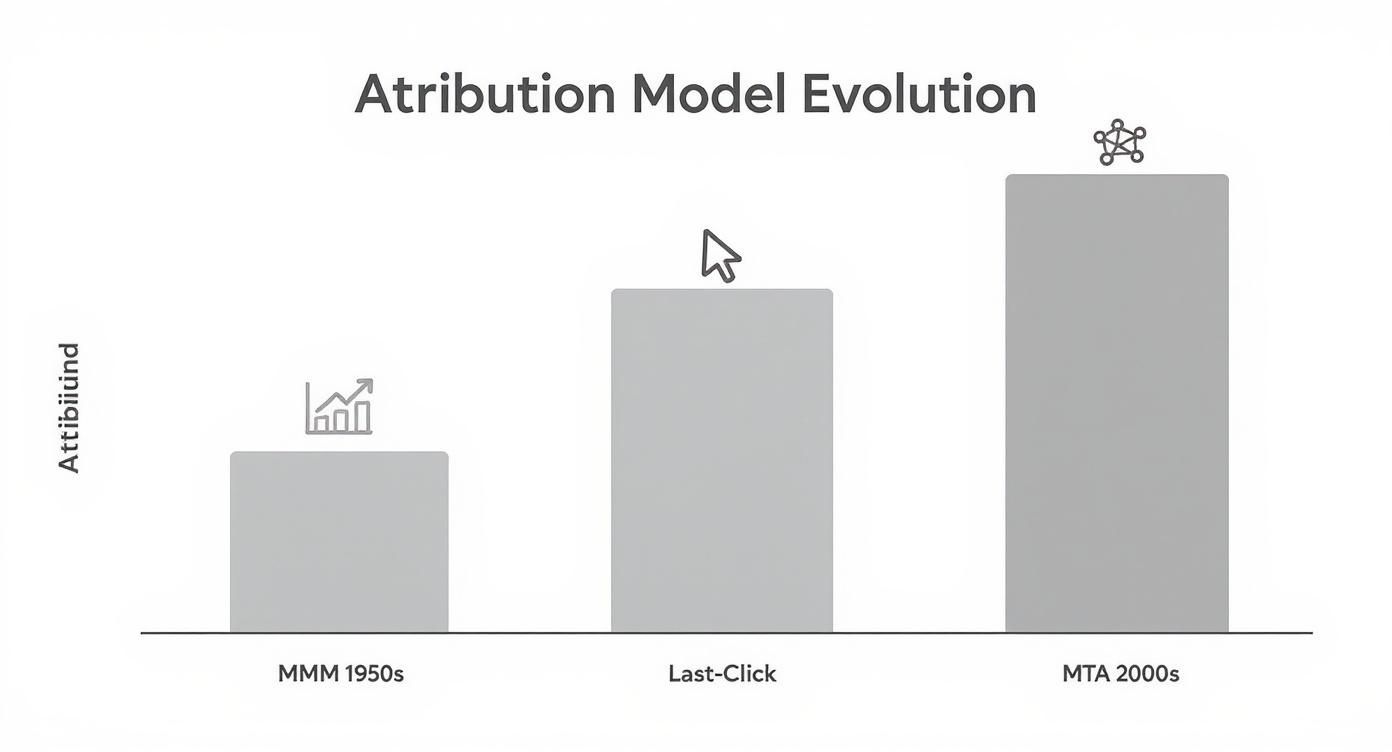
This visual journey highlights the big shift from high-level analysis to the detailed, user-level tracking that’s essential for modern marketing.
How to Implement Attribution Modeling in Your Business

Moving from theory to practice is where attribution modeling really starts to pay off. But you can’t just flip a switch. Implementing it properly is a structured process, starting with a rock-solid data foundation and building up to strategic analysis.
Think of it like building a house—you wouldn’t dare put up the walls before the foundation is perfectly set. The entire process hinges on one thing: flawless conversion tracking. If your data collection is leaky, any model you choose will give you a skewed picture of reality. Your insights are only as good as the data you feed the system.
Establish Your Data Foundation
Before you even start comparing models, your number one job is to make sure you’re capturing every important customer interaction. This is the bedrock of your entire strategy.
Start by setting up conversion goals in your main analytics platform, like Google Analytics. These goals are what you define as a “win”—a completed purchase, a lead form submission, a newsletter signup. Every single marketing channel needs to be configured to report these conversions accurately.
Next, you need a way to track the performance of specific campaigns. This is where UTM parameters become your best friends. They’re simple tags you add to the end of your URLs that tell your analytics tools exactly where a user came from.
A consistent UTM strategy should always include:
- utm_source: The platform that sent the traffic (e.g.,
google,facebook). - utm_medium: The marketing medium (e.g.,
cpc,email,sms). - utm_campaign: The specific campaign name (e.g.,
black_friday_sale).
By meticulously tagging every link in your ads, emails, and social posts, you’re essentially creating a detailed map of your marketing efforts. This turns messy, chaotic traffic data into an organized, analyzable dataset—an absolute must for any kind of attribution modeling.
Choose the Right Model for Your Goals
With solid tracking in place, you can now pick an attribution model. There’s no single “best” model; the right one is simply the one that aligns with your business objectives. Look back at the common models and ask yourself what question you’re trying to answer.
- Goal: Brand Awareness? Go with First-Click. It’s perfect for identifying which channels are best at introducing new people to your brand and shines a light on your top-of-funnel superstars.
- Goal: Optimizing Conversions? Try Last-Click or Time-Decay. These models help you understand which final touchpoints are most effective at closing the deal, which is critical for bottom-of-funnel performance.
- Goal: Holistic Understanding? A Linear or Position-Based model will give you a more balanced view of the entire customer journey, giving credit to the channels that both open and close the loop.
Don’t be afraid to toggle between different models. Analyzing your data through multiple lenses often uncovers insights that a single model would completely miss. This multi-model approach is key when you want to learn how to measure marketing campaign success from all angles.
Connect Data to Revenue Driving Actions
The final piece of the puzzle is tying your attribution data directly to revenue—especially for high-impact activities like cart recovery. For e-commerce stores, this is where the picture becomes crystal clear.
Take a tool like CartBoss, which automates SMS cart recovery. Every text message it sends contains a unique, pre-tagged link. When a customer clicks that link and completes their purchase, the conversion is automatically and perfectly tied back to that specific SMS campaign.
This direct connection lets you see the exact ROI of your recovery efforts. If you spend $50 on text messages and they bring in $1,500 in recovered sales, you have a clear, attributable win. You can then fold this data into a broader attribution model to see how SMS interacts with your other channels.
For example, you might discover that customers who first saw a Facebook ad are 30% more likely to convert from a recovery text. Suddenly, attribution isn’t just a confusing report—it’s a powerful tool for proving ROI and making smarter budget decisions. It gives you the hard evidence you need to invest confidently in the channels that are truly driving growth.
Navigating the Challenges of Modern Attribution
While attribution modeling is a fantastic tool for seeing what’s working, it doesn’t exist in a bubble. The ground beneath our feet is constantly shifting, creating new hurdles for marketers who need good data to make smart decisions. The digital world is getting more private, and that has a direct impact on how accurate our attribution can be.
Big changes, like the slow death of third-party cookies and major privacy updates from companies like Apple, have completely changed the game. These shifts mean we have access to way less user-level data than we used to. The clear lines we once drew from a specific ad click to a final sale are now blurry—and in some cases, they’ve vanished altogether.
This isn’t just a small headache; it’s a full-blown reliability crisis.
The Rise of Ghost Sales and Modeled Data
This reliability crisis stems directly from the drop in trackable conversion data. As platforms get less real data to work with, they have to start guessing to fill in the blanks. When an analytics platform sees a click with certain characteristics, it might predict a conversion should have happened, even if it has no concrete proof.
This is how you end up with “ghost sales”—conversions that show up in your reports but never actually happened in your bank account. These phantom sales can seriously inflate your numbers, tricking you into pouring more money into channels that aren’t really pulling their weight. The less real data a system has, the more it has to rely on modeling, and the less you can trust the results. For a deeper dive on this, Taggrs.io has some great insights on data-driven attribution challenges.
Common Mistakes That Sabotage Your Efforts
Beyond these massive industry shifts, a lot of attribution problems are self-inflicted. Simple mistakes in how you set things up can torpedo your data integrity, making it impossible to trust the results, no matter which model you’re using.
Here are a few of the most common ways marketers accidentally derail their own attribution:
- Inconsistent UTM Tagging: If your team isn’t on the same page with UTM parameters, your data will be a total mess. A campaign tagged as
black-fridayin one ad andBFCMin another will look like two different efforts, making it impossible to see the campaign’s true impact. - Ignoring Offline Touchpoints: A customer’s journey rarely happens entirely online. They might see a billboard, hear a podcast ad, or walk into a physical store. If you fail to account for these offline interactions, you’re missing huge pieces of the puzzle.
- Setting Unrealistic Conversion Windows: This is the time frame after an ad interaction where a sale can be credited. A 90-day window might work for a big-ticket item with a long sales cycle, but it’s completely wrong for an impulse buy and will almost certainly misattribute sales.
To get through these challenges, you have to be realistic about your data’s limitations. You need to accept that perfect, 100% accurate attribution is a thing of the past. The goal now is to get as close as you can by combining solid fundamentals with a more flexible, big-picture approach.
By mapping out the entire modern customer journey, you can adapt your strategies more effectively. To help you visualize this, take a look at our guide on what is customer journey analytics. It provides a great framework for understanding these complex paths. A combination of clean data practices and a deep understanding of how customers really behave is your best defense against the uncertainty of modern attribution.
Best Practices for Actionable Marketing Insights
Picking an attribution model is just the start. The real magic happens when you build a framework that turns raw data into profitable decisions. If you rely on just one model, you’re only getting a slice of the story—and often, it’s a misleading one.
Think of it like using both a telescope and a microscope. The telescope gives you the big picture, while the microscope reveals the tiny details that make all the difference. For example, looking at your data through both a first-click and a last-click lens helps you see which channels are brilliant at drumming up initial interest versus which ones are your heavy hitters for closing the deal.
Fine-Tune Your Strategic Framework
To pull genuinely useful insights from your marketing, you have to measure marketing ROI effectively. Attribution modeling hands you the data, but it’s the tactical adjustments you make that give that data its power.
First up, get your conversion window right. This is the period where a touchpoint can get credit for a sale. For a small, impulse-buy item, a 7-day window might be plenty. But for a pricey piece of furniture, you might need a 30 or even 90-day window. Get this wrong, and you’ll be giving credit to the wrong channels, guaranteed.
Next, you absolutely have to segment your data. Don’t just look at performance by channel. Dig deeper and slice it by:
- Customer Type: Are new buyers and loyal repeat customers taking different journeys to purchase?
- Geography: Do certain channels crush it in some regions but fall flat in others?
- Campaign: How are your big holiday promotions stacking up against your everyday evergreen content?
This kind of granular detail is what separates broad, fuzzy guesses from sharp, actionable insights.
Never “set and forget” your attribution model. Customer behavior is always changing. New channels pop up. Your own strategy shifts. You need to constantly challenge your assumptions and be ready to tweak your model to match what’s happening in the real world.
Connect Attribution to Long-Term Growth
The end game here isn’t just about bagging short-term conversions; it’s about driving sustainable, long-term growth. That means you need to look past the immediate sale and connect your attribution data to bigger business metrics like Customer Lifetime Value (CLV).
For example, you might find that while your Google Ads deliver a higher immediate ROI, the customers you bring in from organic search have a 25% higher CLV over a two-year period. Now that’s an insight you can take to the bank.
This deeper level of analysis makes sure your marketing budget isn’t just spent efficiently, but that it’s actively attracting your most valuable customers. When you put these practices into play, your attribution data stops being a simple reporting tool and becomes your strategic roadmap for lasting success. It’s the foundation for understanding—and improving—your entire marketing machine, something we cover in our guide on how to calculate marketing ROI.
Frequently Asked Questions About Attribution Modeling
Even once you’ve got the hang of the basics, some practical questions always pop up when you start applying attribution modeling to your own store. Let’s tackle a few of the most common ones marketers run into.
What Is the Best Attribution Model?
This is the big one, and the honest answer is: there’s no single “best” model that works for every business. The right choice always circles back to what you’re trying to achieve.
- If your top priority is brand awareness, you’ll want to lean on a First-Click model. It’s fantastic for pinpointing which channels are actually bringing new people into your orbit.
- Focused on optimizing conversions? A Last-Click or Time-Decay model will give you a clearer picture of which touchpoints are sealing the deal right before the purchase.
- Looking for a balanced view of the whole customer journey? That’s where Position-Based or Linear models shine, as they give credit to the multiple interactions that lead to a sale.
Most seasoned marketers don’t just stick to one. The real insights come from looking at your data through the lens of several different models to get a complete, well-rounded picture.
How Often Should I Review My Attribution Model?
Your attribution strategy should never be a “set it and forget it” kind of deal. Customer habits are always shifting, new marketing channels pop up, and your own business goals will change over time.
As a rule of thumb, it’s a good idea to review your model and its results at least quarterly. But if you’re in the middle of a huge campaign or you notice some major swings in your performance data, you might need to jump in and reassess more frequently. The goal is to make sure your model always reflects the reality of how customers are finding and buying from you right now.
Can I Use Attribution for Offline Channels?
Absolutely, though it does take a little extra legwork. While tracking digital touchpoints is straightforward with things like UTM parameters, offline channels like print ads, radio spots, or event sponsorships need their own tracking methods.
You can easily bridge the offline-to-online gap with unique discount codes, dedicated phone numbers, or custom landing page URLs for each campaign. This lets you connect what happens in the real world to online sales, giving you a much more complete view of what’s actually driving your revenue.
Ready to stop losing sales to abandoned carts? CartBoss uses the power of automated SMS to bring customers back and boost your revenue on autopilot. See how it works at https://www.cartboss.io.