



Let’s get real for a second. What is ecommerce automation?
Forget the techy buzzwords. It’s simply about teaching your online store to handle its most boring, repetitive tasks all by itself. This frees you up to focus on the stuff that actually grows your business, like marketing and product development.
Think of it as putting your store on autopilot. Crucial jobs like chasing down abandoned carts, managing inventory, and sending follow-up emails just happen, 24/7, without you lifting a finger.
Unlocking Growth with Ecommerce Automation
Imagine your online store is a busy restaurant. When you first started, you probably did everything—took the orders, cooked the food, cleaned the tables. But as you got popular, you had to hire staff to handle specific jobs so you could focus on perfecting the menu and finding a second location.
Ecommerce automation is your ultimate digital employee. It’s the tireless worker in the background making sure everything runs smoothly.
This isn’t just about simple to-do lists, either. We’re talking about complex, rule-based workflows that directly drive revenue and keep customers happy. Instead of manually emailing every person who abandons a cart, an automated system sends a perfectly timed text message or email to bring them right back. Moving from manual grunt work to smart automation isn’t a luxury anymore—it’s a must-have for any serious store owner.
Why Automation Is No Longer Optional
The online marketplace is ridiculously competitive. Customers expect instant answers, personalized deals, and a shopping experience so smooth they don’t even have to think about it. Trying to deliver that level of service by hand, especially as you scale, is a recipe for burnout.
Automation is the only way to meet and beat those expectations without hiring a massive team.
The market numbers tell the story. The global e-commerce automation market was valued at a massive $10.5 billion and is expected to hit $28.5 billion by 2032. This isn’t just a niche trend; it shows that smart retailers are scrambling to automate everything from their marketing funnels to their shipping process.
By automating the right things, you can turn your biggest headaches into your greatest strengths. A high cart abandonment rate suddenly becomes a predictable stream of recovered sales. Generic, one-size-fits-all emails transform into personalized conversations that build loyalty.
Let’s look at a few examples of this in action.
Ecommerce Automation at a Glance
This table breaks down how automation replaces tedious manual tasks with efficient systems that deliver real results.
| Manual Task | Automated Solution | Business Benefit |
|---|---|---|
| Manually emailing customers who left items in their cart | An SMS or email sequence that triggers automatically after a set time | Recover lost revenue and increase conversion rates |
| Sending a generic “welcome” email to new subscribers | A personalized welcome series with tailored product recommendations | Boost engagement and build a stronger customer relationship |
| Constantly checking stock levels and updating the website | An inventory management system that syncs stock across all channels | Prevent overselling and improve operational efficiency |
| Processing orders and creating shipping labels one by one | A fulfillment workflow that automatically prints labels and sends tracking info | Save time and reduce human error, getting orders out faster |
As you can see, the goal is to systemize the routine so you can humanize the exceptions—like handling a complex customer service issue or brainstorming your next big product launch.
The Real-World Impact on Your Store
The benefits of putting these systems in place are direct, measurable, and often immediate. You’re setting up smart workflows that systematically boost your key metrics without adding more to your plate.
Here’s what that looks like in practice:
- More Sales and Revenue: Automatically recovering abandoned carts with a tool like CartBoss and sending targeted promotions directly pad your bottom line. It’s like finding money you didn’t know you lost.
- A Better Customer Experience: Customers feel seen and valued when they get personalized welcome emails, timely shipping updates, and offers that actually make sense for them.
- Way More Efficiency: Automating inventory, order fulfillment, and basic customer support frees up hours every week. That’s more time for you to think strategically.
Automation isn’t just for the back end, either. It’s also about customer-facing tech. For instance, things like AI powered shopping assistants are changing how people shop online, showing just how broad automation’s reach has become.
Ultimately, all these pieces work together to build a more resilient and profitable business—a core theme you’ll see across all the top ecommerce trends reshaping the digital marketplace.
The Core Components of an Automated Sales Engine
If you think of ecommerce automation as the engine that powers your store, then specific workflows are the pistons, gears, and spark plugs making it all run. Each one targets a make-or-break moment in the customer journey, turning potential drop-offs into sales and one-time buyers into loyal fans.
At its core, this engine is built to handle key customer interactions without you lifting a finger. It works around the clock, 24/7, making sure you never miss an opportunity—whether it’s a customer browsing at 3 AM or a shopper who got distracted right before hitting “pay.”
Let’s break down the most important workflows that form this powerful system.
The Abandoned Cart Recovery Workflow
This is, without a doubt, the most valuable piece of automation you can set up. Think about it: nearly 7 out of 10 online shopping carts are abandoned. That’s a massive pool of warm leads just waiting for a nudge. An abandoned cart workflow automatically reaches out to these shoppers and brings them back to finish what they started.
Here’s a quick look at how it works:
- Trigger: A customer adds an item to their cart but leaves your site without buying.
- Action: After a short delay (say, 30 minutes), the system sends a personalized message. Email works, but SMS is a game-changer with its 99% open rates.
- Result: The customer gets a direct link to their pre-filled cart. Throw in a small incentive like free shipping, and you’ve made it incredibly easy for them to complete the order.
This single workflow plugs the biggest revenue leak in your store. It’s a non-negotiable for any serious ecommerce brand.
The Welcome Series Workflow
First impressions are everything. A welcome series is your automated handshake—a sequence of messages sent to new subscribers or customers to build a relationship from day one. It’s your chance to tell your brand’s story, show off your value, and steer them toward that first purchase.
A great welcome series is more than a simple “thanks for signing up” email. It nurtures the new lead by providing value over a few days. The first message might share your brand story, the second could highlight best-sellers, and the third might offer a special newcomer discount. This slow burn builds trust and keeps your brand top of mind. To see how this plays out in the real world, check out how different customer engagement platforms handle these crucial first touchpoints.
The Post-Purchase Follow-Up
The sale isn’t the end of the journey; it’s the beginning of the next one. What happens after a purchase is critical for turning a one-time buyer into a repeat customer. Post-purchase automations keep the conversation going and build lasting loyalty.
This workflow is your chance to thank the customer, confirm their order, provide shipping updates, and—most importantly—ask for a review. A steady stream of positive reviews builds social proof that helps convert future visitors.
You can also schedule follow-ups for a few weeks later to suggest related products or offer a discount on their next purchase. This simple act of re-engagement can seriously boost your customer lifetime value (CLV). Of course, a key part of this is ensuring that repeat transactions are frictionless, which is where reliable automated payment processing systems come into play.
Together, these three workflows—abandoned cart recovery, welcome series, and post-purchase follow-ups—form the pillars of a solid automation strategy. When they work in sync, they create a self-sustaining cycle of attracting, converting, and retaining customers that drives predictable, hands-off growth.
Where Automation Really Moves the Needle
Knowing what an automated sales engine is and seeing where it actually generates power are two different things. Ecommerce automation isn’t some generic, one-size-fits-all solution. It’s a set of specialized tools that deliver incredible results when you point them at the right parts of your business.
By focusing on the areas with the biggest potential upside, you can turn small, targeted changes into massive gains in both revenue and efficiency. Let’s look at the four spots where automation truly shines, turning sluggish manual tasks into high-growth machines.
Marketing That Feels Personal
Before Automation: Your marketing is a megaphone. You blast the same weekly newsletter to everyone, crossing your fingers that something connects. The most personal you get is using a customer’s first name, and trying to segment your audience is a nightmare that usually gets pushed to next week.
After Automation: Your marketing becomes a one-on-one conversation. Automated workflows slice and dice your audience based on actual behavior—what they look at, what they buy, and what they ignore. This lets you send hyper-relevant product recommendations, birthday discounts, and re-engagement campaigns that feel like they were written just for them.
The growth here is impossible to ignore. The AI e-commerce market, currently valued at USD 8.65 billion, is expected to skyrocket to USD 22.60 billion by 2032. A massive 80% of businesses see a jump in leads after putting these systems in place. You can find more on these ecommerce automation trends on attomy.io.
Turning Lost Sales into Found Money
Before Automation: A lost sale is just… a lost sale. You see the high cart abandonment numbers in your analytics and just have to guess why people are leaving. Reaching out manually is a non-starter, so you write off that revenue as a cost of doing business.
After Automation: A lost sale is a second chance. This is where automation delivers its most immediate and powerful ROI. Workflows like SMS cart recovery are an absolute game-changer.
An abandoned cart isn’t a “no”—it’s a “not right now.” Automation gives you a second chance to turn that hesitation into a sale by removing friction and adding a timely incentive.
Picture this: a customer gets distracted and wanders off. Within minutes, an automated SMS from a tool like CartBoss lands on their phone. It’s a friendly reminder with a direct link back to their cart, which is already filled and waiting for them. With open rates that crush email, SMS cuts through the digital noise and converts shoppers who would have been gone for good. This single automation can directly pump up your store’s total revenue.
Customer Service That Never Sleeps
Before Automation: Every single customer question, no matter how simple, clogs your inbox. You spend half your day answering “Where is my order?” or “What’s your return policy?” As your store grows, you’re either drowning in support tickets or hiring more people, driving up costs.
After Automation: Your support system is on the job 24/7. Here’s how it works:
- AI Chatbots: These bots handle the repetitive, common questions instantly. This frees up your human team to focus on the complex issues that actually need a personal touch.
- Automated Order Updates: Customers get tracking info and delivery notifications via email or SMS automatically. The “where’s my order” questions practically disappear.
- Proactive Help: Workflows can even send helpful messages based on what a customer buys, like sending a quick-start guide after they purchase a technical product.
This isn’t just about saving time. It’s about creating a better, faster, and more responsive experience for your customers.
Operations and Fulfillment on Autopilot
Before Automation: Your back end is held together by manual checklists. You’re constantly double-checking inventory, updating stock levels, printing shipping labels one by one, and then manually telling customers their order has shipped. It’s slow, tedious, and a recipe for human error.
After Automation: Your operations run like a finely tuned machine. Inventory syncs automatically across all your sales channels, so you never oversell. An order comes in, the shipping label prints, the tracking number is generated, and the customer gets notified—all without you lifting a finger.
This kind of efficiency leads to faster shipping, fewer mistakes, and much happier customers. It lets you handle more orders without hiring more people, which is the very definition of smart, sustainable growth. To see how texting plugs into this whole ecosystem, check out our guide on SMS marketing for ecommerce.
Automation Impact Across Your Business
To put it all together, here’s a quick look at how targeted automation can transform different parts of your operation, along with the tools that make it happen.
| Business Area | Example Automation Workflow | Primary Benefit (Metric) | Example Tool |
|---|---|---|---|
| Marketing | Segmenting users by purchase history to send personalized product recommendations. | Increased Customer Lifetime Value (CLV) | Klaviyo |
| Sales Recovery | Sending an SMS with a discount 1 hour after a cart is abandoned. | Higher Cart Conversion Rate & Revenue | CartBoss |
| Customer Support | Using an AI chatbot to answer common questions like “Where is my order?” | Reduced Support Ticket Volume & Faster Response | Gorgias |
| Operations | Automatically syncing inventory levels across Shopify, Amazon, and physical stores. | Fewer Stockouts & Less Manual Data Entry | ShipStation |
As you can see, the right workflow in the right place doesn’t just save a bit of time—it directly impacts key metrics that drive growth, from conversion rates to customer loyalty.
How to Build Your Ecommerce Automation Stack
Getting started with ecommerce automation can feel like you’ve been handed a box of complex parts with no instruction manual. The secret? Don’t try to build the entire machine at once. Start with a clear plan and focus on the small changes that deliver the biggest results first.
Instead of trying to automate everything from day one, put on your detective hat. Figure out where your business is bleeding the most time and money. This “start small, scale smart” method keeps you from getting overwhelmed and makes sure every tool you add actually solves a real problem.
Your end goal is to build a cohesive system—an automation stack—where different tools communicate with each other to create a smooth, hands-off experience for both you and your customers.
Let’s walk through how to build a powerful stack that’s tailored to your store.
Step 1: Find Your Biggest Pain Points
Before you even glance at a single tool, you need to know what you’re trying to fix. Grab a notebook or open a spreadsheet and start listing the most repetitive, time-sucking, or just plain annoying tasks you deal with every day.
Ask yourself a few honest questions:
- Where is my time going? Is it spent manually answering the same five customer questions, processing orders one by one, or constantly updating inventory levels?
- Where am I losing money? For most stores, the answer is abandoned carts. What percentage of your shoppers are bailing at the last minute? That’s pure profit walking out the door.
- What tasks do I absolutely hate doing? Let’s be real—the jobs you dread the most are usually perfect candidates for automation.
This simple audit will give you a crystal-clear, prioritized list of problems that need solving. For almost every store, tackling abandoned carts is the fastest way to see a return on your investment.
Step 2: Prioritize High-ROI Workflows First
Now that you have your list, it’s time to decide what to tackle first. The golden rule here is to focus on workflows that directly pump money back into your business. Automating your social media posts is nice, but recovering lost sales will have a much bigger impact on your bottom line.
Here’s a simple hierarchy to get you started:
- Sales Recovery: This is your top priority. Start with abandoned cart recovery.
- Customer Nurturing: Set up a welcome series for new subscribers to guide them toward their first purchase.
- Customer Retention: Automate post-purchase follow-ups to get reviews and encourage repeat business.
- Operational Efficiency: Once you’re making more money, automate things like inventory management and order fulfillment to save yourself time.
Following this order means you’ll be making money with automation before you start using it just to save time. It’s a smarter way to grow.
Step 3: Choose the Right Tools for the Job
Okay, now you can start shopping for tools. The key is to find software that solves the specific problems you identified in Step 1. It’s absolutely critical to pick platforms that integrate seamlessly with your ecommerce setup, whether you’re on Shopify, WooCommerce, or something else.
The market for this stuff is blowing up. It’s expected to hit USD 44.3 billion by 2029, as more small businesses use technology to compete with the big guys by cutting costs and improving service. You can read the full report on retail automation trends if you want to dive deeper.
When you’re picking tools, think simplicity and performance. A tool that’s a headache to set up or manage just creates more work. Look for plug-and-play solutions with a proven track record.
To make the best choice, you’ll want to compare a few options. Our detailed guide on the best ecommerce automation tools can help you pick the perfect software for every part of your stack.
This flowchart shows how automation fits into the key areas of growth—attracting new customers (Marketing), converting them into buyers (Sales), and keeping them happy for the long haul (Service).
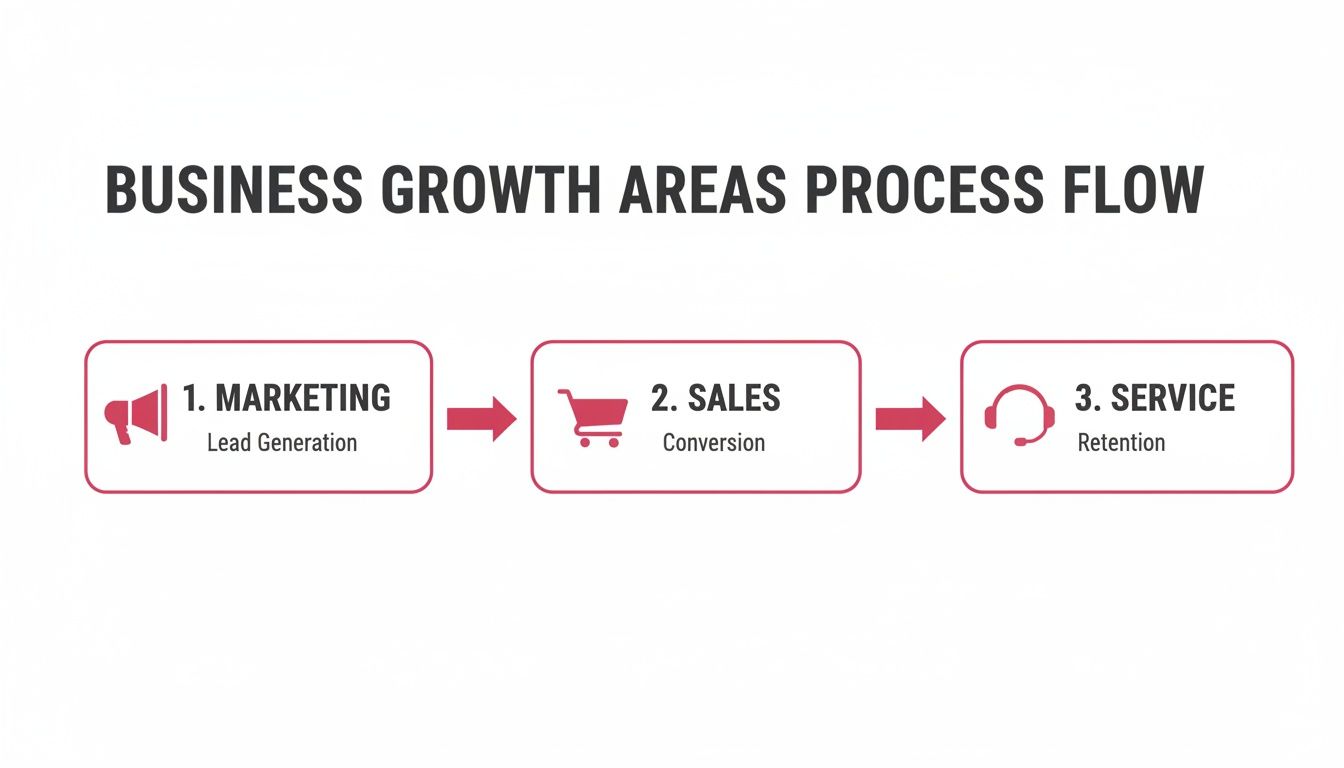
As you can see, a solid automation strategy isn’t just about one thing; it’s about supporting the entire customer journey from start to finish.
By following these steps, you can build an ecommerce automation stack that doesn’t just free up your time—it becomes a powerful engine that actively drives more revenue for your store.
Measuring Success and Optimizing Your Strategy
Setting up an automation workflow is just the start. The real magic happens when you stop treating it like a one-and-done task and start seeing it as a living part of your store that you can constantly improve. To pull this off, you need to learn how to listen to what your data is telling you.
Think of it like tuning a race car. You wouldn’t just slap an engine in and hope for the best, right? You’d be constantly checking the gauges, listening to how it runs, and making tiny tweaks to squeeze out more power and efficiency. Your automation strategy is no different. Tracking the right metrics lets you move from guesswork to knowing exactly what works.
This whole process turns your automations from simple tools into a predictable, profit-generating machine. It lets you spot the weak links, double down on your winners, and steadily grow your return on investment.
Key Performance Indicators That Matter
Don’t drown in a sea of vanity metrics. When it comes to ecommerce automation, a handful of key performance indicators (KPIs) tell you pretty much everything you need to know. These are the gauges on your dashboard that show real, bottom-line impact.
You’ll want to focus on these essentials:
- Cart Recovery Rate: This is the big one, especially for automations designed to drive sales. It’s the percentage of abandoned carts your automated messages actually bring back to complete a purchase. A high recovery rate is direct, in-your-pocket proof that your strategy is making you money.
- Conversion Lift: This metric cuts through the noise and shows the direct impact of your automations. It measures the increase in conversions from customers who got an automated message versus a control group who didn’t. For example, if your welcome series has a 5% conversion lift, it means you’re ringing up 5% more sales than you would have otherwise.
- Customer Lifetime Value (CLV): Good automation doesn’t just make one sale; it builds loyalty. An increasing CLV is a fantastic sign that your post-purchase follow-ups and personalized campaigns are working, turning one-time buyers into long-term fans of your brand.
Keeping a close eye on these numbers is non-negotiable. To get a deeper understanding, you can explore our full list of the most important ecommerce metrics to track for your business.
Making Data-Driven Adjustments
Once you have the numbers, it’s time to act. Optimization isn’t a single event; it’s a continuous cycle of analyzing, testing, and refining your workflows. This is where you can make small changes that lead to huge wins.
For instance, maybe your cart recovery SMS has a killer open rate, but the click-through rate is lagging. That tells you people are seeing the message, but it isn’t quite convincing them to act. You could A/B test different offers—like a 10% discount versus free shipping—to see which one actually gets shoppers to come back and buy.
The goal is to create a feedback loop where performance data directly informs your next move. This iterative process is how you turn a good automation strategy into a great one.
Whatever you do, avoid the trap of sending generic, impersonal messages. If your analytics show engagement is dropping off, it’s often a sign that your communication feels robotic. Use the data you have to add a human touch, like mentioning the specific items left in their cart. This constant refinement is the secret sauce for sustained growth.
Real-World Examples of Automation in Action

Theory is one thing, but seeing how automation actually works for a real store is what makes it click. Let’s walk through a success story that shows the direct impact of a simple, smart automation strategy.
Imagine an online apparel store called “Urban Threads.” Like a lot of growing brands, they were running into two huge problems. First, their cart abandonment rate was a painful 75%—meaning for every four shoppers who added an item to their cart, three of them walked away. Second, getting those customers to come back for another purchase was a constant struggle, which kept their customer lifetime value low.
The team was stretched thin, doing everything by hand, from managing inventory to answering support tickets. They knew they were leaving money on the table but just didn’t have the bandwidth to chase down every lost sale. This is where automation changed the game for them.
Crafting a Simple Yet Powerful Automation Stack
Urban Threads decided not to boil the ocean with a massive, complicated overhaul. Instead, they got laser-focused on the two things that would give them the biggest and fastest return: recovering abandoned carts and building customer loyalty.
Their entire strategy boiled down to just two core workflows:
- SMS Abandoned Cart Recovery: They knew email inboxes were crowded. So, they set up a tool to send automated text messages to shoppers who left items in their cart.
- Post-Purchase Follow-Ups: They created a simple sequence to thank customers after a purchase, ask for a review, and later, send a special discount to encourage a second order.
This approach meant they could get a powerful solution up and running in less than an hour. They used pre-written and translated message templates that automatically adapted to each customer’s language, so there was almost no setup required.
The key to their success wasn’t adding a dozen new tools. It was pinpointing their biggest revenue leak—abandoned carts—and aiming a single, high-impact solution right at the problem.
This targeted strategy started paying off almost immediately, turning a huge weakness into a reliable revenue stream.
The Tangible Results of Smart Automation
Within the first month, the results were impossible to ignore. The SMS cart recovery campaign quickly became the store’s most profitable marketing channel, bringing back customers who would have otherwise been gone for good. The text messages felt personal, friendly, and included a direct link to a pre-filled checkout, making it ridiculously easy for shoppers to pick up where they left off.
Here’s what that transformation looked like in numbers:
- Recovered Sales: The store clawed back an extra 18% of its abandoned carts. This translated into thousands of dollars in new revenue every single week.
- Campaign Profitability: The SMS campaign hit a massive 4,500% return on ad spend (ROAS). Why? Because it only targeted shoppers who had already shown clear intent to buy.
- Customer Engagement: Their post-purchase follow-ups led to a 30% increase in product reviews and a very noticeable jump in repeat purchases.
Urban Threads’ story is the perfect example of how a focused automation strategy delivers outsized results. By automating the most critical moments in the customer journey, they not only plugged a major revenue leak but also built a stronger, more profitable relationship with their customers—all without adding more work to their team’s plate.
Your Top Questions About Automation, Answered
Jumping into ecommerce automation can feel like a big step, and it’s natural to have questions. Getting straight answers is the best way to feel confident, so let’s walk through some of the most common things store owners wonder about.
Is This Going to Be Too Expensive for My Business?
Not at all. In fact, many of the most powerful automation tools are built specifically for small and growing stores. They often use flexible, performance-based pricing, which is a total game-changer because you don’t have to worry about big upfront costs or fixed monthly fees.
Take SMS cart recovery, for example. Some of the best tools only charge a small cut of the sales they successfully bring back. This means you only pay when you make money. It’s a risk-free investment that usually pays for itself many, many times over. The trick is to start with high-impact automations like abandoned cart recovery that put cash directly back into your business.
Will Automation Make My Brand Feel Like a Robot?
That’s a fair question, but modern automation is all about creating more personal experiences, not less. The goal isn’t to replace real human conversations. It’s to take care of the repetitive stuff so you have more time to connect with customers when it really counts.
Good automation tools let you pull in customer data—like their name, what they’ve bought before, or the exact items they left in their cart—to send messages that feel incredibly personal and helpful.
When you do it right, automation actually makes the customer experience better. It helps your brand feel more attentive and on the ball by sending useful reminders and timely offers, not less human.
This approach shows your customers you’re paying attention to what they need, which is a great way to build a stronger relationship.
How Much Time Will It Take to Get This Set Up?
You’d be surprised how fast it can be. You can get high-impact automations live in just a few minutes—not days or weeks. A lot of the newer tools, especially those made for platforms like Shopify and WooCommerce, are designed to be simple, plug-and-play installs.
For instance, a top-tier cart recovery solution like CartBoss can be up and running in under 60 seconds. These platforms often come loaded with pre-written, translated message templates, so you can launch your first campaign almost instantly and start seeing results the same day.
What’s the Single Most Important Thing to Automate First?
For almost every ecommerce store out there, abandoned cart recovery is the most profitable workflow to automate first. It’s a no-brainer. With average cart abandonment rates sitting around 70%, this one area is a massive, untapped pool of revenue you’re currently leaving on the table.
Automating this process, especially with a powerhouse channel like SMS that has a near-perfect open rate, delivers the fastest and biggest return. You’re directly reaching shoppers who were just a click away from buying, giving you an immediate and powerful way to boost your sales.
Ready to turn those abandoned carts into your most profitable revenue stream? CartBoss makes it simple. Set up our automated SMS recovery campaigns in under 60 seconds and watch your sales climb. Start recovering lost sales today.