


Picture this: you’ve got a constant stream of repetitive marketing tasks on your plate. Welcome emails, abandoned cart reminders, product recommendations… the list goes on. E-commerce marketing automation is like hiring a tireless digital assistant who handles all of that for you, delivering personalized experiences to every customer without you lifting a finger. It’s how even small teams can create sophisticated, perfectly-timed customer journeys that feel personal and drive sales.
What Is Ecommerce Marketing Automation

Imagine your online store is a high-end physical boutique. As the owner, you simply can’t greet every person who walks in, guide them to products they might like, and then chase after them if they leave without buying. There just aren’t enough hours in the day.
Marketing automation for e-commerce is the technology that lets you do exactly that—but in the digital world.
It’s a system that automates your marketing actions across different channels, all based on what your customers do (or don’t do). Instead of blasting out generic emails to everyone, automation lets you have thousands of relevant, one-to-one conversations at the same time. The results speak for themselves. A report covering the first three quarters of 2025 showed that automated emails drove nearly 40% of all email revenue while making up only about 3% of total sends. That’s some serious efficiency.
The Core Mechanics of Automation
At its heart, marketing automation runs on simple “if this, then that” logic. These automated sequences, often called workflows, are built from three key pieces that work together to create a seamless experience for your customers.
- Triggers: This is the event that kicks everything off. A trigger could be anything—a new subscriber signing up, a customer adding an item to their cart, or someone making their very first purchase.
- Actions: Once a trigger fires, the system performs a specific, pre-defined action. Most of the time, this means sending an email or an SMS message, but it could also be something like adding the customer to a specific list or updating their profile with a new tag.
- Timing: Workflows aren’t just about what you send, but when. You can build in delays to make sure messages land at the most effective moments. For example, an abandoned cart reminder might go out one hour after the trigger, with a follow-up scheduled for 24 hours later if the cart is still empty.
This strategic approach allows you to engage customers across various touchpoints. While email is a foundational channel, modern automation often integrates other platforms. To learn more about this, you can explore our guide on what is multi-channel marketing and how it builds a cohesive customer experience.
By combining these elements, you can build powerful workflows that nurture leads, recover sales you thought were lost, and build genuine, long-term loyalty. The real magic here is that it makes your marketing feel personal and helpful, not robotic. When a customer gets a timely, relevant message that speaks to their exact needs, it strengthens their connection to your brand, turning a one-time visitor into a loyal fan. And the best part? It frees you up to focus on the bigger picture—strategy, growth, and building an even better business.
The Core Benefits of Automating Your Ecommerce Marketing

Jumping into marketing automation for e commerce isn’t just a tech upgrade; it’s a fundamental shift in how you run your business. Think of it as a force multiplier for your store, amplifying everything you do across the three pillars that actually matter: selling more stuff, keeping customers happy, and getting your precious time back.
Without automation, your marketing is like trying to water a giant garden with a single watering can. You can only hit one spot at a time, and a whole lot of potential customers get ignored. Automation, on the other hand, is like installing a smart irrigation system that gives every visitor and customer exactly what they need, right when they need it.
Directly Increase Sales and Recover Revenue
The most obvious win you’ll see from automation is a direct hit to your bottom line. Every single day, sales slip through the cracks. A shopper gets distracted and abandons a full cart, or a new visitor browses and leaves without buying anything. Automation is your safety net, built to catch that lost revenue.
The classic abandoned cart sequence is the perfect example. When a customer leaves, an automated workflow can shoot them a perfectly timed email or SMS reminder. That simple nudge is often all it takes to bring them back to finish the purchase, turning a near-miss into a sale.
The numbers don’t lie. Email marketing alone has shown an average return on investment (ROI) of $36 for every $1 spent. That’s a staggering 3600% ROI, and it proves just how powerful these automated nudges are. You can dig deeper into the ROI of marketing automation at inbeat.agency.
Enhance Customer Loyalty and Lifetime Value
Let’s be real—long-term success in e-commerce isn’t about one-time sales. It’s about building a base of repeat customers who choose your brand over and over again. Automation is the engine that drives modern customer loyalty by making personalized, ongoing communication possible. It makes people feel seen.
Take a simple post-purchase follow-up. Instead of radio silence after an order, you can automatically:
- Send a “thank you” message with tips on how to use their new product.
- Ask for a review a week after the item arrives.
- Recommend complementary products a month later based on what they bought.
This kind of consistent, relevant communication turns a one-off transaction into a real relationship. It shows you care about their experience beyond the checkout page, which is absolutely critical for boosting customer lifetime value (CLV) and building a loyal fan base.
Save Invaluable Time and Boost Efficiency
Finally, you can’t ignore the massive operational advantage. Imagine manually sending welcome emails, segmenting customer lists, or chasing down every abandoned cart. You’d need a whole team working around the clock, and they’d still make mistakes.
By handing these repetitive jobs over to an automated system, you free up your team to focus on what humans do best: strategy, creativity, and big-picture thinking. They can work on product development, brand building, or planning the next big campaign.
To put this in perspective, let’s compare the manual grind to the impact of a smooth, automated workflow.
Manual Effort vs Automated Workflow Impact
| Marketing Task | Manual Approach (Per 100 Customers) | Automated Approach (Per 100 Customers) | Key Benefit |
|---|---|---|---|
| Welcome Series | Manually send individual emails. Time: 2-3 hours. | A 3-part email series is sent automatically upon signup. Time: 0 hours (after setup). | Frees up hours, ensures consistency. |
| Cart Recovery | Identify abandoned carts and send follow-ups one-by-one. Time: 4-5 hours. | Triggers an instant SMS/email sequence to all abandoned carts. Time: 0 hours. | Recovers revenue around the clock. |
| Customer Segmentation | Manually create and update lists based on purchase history. Time: 3-4 hours. | Automatically tags and segments customers based on real-time behavior. Time: 0 hours. | Enables highly targeted campaigns. |
| Post-Purchase Follow-up | Track deliveries and send review requests manually. Time: 2-3 hours. | Sends review requests and cross-sell offers automatically after delivery. Time: 0 hours. | Increases reviews and repeat purchases. |
This shift from manual labor to strategic oversight allows even a one-person shop to operate with the efficiency of a much larger company. It’s not just about doing more with less; it’s about empowering your team to do better, more meaningful work that actually moves the needle.
Essential Automated Workflows for Your Online Store
Think of marketing automation workflows as your store’s pre-built playbooks. Each one is designed to connect with a specific type of customer at just the right moment, gently nudging them toward the next step—whether that’s making their first purchase or becoming a lifelong fan.
Setting up the right workflows is where you’ll see the real magic of marketing automation for e commerce happen. While you can build dozens of them, a few core sequences deliver the biggest bang for your buck right out of the gate. These are the automations every online store should have running 24/7.
The Abandoned Cart Recovery Series
This one’s the undisputed champion of e-commerce automation, and for good reason—it directly recovers sales you would have otherwise lost. Nearly 70% of online shopping carts are abandoned, which is a massive pile of cash just sitting there. An automated recovery series is your safety net, designed to bring these super-interested shoppers back to finish what they started.
The goal here is simple: remind, incentivize, and make it easy.
- Trigger: A shopper adds an item to their cart but bounces without buying.
- Goal: Win back the sale by reminding them what they left behind and overcoming any last-minute hesitation.
- Content Tip: The first message, sent about an hour later, should be a friendly nudge. A second message 24 hours later can sweeten the deal with a small incentive, like a 10% discount or free shipping, to create a little urgency.
The Welcome Series for New Subscribers
When someone new signs up for your list, their interest in your brand is at an all-time high. A powerful welcome series grabs this moment by the horns, turning that initial curiosity into a sale. This is more than just a “hello”; it’s your shot to tell your brand story, show off what makes you special, and build an instant connection.
This workflow is all about turning passive subscribers into active customers.
Research shows that over half (54.2%) of e-commerce automation workflows are used to recover abandoned carts, with another 30.8% dedicated to welcome emails. This focus pays off big time, as automated messages can generate up to 30 times more revenue per recipient than standard campaigns. You can find more insights on these powerful automation statistics at emailvendorselection.com.
Post-Purchase Follow-Up and Review Requests
The customer’s journey doesn’t stop once they click “buy.” In fact, the moments after a purchase are goldmines for building long-term loyalty. A post-purchase workflow reassures customers that their order is on the way, helps them get the most out of their new product, and asks them to leave a review.
- Trigger: A customer completes a purchase.
- Goal: Boost customer satisfaction, get social proof through reviews, and pave the way for repeat business.
- Content Tip: Time your review request to land after the product has been delivered and they’ve had a chance to try it out. Make it dead simple by linking them straight to the product review page.
The Customer Win-Back Campaign
It’s natural for some customers to go quiet over time. A win-back campaign is your proactive plan to re-engage these dormant shoppers before you lose them for good. By acknowledging they’ve been gone and giving them a compelling reason to come back, you can reactivate a valuable part of your audience that already knows who you are.
This is way cheaper than finding a brand-new customer. To get more ideas for different sequences, check out our detailed post on powerful marketing automation workflow examples.
The VIP and Customer Loyalty Flow
Your best customers deserve the red-carpet treatment. A VIP workflow automatically flags and rewards your most loyal shoppers, making them feel appreciated and encouraging them to keep coming back. You could trigger this when they hit a certain spending amount or make a specific number of purchases.
This automation turns repeat buyers into raving fans. Think exclusive perks like early access to sales, special discounts, or a sneak peek at new products. By putting these essential workflows in place, you build a solid system that not only drives sales but also builds lasting customer relationships, all on autopilot.
Building Your Ecommerce Automation Strategy
Jumping into marketing automation for e commerce can feel like trying to build an engine from scratch—it looks complex and a little intimidating. But a great strategy isn’t something you build overnight. It’s assembled piece by piece, starting with a clear roadmap that breaks the whole thing down into manageable chunks.
Think of it less like a frantic sprint and more like building with LEGOs. You start with the foundation, add the main structure, and then start snapping on the cool, fun features. By focusing on one phase at a time, you can put together a powerful automation system without getting overwhelmed. This way, you end up with a strategy that’s not just working, but is a perfect fit for your store’s unique needs.
Set Your Goals and Choose Your Platform
Before you even think about creating a workflow, you have to know what you’re trying to accomplish. Are you laser-focused on recovering lost sales? Nurturing new leads into customers? Or maybe you want to boost repeat purchases from your existing base? Defining clear, measurable goals is the bedrock of your entire strategy.
Once you know what you’re aiming for, the next step is picking the right tool for the job. Your automation platform is the command center for everything you’ll do, so this decision is a big one.
Here are a few things to keep in mind when you’re looking at options:
- Budget: Platforms can range from affordable tools for startups to massive enterprise solutions. Find one that fits where you are now but gives you room to grow.
- Store Integration: This is a non-negotiable. Does the platform connect seamlessly with your e-commerce provider, like Shopify or WooCommerce?
- Ease of Use: A tool is only useful if you can actually use it. Look for a clean, intuitive interface and pre-built templates to help you get going faster.
When you’re mapping out your e-commerce automation plan, it can also be a smart move to see how you might bring in outside expertise, like outsourcing digital marketing specialists.
Connect Your Data and Segment Customers
With your platform locked in, the next phase is all about data. Think of your customer data as the fuel for your automation engine. Connecting your store is like hooking up the fuel line. This integration lets the platform see what your customers are doing in real-time—what they buy, what they browse, and what they leave behind in their cart.
This wealth of data is what allows you to do segmentation, which is really just the art of grouping customers based on shared behaviors or characteristics. Instead of blasting one generic message to everybody, you can create campaigns that are incredibly targeted.
A well-defined segmentation strategy is the difference between marketing that feels like spam and marketing that feels like a personal recommendation. It empowers you to speak directly to customer needs at every stage of their journey.
To get started, focus on a few high-impact segments:
- First-Time Buyers: Welcome them to the family and gently guide them toward making a second purchase.
- High Spenders (VIPs): Roll out the red carpet with exclusive offers and early access to new products.
- Inactive Customers: Target them with a friendly “we miss you” win-back campaign to re-engage them.
The sheer scale of e-commerce makes this a necessity. By 2025, global e-commerce sales are expected to blow past $6.8 trillion, with over 2.77 billion people shopping online. Automation is the only realistic way to manage your marketing in a market that massive.
Launch Your First Essential Workflows
Alright, now it’s time for the fun part: bringing your strategy to life. Don’t make the mistake of trying to build every single workflow you can imagine all at once. Start with the two automations that deliver the most immediate impact and give you the quickest wins. This helps build momentum and shows a clear return on your investment right away.
The infographic below breaks down the most critical workflows to launch first: welcome messages, abandoned cart reminders, and post-purchase follow-ups.
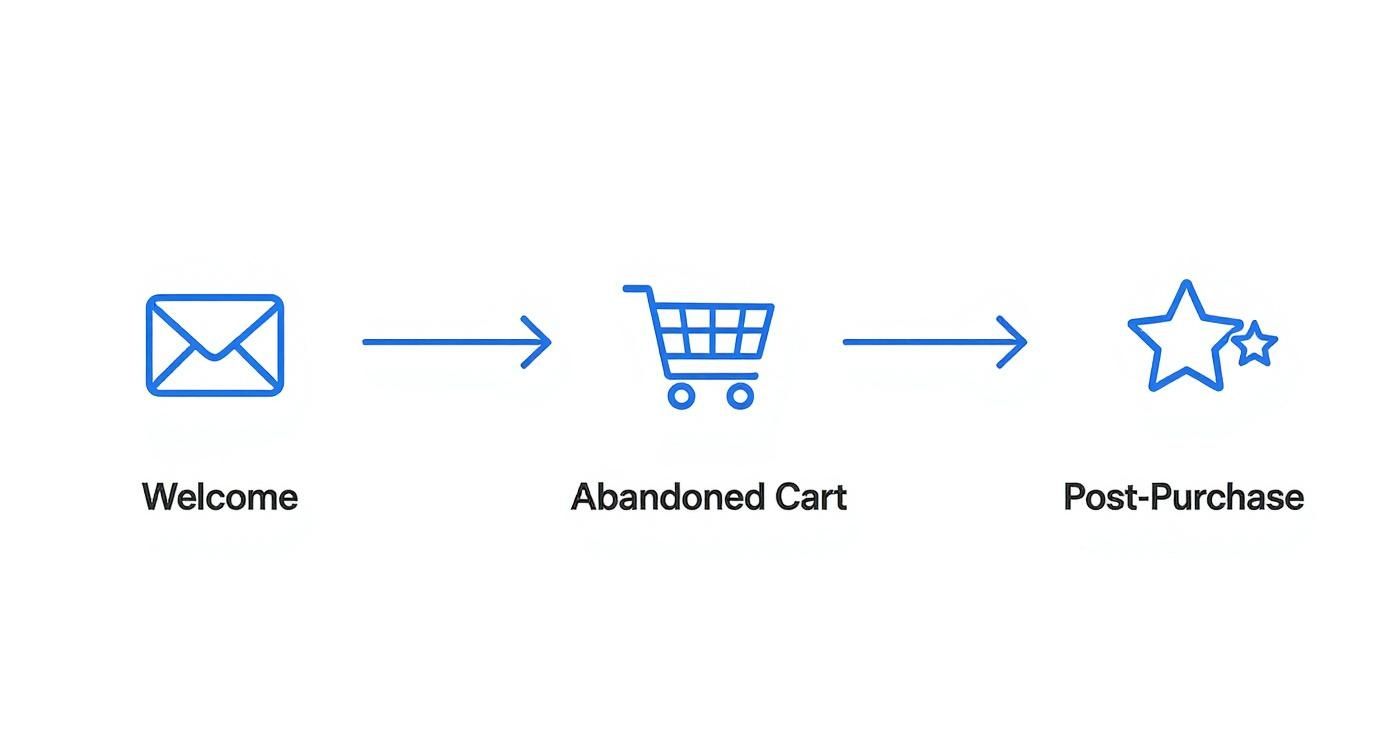
This flow shows how each automation hits a key moment in the customer journey, from that first “hello” to recovering revenue and building long-term loyalty.
Your launchpad should focus on these two workflows:
- The Welcome Series: This is your first impression, so make it count. Nurture new subscribers with a series of emails that introduce your brand, show off your best-selling products, and maybe offer a small incentive to get them to make that first purchase.
- The Abandoned Cart Recovery Series: This is your highest-impact workflow, hands down. Automatically remind shoppers about the items they left behind and give them a compelling reason to come back and finish checking out.
By mastering these two foundational workflows, you create a solid base for your entire automation strategy. From there, you can expand into more advanced automations like post-purchase follow-ups and VIP campaigns. For a more detailed guide, check out our post on how to set up marketing automation the right way.
Using SMS to Supercharge Your Cart Recovery
Email is the bedrock of any solid cart recovery strategy, but what if you could reach distracted shoppers in a far more direct and immediate way? This is exactly where SMS automation steps in. It turns your recovery efforts from a single-channel shot in the dark into a powerful, multi-pronged approach that demands attention.
Just think about your own phone habits. An email might sit unopened for hours, maybe even days. A text message notification? It’s almost impossible to ignore. That raw immediacy is the secret weapon of SMS in marketing automation for e commerce.
With open rates hitting an insane 98%, text messages slice through the digital noise in a way email just can’t anymore. When a customer ditches a cart, the clock starts ticking. An SMS sent just 30-60 minutes after they leave can land at the perfect moment to reignite their interest and lock in the sale before they’ve moved on for good.
Why SMS Is a Game-Changer for Recovery
Adding SMS to your recovery plan isn’t about replacing email—it’s about building a smarter, more responsive system. Email is fantastic for detailed storytelling and showing off great product visuals. SMS, on the other hand, excels at delivering short, urgent, and incredibly actionable messages.
This one-two punch lets you create a dynamic workflow that reacts to how your customers behave. You could send an initial email reminder, and if it’s still unread an hour later, automatically follow up with a friendly, punchy text.
The real key to making SMS work is to be helpful, not annoying. You’re aiming for a gentle, timely nudge with a crystal-clear path back to the checkout. It should feel less like a marketing blast and more like premium customer service.
Best Practices for SMS Cart Recovery
To get the most out of SMS, you have to play by a few simple rules. Remember, you’re entering the personal space of someone’s text inbox, so respect it. Keep your messages concise, valuable, and always compliant.
- Timing is Everything: Your first SMS should go out within an hour of the cart being abandoned. This is the sweet spot where the purchase is still fresh in their mind. Sending texts late at night or too often will just feel spammy.
- Keep It Short and Sweet: Get straight to the point. A quick, friendly reminder, a link back to their cart, and maybe a small incentive is all it takes. “Hey [Name], you left something in your cart! Finish your order here: [Link]” is often more than enough.
- Always Offer an Opt-Out: Compliance is non-negotiable. Every single message has to include a clear and simple way for users to unsubscribe, like replying with “STOP”.
A tool like CartBoss is built to put this whole process on autopilot. It plugs right into your e-commerce platform to trigger these SMS reminders automatically, complete with pre-filled checkouts to make finishing the purchase completely frictionless. For a deeper look, check out our guide on how to recover abandoned carts with text messages and see exactly how it works.
By blending the strengths of email and SMS, you build a comprehensive recovery engine that meets customers wherever they are. This multi-channel strategy ensures you’re doing everything you can to bring shoppers back, maximizing your conversion rates and clawing back revenue that would otherwise be lost forever.
Measuring the Success of Your Automation Efforts
Running an automation strategy without measuring it is like driving with your eyes closed. You’re definitely moving, but you have no clue if you’re headed toward a cliff or your destination. To really get a handle on what your marketing automation for e commerce is doing, you have to look past the flashy, feel-good numbers and zero in on the KPIs that actually grow your business.
This means you stop obsessing over open and click rates and start tracking the numbers that hit your bottom line. Sure, a high open rate looks great on a report, but it doesn’t pay the bills. The real questions you should be asking are: How much cash did this workflow actually bring in? How many sales did we save from the brink?
Key Metrics for Email and SMS Workflows
When you’re looking at your core automated messages—especially the ones built to make sales—you need to be ruthless and laser-focused on revenue. For your welcome series, abandoned cart reminders, and post-purchase flows, two metrics tell you almost everything you need to know.
- Conversion Rate: This is the big one. It’s the percentage of people who actually did what you wanted them to do (usually, make a purchase) after getting your message. It’s the clearest sign of whether your copy is hitting the mark.
- Revenue Per Recipient (RPR): This metric is beautifully simple: it tells you exactly how much money each email or text is making, on average. RPR lets you compare your different automations head-to-head to see which ones are your true money-makers.
To really understand the financial health of your campaigns, you need to calculate your return on investment. We break it all down in our guide on how to calculate marketing ROI, which will help you tie every dollar you spend to real, tangible results.
Measuring Abandoned Cart Recovery Success
Now let’s talk about your most profitable workflow: abandoned cart recovery. Here, your focus gets even tighter, narrowing down to two make-or-break numbers. These KPIs tell you exactly how good you are at rescuing sales that were otherwise gone for good.
- Recovery Rate: This is the percentage of abandoned carts you successfully claw back into completed orders using your automated reminders. A solid recovery rate usually sits somewhere between 5% and 15%. If you’re hitting that, your strategy is working.
- Total Revenue Recovered: This is the raw dollar amount your abandoned cart workflows have generated. It’s the most direct, no-fluff measure of how much financial impact this single automation is having on your store.
If you want to zoom out and get a better handle on evaluating marketing performance in general, this guide on how to measure marketing effectiveness offers some great foundational advice.
Tracking Long-Term Customer Health
Great automation doesn’t just drive one-off sales; it builds relationships and creates a healthier business over the long haul. To see this bigger picture, you need to track customer-centric metrics that reveal loyalty and retention.
- Repeat Purchase Rate: This one’s straightforward—it’s the percentage of customers who come back for a second, third, or fourth purchase. Good automation keeps your brand top of mind and makes this number climb.
- Customer Lifetime Value (CLV): CLV is the total amount of money you can expect to make from a single customer over their entire relationship with you. By sending personalized follow-ups and loyalty rewards, automation is one of the best tools you have for boosting this critical metric.
By keeping a close eye on these KPIs, you stop guessing and start making data-driven decisions. You’ll know what’s working, what’s not, and you’ll have the hard numbers to prove just how valuable your automation efforts truly are.
Common Questions About Ecommerce Automation
Jumping into ecommerce automation usually sparks a few questions. You might be wondering about the real-world costs, if your messages will sound like they were written by a robot, or simply where on earth to begin.
Getting straight answers to these common hang-ups is the key to moving forward and building a strategy that actually works for your store. Let’s clear the air and tackle the questions we hear most from store owners.
How Much Does Marketing Automation for Ecommerce Typically Cost?
Honestly, the costs can be all over the map, which is both a blessing and a curse. What you’ll pay really boils down to the platform you choose, how many contacts are on your list, and the features you can’t live without.
Simple, email-only tools can get you started for as little as $20-$50 per month if you have a smaller subscriber list. But if you’re looking for more powerful platforms with multi-channel muscle—like SMS and detailed analytics—you could be looking at several hundred to even thousands of dollars each month.
The price tag isn’t the most important part, though. It’s all about the return on investment (ROI). A good automation tool should pay for itself, and then some, by recovering abandoned carts and bumping up your customer lifetime value. Your best bet is to map out your must-have features first, then find a platform that can grow with you.
Can Marketing Automation Feel Too Robotic to Customers?
It definitely can, but only if you do it wrong. The whole point of great automation isn’t to kill human connection—it’s to do it at scale. The secret sauce that keeps things feeling human is personalization.
When you use the customer data you already have—like their first name, what they’ve bought before, or products they’ve looked at—you turn a generic blast into a one-on-one conversation.
Think about it: a post-purchase email suggesting products that go perfectly with a customer’s recent order isn’t robotic at all. It’s just plain good customer service. The key is to deliver real value at just the right moment. That builds the relationship, it doesn’t break it.
What Is the Single Most Important Automation to Set Up First?
That’s an easy one. For pretty much every ecommerce store out there, the abandoned cart recovery workflow is the number one priority. It has the most direct and immediate impact on your revenue, making it the ultimate quick win.
People abandon carts for a million reasons—the dog started barking, they got sticker shock from shipping costs, or they just got distracted. A timely, automated reminder is often the gentle nudge they need to come back and finish checking out. This one workflow can pull back a surprising amount of otherwise lost sales.
Starting here gives you a fast return on your investment in an automation platform. It also proves the concept, builds momentum, and makes it way easier to get excited about building out other powerful automations down the road.
Ready to turn abandoned carts into your biggest revenue driver? CartBoss uses the power of automated SMS to bring shoppers back and recover sales effortlessly. Start recovering lost revenue today.