



Let’s talk numbers. The average Shopify conversion rate usually lands somewhere between 1.4% and 1.8%. That means for every 100 people who visit a typical store, only one or two actually pull out their wallets and buy something. Knowing this benchmark is the first step to figuring out how your own store stacks up.
What Is the Average Shopify Conversion Rate Right Now?
Think of your store’s conversion rate like a batting average in baseball. If you get 100 visitors (chances at bat) and make two sales (get two hits), your conversion rate is 2%. It’s a simple metric, but it’s one of the most powerful signs of your store’s health, telling you exactly how good you are at turning curious browsers into paying customers.
But here’s the thing: just hitting the “average” isn’t the goal. The gap between an average store and a top-tier seller is huge. If you’re sitting in the average zone, it’s not a sign you’ve made it—it’s a sign there’s a massive opportunity for growth just waiting for you.
The Real Story Behind the Numbers
When you look at data from millions of stores, you see a pretty wide range of performance. While the average conversion rate for a Shopify store is about 1.4% to 1.8%, the middle 60% of stores fall somewhere between 0.5% and 3.2%.
Stores hitting 3.2% or higher are in the top 20% of performers. The truly elite stores, those in the top 10%, are converting at 4.7% or more.
This spread shows a critical truth: your store doesn’t exist in a bubble. A rate that’s considered average for a high-end furniture brand might be terrible for a shop selling novelty t-shirts. For a fuller picture, it’s worth checking out these comprehensive ecommerce conversion rate benchmarks to see where you stand in the broader market.
A conversion rate is more than just a number; it’s a reflection of your entire customer experience. Every single touchpoint—from the first ad they see to the final click on the “Buy Now” button—plays a role in their decision.
To make this clearer, let’s break down what those performance tiers look like.
Shopify Conversion Rate Performance Tiers
This table gives you a quick snapshot of where a store might fall on the performance spectrum based on its conversion rate.
| Performance Tier | Conversion Rate |
|---|---|
| Underperforming | Below 0.5% |
| Average | 0.5% – 3.2% |
| Top 20% | 3.2% or higher |
| Elite 10% | 4.7% or higher |
At the end of the day, your goal shouldn’t be to just meet the average. It’s to understand what that average means, blow past it, and join the ranks of the top-performing stores in your niche.
How to Accurately Calculate Your Conversion Rate

Before you can even think about improving your numbers, you have to know what they are. Calculating your conversion rate is like checking the speedometer in your car—it tells you exactly how fast you’re going so you can decide whether to hit the gas or just cruise.
Thankfully, you don’t need a math degree to figure this out. The formula is surprisingly simple, but it unlocks powerful insights into how your store is actually performing.
The Basic Conversion Rate Formula
At its core, the calculation is just a straightforward percentage. It tells you how many of the people who visited your store actually ended up buying something.
Here’s the formula:
(Total Orders / Total Sessions) x 100 = Conversion Rate
A “session” is just a single visit to your store. If the same person pops onto your site in the morning and then comes back in the evening, that counts as two separate sessions. This is a really important detail because it gives you a much clearer picture of how many visits it takes to get a sale.
A Practical Example
Let’s make this real. Imagine you run an online store selling custom phone cases. You pull up your Shopify Analytics for last month and see these numbers:
- Total Sessions: 5,000
- Total Orders: 75
Plugging those numbers into our formula, the math looks like this:
(75 Orders / 5,000 Sessions) x 100 = 1.5%
Boom. Your conversion rate for the month was 1.5%. This number is now your baseline, the starting point for everything else. You can find this data right in your Shopify Analytics dashboard under “Reports” or by setting up ecommerce tracking in Google Analytics. If you want to go deeper, check out our complete guide on how to calculate conversion rate for more examples.
Tracking this metric consistently is the key. Don’t get hung up on daily numbers; they bounce around too much. Instead, focus on weekly or monthly trends. That’s where you’ll find a stable, actionable understanding of your store’s health.
Key Factors That Influence Your Conversion Rate
Understanding the average Shopify conversion rate is a good start, but that’s all it is—a starting point. Your store’s performance is rarely average because it’s a unique mix of different ingredients. Think of your conversion rate less like a fixed number and more like a dynamic result shaped by who visits your store, how they got there, and what you’re selling.
For example, someone buying custom-engraved jewelry is on a completely different path than someone grabbing a cheap phone charger. The first is a slow, emotional decision; the second is a quick, practical one. Getting a handle on these variables is the first step to figuring out where your store shines and where it needs work.
Traffic Source and Visitor Intent
The digital road a visitor takes to your store has a massive impact on whether they’ll buy. Not all traffic is created equal, because each channel comes with a different level of visitor intent.
- Search Engine Traffic: If someone googles “buy handmade leather wallet” and clicks your link, their intent is sky-high. They’re actively hunting for a product you sell, making them a perfect candidate to convert.
- Social Media Traffic: A visitor coming from a TikTok video or an Instagram ad is usually in discovery mode, not buying mode. They were scrolling, not shopping. It’s no surprise that conversion rates from social channels are typically lower.
- Email and SMS Traffic: This audience is already familiar with you. They signed up for your updates, so they’re already a warm lead. Conversion rates from these owned channels are almost always the highest.
Knowing this helps you set realistic goals for your marketing campaigns. A low conversion rate from a social media ad isn’t a failure—it just reflects the visitor’s casual mindset when they clicked.
Product Price and Industry Niche
What you sell and for how much is another huge piece of the puzzle. A higher price tag naturally means a longer time to decide, and often, a lower conversion rate. Nobody impulse-buys a $2,500 sofa.
Likewise, different industries play by different rules. A store in the Food & Beverage space might enjoy higher conversion rates because its products are often low-cost and purchased repeatedly. On the flip side, a high-fashion apparel brand needs to build a lot more trust, leading to lower conversion rates but much higher profit per sale.
Your conversion rate is a direct reflection of the trust a customer has in your product and the clarity of your offer. A high-ticket item demands more social proof, clearer value propositions, and a flawless user experience to earn that trust.
One of the most common trust-killers is surprise shipping costs at checkout. Learning how to accurately calculate shipping charges can stop that sticker shock dead in its tracks and prevent abandoned carts. For a deeper look at creating a smooth, trust-building shopping journey, check out these essential ecommerce UX best practices.
Benchmarking Your Store Against Industry Averages
Context is everything. A 1.5% conversion rate might sound okay when you look at the general average, but what if you’re in an industry where 2.5% is the norm? Suddenly, your “average” number starts to look like you’re leaving money on the table.
Comparing your store to broad, catch-all statistics is like trying to navigate a city with a map of the world—it’s just not specific enough to give you real direction. To get a true sense of how you’re doing, you need to measure your performance against your specific industry and, just as importantly, the channels bringing you traffic.
Think about it: a visitor who Googles “buy red running shoes” is on a mission. They have a completely different level of buying intent than someone who casually clicks a Facebook ad while scrolling their feed. Each channel has its own unique potential for conversion.
Conversion Rates by Industry and Traffic Source
Different industries naturally have different buying cycles and price points, which has a huge effect on their average Shopify conversion rate. A customer might impulse-buy a $15 bag of coffee, but they’ll probably take weeks to think about a $1,500 piece of furniture.
The same goes for traffic sources. Someone who clicks through from your email list is already a warm lead. They know you. But a first-time visitor from a paid ad is still just getting to know you. You can’t expect them to convert at the same rate.
Let’s look at some benchmarks to see how this plays out.
Shopify Conversion Rate Benchmarks by Industry and Traffic Source
Here’s a look at how average conversion rates can vary across different e-commerce industries and the channels that drive traffic to them.
| Category | Average Conversion Rate |
|---|---|
| Food & Beverage | 2.5% – 3.5% |
| Fashion & Apparel | 1.5% – 2.5% |
| Electronics | 1.0% – 1.8% |
| Home & Garden | 0.8% – 1.5% |
| Email/SMS Marketing | 4.0% – 6.0% |
| Organic Search | 2.5% – 3.5% |
| Paid Search (PPC) | 1.5% – 2.5% |
| Social Media Ads | 0.7% – 1.2% |
This data paints a much clearer picture, doesn’t it? If your electronics store is converting at 1.4%, you’re actually performing quite well for your niche. But if your fashion brand is hitting that same 1.4%, you now know there’s a big opportunity to improve and catch up to the industry standard.
Setting Realistic Goals for Your Store
With these benchmarks, you can stop chasing a single, generic number and start setting smarter, channel-specific targets. This is how you allocate your marketing budget effectively and measure success with real accuracy. A low conversion rate from a social media campaign isn’t necessarily a failure—it’s just a reflection of how that channel works.
The goal isn’t just to track one conversion rate; it’s to understand the story behind several rates. Each tells you something different about your customers, your marketing, and your store’s overall health.
By breaking down your data this way, you can spot weaknesses and double down on what’s working. This level of detail is one of the most important ecommerce metrics to track for sustainable growth. This approach transforms your conversion rate from a simple number into a powerful tool for making strategic business decisions.
Actionable Strategies to Boost Your Shopify Conversions
Knowing your store’s numbers is one thing, but actually improving them is a totally different ballgame. The real growth happens when you shift from just watching your analytics to actively optimizing your store. That’s how you turn an average conversion rate into a fantastic one.
It’s all about making smart, strategic changes that remove friction, build trust, and make it ridiculously easy for people to go from browsing to buying. The best part? You don’t need a massive budget or a complete website overhaul to see a difference. Small, focused tweaks in the right places can lead to a serious lift in sales.
Streamline Your Checkout Process
Think of your checkout as the final hurdle. If it’s complicated, confusing, or slow, you’re practically guaranteed to lose the sale. The average cart abandonment rate is a staggering 70%, and a clunky checkout is one of the main culprits. Your mission here is simple: make paying as quick and painless as possible.
Here are a few high-impact adjustments you can make right away:
- Enable Guest Checkout: Don’t force people to create an account. Forcing registration is a massive friction point and a top reason shoppers bounce right at the finish line.
- Reduce Form Fields: Only ask for what you absolutely need to process the order. Do you really need a phone number if you aren’t using it for shipping updates? Every extra field is another tiny reason for someone to give up.
- Offer Multiple Payment Options: People love choices. By including options like PayPal, Apple Pay, and Google Pay alongside credit cards, you build trust and add a layer of convenience that shoppers appreciate.
For a deeper dive into more advanced tactics, check out this guide on how to improve ecommerce conversion rates.
This chart shows just how much conversion potential can vary from one industry to another. What’s considered “good” is all relative.
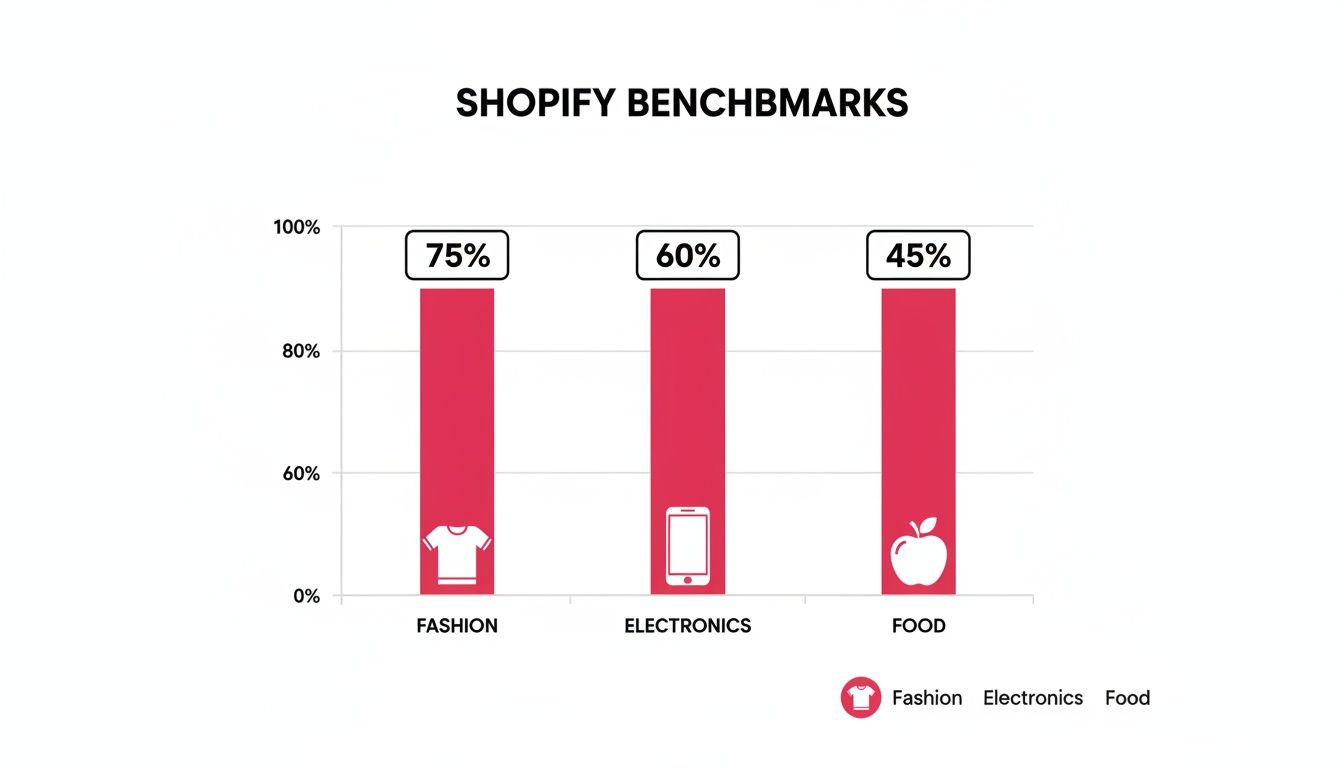
As you can see, a strong conversion rate in electronics might be considered just average in the fashion world. Context is everything.
Build Powerful Social Proof
Here’s a simple truth of ecommerce: shoppers trust other shoppers way more than they trust brands. Social proof is the digital version of a word-of-mouth recommendation. It calms a new visitor’s anxieties and validates their decision to buy from you.
Social proof is the online equivalent of a busy restaurant. An empty one makes you wonder what’s wrong, while a full one signals that it’s a place worth visiting.
Sprinkle social proof throughout your store to build that crucial confidence:
- Display Customer Reviews Prominently: Put star ratings and written reviews right on your product pages where people can see them. Authentic feedback—even if it’s not all five stars—is far more believable than slick marketing copy.
- Use User-Generated Content (UGC): Encourage your customers to share photos of themselves using your products on social media. Featuring these real-world images on your product pages is incredibly powerful.
- Highlight Testimonials and Endorsements: If an influencer or a respected voice in your niche says something great about your product, shout it from the rooftops! Showcase their endorsement on your homepage or key product pages.
Craft Product Descriptions That Sell
Your product descriptions have one job: to sell. They need to do more than just list features and specs; they need to sell an experience or a solution to a problem. A great description answers a customer’s unspoken questions and paints a picture of how much better their life will be with your product.
A weak description leaves shoppers with doubts, and doubt is the ultimate conversion killer.
To write descriptions that are more compelling, focus on these elements:
- Emphasize Benefits, Not Just Features: Don’t just say “waterproof material” (a feature). Say “keeps you completely dry in a downpour” (a benefit). Connect the dots for your customer.
- Use High-Quality Images and Videos: Show your product from every possible angle. Even better, a short video of the product in action can be the next best thing to holding it in their hands.
- Address Objections: Think about what might make a customer hesitate. If you sell clothes, include a super-detailed size guide. If it’s an electronic gadget, make the warranty information clear and easy to find.
By focusing on these three core areas—your checkout, social proof, and product descriptions—you can start making meaningful improvements to your Shopify conversion rate today.
Turn Abandoned Carts Into Revenue with SMS Recovery
Even with a perfectly optimized store, there’s one giant hurdle that can tank your conversion rate: cart abandonment. You’ve done everything right—a customer finds a product they love, adds it to their cart, and starts the checkout process.
Then life happens. The dog starts barking, a work email pops up, or they simply have second thoughts.
Just like that, a sale you practically had in the bag is gone. This isn’t a rare fluke; it’s a constant leak in your revenue stream. For years, the go-to solution has been email reminders, but their power is fading fast. Inboxes are overflowing, and open rates often struggle to even hit 20%.
Why SMS Is the Modern Solution
Now, let’s try a different approach. Instead of an email getting buried under a mountain of promotions, your customer gets a simple text. SMS messages have a near-perfect 99% open rate, and most are read within minutes of being delivered. This immediacy cuts right through the digital noise, re-engaging shoppers while your store is still fresh in their minds.
Think back to our distracted shopper. Ten minutes after they wandered off, their phone buzzes. It’s a friendly text: “Hey, looks like you forgot something! Here’s 10% off to finish your order,” complete with a direct link that takes them right back to their pre-filled checkout.
This isn’t just another reminder—it’s a frictionless path straight back to the purchase. For a deeper dive into this tactic, check out our guide on how to recover abandoned carts with text messages.
The real power of SMS recovery is its ability to combine perfect timing with a personalized offer. It turns a moment of hesitation into an immediate, completed sale by starting a direct conversation in a world full of noise.
Bridging the Checkout Conversion Gap
This strategy directly attacks one of the most critical bottlenecks in the sales funnel. Shopify’s checkout conversion rate—the percentage of people who go from adding an item to their cart to actually buying it—hovers somewhere between 25-40%.
That means for every 100 people who add a product to their cart, as many as 75 walk away without paying. That’s a massive amount of leaked revenue. SMS recovery tools are built to plug that leak. They send automated, localized messages that use a bit of urgency and a well-timed discount to nudge that metric upwards, sometimes pushing it past 50%.
Automated SMS workflows handle all the heavy lifting. These tools can:
- Send Timely Reminders: Automatically text a shopper just minutes after they abandon their cart.
- Offer Dynamic Discounts: Tempt hesitant buyers with a special offer, like free shipping or a percentage off.
- Provide Pre-Filled Checkout Links: Remove every possible barrier by taking them straight to a checkout page with all their info already entered.
By treating cart abandonment as an opportunity, you can give your store’s overall conversion rate a serious lift. You’re not just clawing back lost sales; you’re turning on-the-fence shoppers into loyal customers with a seamless and genuinely helpful experience.