



Think of a payment text message as an e-commerce superpower. It’s an SMS sent straight to a customer’s phone with a direct link to pay, most often used to rescue an abandoned shopping cart. It cuts through the noise and turns a simple text into a direct path to a sale.
What Is a Payment Text Message and Why It Matters
We’ve all seen it happen. A customer meticulously shops on your store, fills their cart with products they clearly want, and then…poof. They vanish. This is cart abandonment, and it’s a massive source of lost revenue for online stores.
It’s like a great conversation that ends abruptly right before the best part. A payment text message is the perfect, personal nudge to get that conversation going again and gently guide the customer across the finish line.
This isn’t just a generic notification. This message contains a clickable link that takes them directly to a pre-filled checkout page. It closes the gap between their intention to buy and the final click, making it incredibly easy to complete the order right from their phone.
The Psychology of Immediate Access
The real magic of a payment text message lies in how immediate and personal it feels. Emails can sit in an inbox for hours, but texts demand instant attention. This direct line to your customer taps into a few powerful psychological triggers:
- Urgency: A quick message reminds the customer of their interest before it has a chance to cool off.
- Convenience: They don’t have to find their way back to your site, relocate their cart, and start over. One click, and they’re right where they left off.
- Trust: A message on a personal device feels more important and direct than a promotional email lost in a crowded inbox.
This potent combination is exactly why SMS is no longer a “nice-to-have” for Shopify or WooCommerce stores. It’s a core tool for recovering sales and building stronger connections with customers.
A payment text message isn’t just a reminder; it’s a service. By simplifying the checkout process, you are actively helping a customer complete a task they already started, turning a potential annoyance into a valued convenience.
To put it simply, here’s a quick breakdown of why this strategy is so effective.
Why Payment Text Messages Work
| Benefit | Business Impact | Real-World Example |
|---|---|---|
| High Visibility | Your message gets seen almost instantly, unlike emails that can get lost or ignored. | A customer abandons a cart during their lunch break. A text arrives 10 minutes later, and they complete the purchase before going back to work. |
| Reduced Friction | A direct link to a pre-filled cart removes steps and makes buying effortless. | Instead of re-entering shipping info, the customer just clicks the link, confirms their details, and pays. The whole process takes less than a minute. |
| Increased Conversions | By making it easy and timely, you recover sales that would otherwise be lost for good. | A store sees a 25% recovery rate on abandoned carts just by sending a single, well-timed SMS with a payment link. |
The Growing Economic Impact of Mobile Payments
This isn’t just theory; it’s backed by huge market trends. The global mobile payment market is on track to explode from $116.14 billion in 2025 to a staggering $1,717.04 billion by 2034.
SMS-based payments are a huge part of this growth, especially since nearly 70% of online shopping carts are abandoned. A tool that can effectively re-engage these shoppers is no longer optional—it’s essential. For a broader look at the innovations in this space, you can check out industry-leading payments-experts.
When a timely payment link can pre-fill checkout details and automatically apply a discount—which is exactly what CartBoss does—it turns this massive market momentum directly into sales for your store. Of course, this is just one of many ways to use SMS, and you can explore more in our guide on the different kinds of text messages brands can send.
Unpacking the Power of SMS in Modern E-commerce
In the world of e-commerce, your customer’s attention is everything. They’re constantly hit with emails, social media ads, and notifications, making it incredibly tough for your message to actually land. This is where the simple, direct power of a payment text message completely changes the game.
Think about it like this: Email is a flyer you get in the mail—it might get a glance, but it’s easily lost in a stack of other promos. Social media is a billboard on a busy highway; you just hope someone looks up. But an SMS message? That’s like a personal, hand-delivered note. It’s almost guaranteed to be opened.
The numbers don’t just support this; they scream it. While the average email open rate is stuck around 21%, SMS messages have a near-perfect open rate of 99%. This isn’t just a small step up; it’s a massive leap in engagement. Your message isn’t just getting sent; it’s getting read, usually within minutes.
Why SMS Cuts Through the Noise
The magic of SMS is its immediacy and personal touch. People have their phones on them constantly, and that text notification creates an urgency that other channels just can’t match. Having that direct line to your customer is priceless, especially when you see how flooded every other platform has become.
It’s also a channel people trust. Unlike email, which is fighting a losing battle against spam filters and overflowing inboxes, a text message feels more personal and important. That trust leads directly to action, especially when you’re trying to recover a sale that’s about to disappear.
This infographic really drives home the key strengths of SMS, showing how it directly solves some of the biggest challenges in e-commerce.
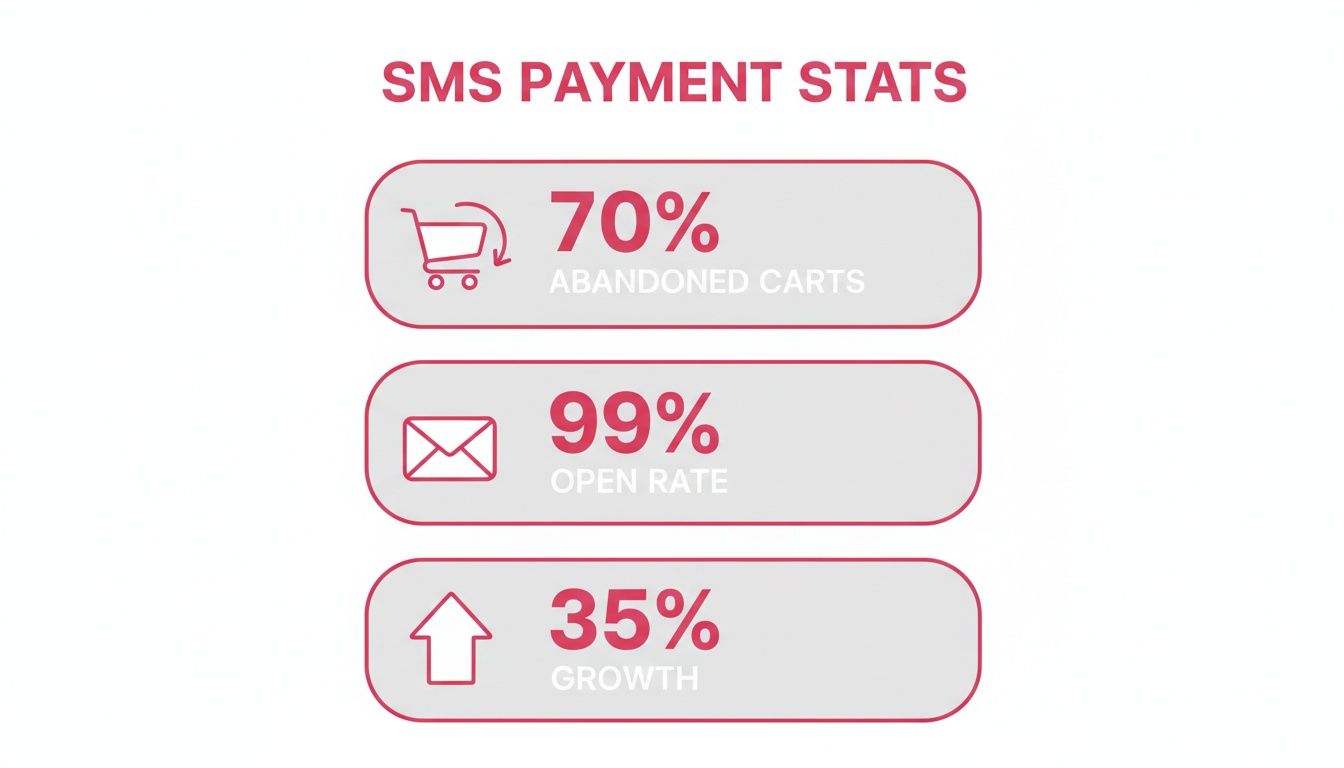
These stats paint a very clear picture: There’s a huge abandoned cart problem out there, and SMS provides a nearly perfect engagement solution that fuels real business growth.
The Undeniable Data Behind SMS Dominance
The explosive growth of SMS marketing isn’t just some passing trend; it’s a reality backed by hard data. In a world where everyone is glued to their phone, SMS marketing has swelled into a massive $327.1 billion global industry. Businesses are pouring money into it because the results are impossible to ignore: 82% of consumers open a text within just five minutes.
For online stores fighting the constant battle against abandoned carts, this is a goldmine. In fact, platforms like CartBoss are built on this principle, sending automated reminders that can boost conversions by up to 50%. You can dive deeper into these figures by checking out the latest SMS marketing statistics.
This isn’t just about reaching people; it’s about connecting with them on the channel they actually use.
The success of SMS isn’t rooted in complex technology but in simple human behavior. It meets customers where they already are—on their phones—with a message that is brief, direct, and actionable.
Translating Engagement Into Revenue
High open rates are nice, but what does that mean for your bottom line? The connection is direct and incredibly powerful. Every single payment text message sent to recover an abandoned cart is a chance to reclaim revenue you would have otherwise lost.
Here’s a quick breakdown of how it works:
- Immediate Re-engagement: A customer gets distracted and leaves your site. A text sent 30 minutes later puts your brand and their cart right back at the top of their mind.
- Frictionless Experience: The message includes a direct link to their pre-filled checkout. This removes the hassle of finding your site again and re-entering their info, which is a huge reason people give up.
- Incentivized Action: You can sweeten the deal with a small, time-sensitive discount right in the text, creating that gentle nudge they need to finish the purchase now.
This simple, automated flow can turn a lost sale into a completed order, time and time again. For businesses using Shopify or WooCommerce, integrating a tool like CartBoss puts this entire revenue recovery engine on autopilot, delivering a massive return on investment by turning forgotten carts into consistent profit.
How to Craft High-Converting Payment Text Messages
Knowing a payment text message works is one thing. Writing one that actually gets people to click and buy is a whole different ball game. The line between a helpful reminder and an annoying spam text can be razor-thin, often coming down to a few carefully chosen words.
A great SMS isn’t just a demand for payment. Think of it as a piece of top-notch customer service, designed to make your customer’s life easier. It should feel less like a sales pitch and more like a friendly assistant reminding them of something they already wanted. Every single part, from the greeting to the link, has to work together to create a smooth, easy path back to your checkout.
This is the natural habitat for your text message. Your customer is likely multitasking, and convenience is everything. A simple, direct link in that text means they don’t have to switch devices or hunt for the right browser tab. You capture the sale right then and there.
Core Elements of a Winning Message
Crafting a compelling text follows a simple but powerful formula. The goal is to be helpful and direct, never aggressive. Let’s break down the essential pieces that every single abandoned cart text needs to have.
- Personalization: Always address the customer by their name. A simple “Hi [Name],” instantly makes the message feel less like a mass-produced blast.
- Clear Context: Don’t make them guess. Immediately remind them what the message is about by mentioning your store name and maybe even the items they left behind.
- A Clear Call-to-Action (CTA): Tell them exactly what to do next. Phrases like “Complete your purchase” or “Finish checking out” are direct, simple, and effective.
- The Payment Link: This is the most crucial part. The link absolutely must take them directly to a pre-filled checkout page. Every extra step you add here is a chance for them to leave again.
Comparing Payment Text Message Templates
Not all abandoned carts are created equal, so your messages shouldn’t be a one-size-fits-all solution. The right tone and offer can change dramatically depending on how much time has passed since they left your site.
Here’s a quick comparison of templates you can adapt, moving from a gentle nudge to a more compelling, urgent offer.
| Scenario | Template Example | Key Elements | Best For |
|---|---|---|---|
| The Gentle Nudge | “Hi [Name]! It’s [Store]. Looks like you left something great in your cart. Ready to make it yours? [Short Link]” | Friendly, low-pressure, assumes they just got distracted. | Sending within the first 30-60 minutes. Catches them while the purchase is still fresh. |
| The Value-Add | “[Store]: Hi [Name], still thinking it over? We saved your cart! Plus, get free shipping when you finish your order. [Short Link]” | Adds an incentive, removes a common friction point (shipping costs). | Sending ~24 hours later. Perfect for customers who were on the fence about the total cost. |
| The Final Offer | “[Store]: We don’t want you to miss out, [Name]! Here’s 10% OFF to help you complete your order. This expires tonight! [Short Link]” | Creates urgency with a discount and a deadline. | Sending ~48 hours later. A strong final attempt to recover the sale before it goes cold. |
Each of these templates serves a different purpose in the recovery timeline. By automating this sequence, you can systematically address different customer hesitations without any manual effort.
Automating the Perfect Message with CartBoss
Let’s be real: manually sending these messages is impossible if you want to grow. This is where an automation tool like CartBoss becomes your secret weapon. CartBoss doesn’t just send texts; it perfects and personalizes them at scale.
A killer feature is that the platform automatically detects the customer’s language and sends a pre-written, translated message that feels native. This small detail can make a massive difference in trust and conversion rates, especially if you sell internationally.
Beyond that, CartBoss intelligently handles dynamic discounts and generates those critical pre-filled checkout links for every single message. This means you can run a sophisticated, multi-step campaign like the one above without lifting a finger.
It ensures the right payment text message hits the customer’s phone at the perfect time, turning a complex recovery strategy into a simple, automated revenue stream. For more ideas, you can find extra tips on perfecting your text message wording in our detailed guide.
Navigating SMS Compliance and Best Practices
Sending a payment text message is about much more than just good copy. The whole process is built on a foundation of customer trust and, just as importantly, legal respect.
Jumping into SMS without knowing the rules is like driving without knowing the traffic laws. You might get away with it for a little while, but sooner or later, it’s going to cause problems. This isn’t about getting tangled up in legal jargon. Think of compliance as the bedrock for a strong, profitable relationship with your customers. When people trust you with their phone number, they expect you to be respectful. Following the rules isn’t just a legal hoop to jump through—it’s just good business that protects your brand’s reputation.
The Golden Rule: Get Explicit Consent
Before you even think about sending a single message, you must have clear and explicit permission from your customer. This is the cornerstone of all SMS marketing regulations, from the Telephone Consumer Protection Act (TCPA) in the US to GDPR in Europe.
This means a customer has to actively agree to receive marketing texts from you. You can’t just assume they’re okay with it because they gave you a phone number at checkout.
- Active Opt-In: The best way to do this is with a checkbox at checkout that is unchecked by default. The customer has to physically click it to agree.
- Clear Language: The text right next to that checkbox needs to be crystal clear. Something like, “Sign me up for exclusive offers and cart reminders via text.”
- No Hidden Terms: Don’t try to bury consent in your general terms and conditions. It needs to be a separate, obvious action.
This initial opt-in is completely non-negotiable. It’s what separates a welcome reminder from an intrusive—and potentially illegal—spam message.
Always Provide an Easy Way Out
Getting permission is step one, but making it easy for customers to change their minds is just as critical. Every single promotional text you send must include a clear and simple way to opt out.
The universal method is letting customers reply with a keyword like “STOP.”
Providing a clear opt-out path isn’t just a legal requirement; it builds immense trust. When customers know they can easily unsubscribe, they’re more likely to subscribe in the first place because they feel in control.
This process should be immediate and fully automated. Once a customer texts “STOP,” they should get one final confirmation message and then be permanently removed from your list. Platforms like CartBoss have these compliance features built right in, automatically managing opt-ins and opt-outs so you don’t have to guess. You can dive deeper into building a compliant program by reviewing the essentials of SMS marketing compliance.
Best Practices for Deliverability and Trust
Beyond the legal stuff, a few key practices will make sure your messages not only land in the inbox but are actually welcomed by your customers.
- Use a Branded Sender ID: Whenever you can, send messages from a recognizable name (your brand) instead of a random number. It instantly builds credibility and boosts open rates.
- Mind Your Timing: Send messages during reasonable hours. An automated “Do-Not-Disturb” feature that respects local time zones is a must-have, especially if you have a global audience.
- Avoid Spam Triggers: Stay away from using ALL CAPS, a ton of exclamation points, or spammy-sounding phrases like “FREE MONEY!!!!”. These can get your messages blocked by carrier filters.
- Stay Relevant and Valuable: Every message has to offer clear value. Whether it’s a helpful reminder with a pre-filled cart or an exclusive discount, make sure your text actually serves the customer’s needs.
Automating Your Sales Recovery with CartBoss
Knowing the theory behind a killer payment text message is one thing. Actually turning that knowledge into a hands-off, automated profit machine is the real goal. This is where a specialized tool bridges the gap, putting your entire sales recovery process on autopilot so you can focus on growing your business.
Think of it like having an expert salesperson working 24/7 to chase down every single abandoned cart. That’s exactly what a solution like CartBoss does. It’s built from the ground up to handle the tricky stuff we’ve discussed—timing, personalization, compliance—and quietly turn lost revenue into completed sales in the background.
Getting started is designed to be ridiculously simple. You can plug a powerful SMS tool like this directly into your existing e-commerce platform in just a few clicks.
This kind of direct integration with platforms like Shopify and WooCommerce means you’re up and running in minutes, not days. It’s a true “set it and forget it” system that starts boosting your sales from the moment it’s activated.
Core Features That Drive Conversions
Smart automation is about more than just firing off a text. It’s about creating a seamless, frictionless experience that makes it incredibly easy for your customer to come back and click “buy.” A few key features work together here to knock down any potential barriers.
- Pre-Filled Checkouts: This is an absolute game-changer. When a customer taps the link in their text, they’re taken straight to a checkout page where their cart, shipping info, and contact details are already filled out. All they need to do is enter their payment details and they’re done.
- Automatic Language Detection: Selling to a global audience? This is essential. The system automatically figures out the customer’s country and sends a pre-written message in their native language. This small touch builds instant trust and makes the message feel personal.
- Dynamic Discounts: You can automatically slip a unique discount code into the recovery text. Sometimes, that little incentive is the final nudge a hesitant shopper needs to pull the trigger.
These features work in concert to turn a simple reminder into a high-powered conversion tool. For you, the store owner, it means a sophisticated and personalized recovery campaign runs on its own, without you lifting a finger. If you want to dive deeper, check out our guide on setting up an auto SMS responder.
The Global Shift to Text-Driven Payments
This move toward SMS recovery isn’t just some niche strategy; it’s part of a massive global trend. Digital payment volume has exploded to $18.7 trillion, and text messages are a huge piece of that puzzle, especially for instant nudges like abandoned cart reminders.
When you consider that the average cart abandonment rate is still hovering around 69.8%, the 82% read rate of SMS messages offers a direct line to reclaiming that lost cash. It’s fast, effective, and cuts through the noise.
The real power of automation is that it lets you execute a perfect strategy, consistently and at scale. It ensures every abandoned cart gets the right follow-up at the right time, turning a common e-commerce headache into a predictable revenue stream.
By plugging in a tool designed specifically for this job, any Shopify or WooCommerce store owner can transform their abandoned cart problem into a reliable source of income. It’s not just about sending a payment text message; it’s about building an automated system that squeezes the maximum value out of every single sales opportunity.
How to Measure and Optimize Your SMS Strategy
A great marketing strategy isn’t something you just set and forget; it’s a living, breathing process that feeds on data. Sending a payment text message is really just the first step. The real magic—and the real growth—happens when you dig into what’s working, what isn’t, and start tweaking your approach based on what you see.
Measuring your campaign success is more than just watching sales figures. It’s about dissecting the entire journey, from the moment someone gets that text to the final click of the “buy” button. This is how you turn hopeful guesses into a predictable engine that drives revenue. By tracking the right numbers, you get a crystal-clear picture of your performance and find the insights you need to make smart, data-backed decisions.
Key Metrics That Truly Matter
If you want to fine-tune your SMS strategy, you have to look past the vanity metrics and zero in on the numbers that actually move the needle on revenue and engagement. These are the core stats that tell you if your texts are putting money in the bank.
- Conversion Rate: This is the big one. It’s the percentage of people who actually finish their purchase after clicking the link in your text. A high conversion rate is a great sign that your message is hitting the mark and your checkout is nice and smooth.
- Click-Through Rate (CTR): This number tells you what percentage of people who got your text actually clicked the payment link. A strong CTR means your copy and timing are grabbing their attention right when it matters most.
- Return on Ad Spend (ROAS): This is the clearest indicator of profitability. It calculates how much revenue you’re making for every dollar you spend on your SMS campaigns. It’s the bottom-line metric that shows the financial impact of your strategy.
Think of it this way: your goal isn’t just to send messages, it’s to create a profitable feedback loop. Getting a high CTR but a low conversion rate? The problem probably isn’t the text—it’s likely something on your checkout page. Seeing a low CTR? That’s your cue to refresh your message copy or experiment with the timing.
The Power of A/B Testing
Once you start tracking these metrics, you can begin to actively improve them with A/B testing. It’s a simple concept: you send two slightly different versions of a message to small groups of your audience to see which one performs better. You can test just about anything.
- Message Timing: Does a text sent 30 minutes after they leave convert better than one sent an hour later?
- Copy and Tone: Is a friendly, casual vibe more effective than a direct, more urgent tone?
- Offers and Incentives: Does a 10% discount pull in more sales than a “free shipping” offer?
By testing just one thing at a time, you can systematically figure out exactly what resonates with your customers and slowly but surely bump up your conversion rates. To really prove the value of your SMS payment campaigns, you’ve got to master how to calculate marketing ROI and understand what the numbers are telling you.
Platforms like CartBoss make this whole process ridiculously simple by giving you a clean analytics dashboard. You can see all your key metrics at a glance without getting buried in spreadsheets, making it easy to spot trends and jump on opportunities. To get a better feel for what good performance looks like, check out our guide on improving SMS marketing conversion rates. It’s all about creating a system where every payment text message you send is a little bit smarter than the last.
Got Questions About Payment Texts? We’ve Got Answers
So, you’re thinking about adding text messages to your eCommerce playbook. Smart move. But you probably have a few questions floating around. Let’s tackle the common ones head-on so you can get started with confidence.
Getting your SMS strategy up and running is usually simpler than you’d think, especially once you grasp the basics of getting permission and offering real value.
Is It Actually Legal to Send Customers a Payment Text?
Yes, it’s 100% legal, but with one non-negotiable rule: you absolutely must have explicit permission (an opt-in) from the customer to send them texts.
Regulations like the TCPA in the US and GDPR in Europe are very clear on this. You also have to give them an easy way out, like replying “STOP” to unsubscribe. The good news is that a compliant platform handles all these rules for you, so you don’t have to sweat the legal details.
When Is the Best Time to Send a Cart Recovery Text?
Timing is everything. You want to catch them while the purchase is still fresh in their mind, but not so fast that it feels creepy. The sweet spot is generally 30 to 60 minutes after they’ve left their cart behind.
This window gives them a moment but doesn’t let them forget what they were looking at. While that’s a solid starting point, you should always test different delays to see what clicks with your audience and products.
Will I Annoy My Customers with Payment Reminder Texts?
Not if you do it right. When these texts are framed as a helpful service rather than a sales pitch, customers actually appreciate them. You’re not just nagging them to buy; you’re making their life easier with a direct link back to a cart you saved for them.
By framing the message as a convenience—”Hey, we saved your items for you!”—you turn a potential annoyance into a welcome reminder. As long as you respect opt-outs and send messages at decent hours, you’re golden.
Tossing in a small discount can also make the message feel more like a friendly tip than a demand.
What Kind of Conversion Rate Can I Realistically Expect?
This is where SMS really shines. While results will vary, text messages consistently blow other marketing channels out of the water. With open rates that often hit over 98%, the potential is huge.
It’s not uncommon for online stores to see cart recovery conversion rates between 15% and 30% from SMS alone. Some finely-tuned campaigns do even better. A solid text message strategy can be a massive revenue booster, capturing sales that would have otherwise just slipped away.
Ready to turn those abandoned carts into your biggest revenue stream? CartBoss automates your sales recovery with smart, effective text message campaigns that customers actually like. Start converting lost sales into profit today by visiting https://www.cartboss.io.
