

Seven in ten shoppers who fill a cart leave without paying. That’s not a traffic problem you can ad spend your way out of, it’s a follow-up problem, and it’s why SMS customer engagement earns its keep when it’s treated as a consent-based conversation instead of another broadcast blast. Done well, you recover high-intent orders, answer the question that blocked checkout, and measure every message against revenue. Done poorly, you train customers to reply STOP.
Table of Contents
- Why SMS Customer Engagement Deserves a Place in Your Stack
- How SMS Engagement Actually Works
- Building a Compliant Opt-In Flow That Converts
- Segmenting and Personalizing Without Crossing the Line
- Messaging Tactics That Drive Clicks and Replies
- Measuring SMS Engagement Beyond Open Rates
- Choosing the Right SMS Engagement Tool
- Your First 30 Days of SMS Customer Engagement
Why SMS Customer Engagement Deserves a Place in Your Stack
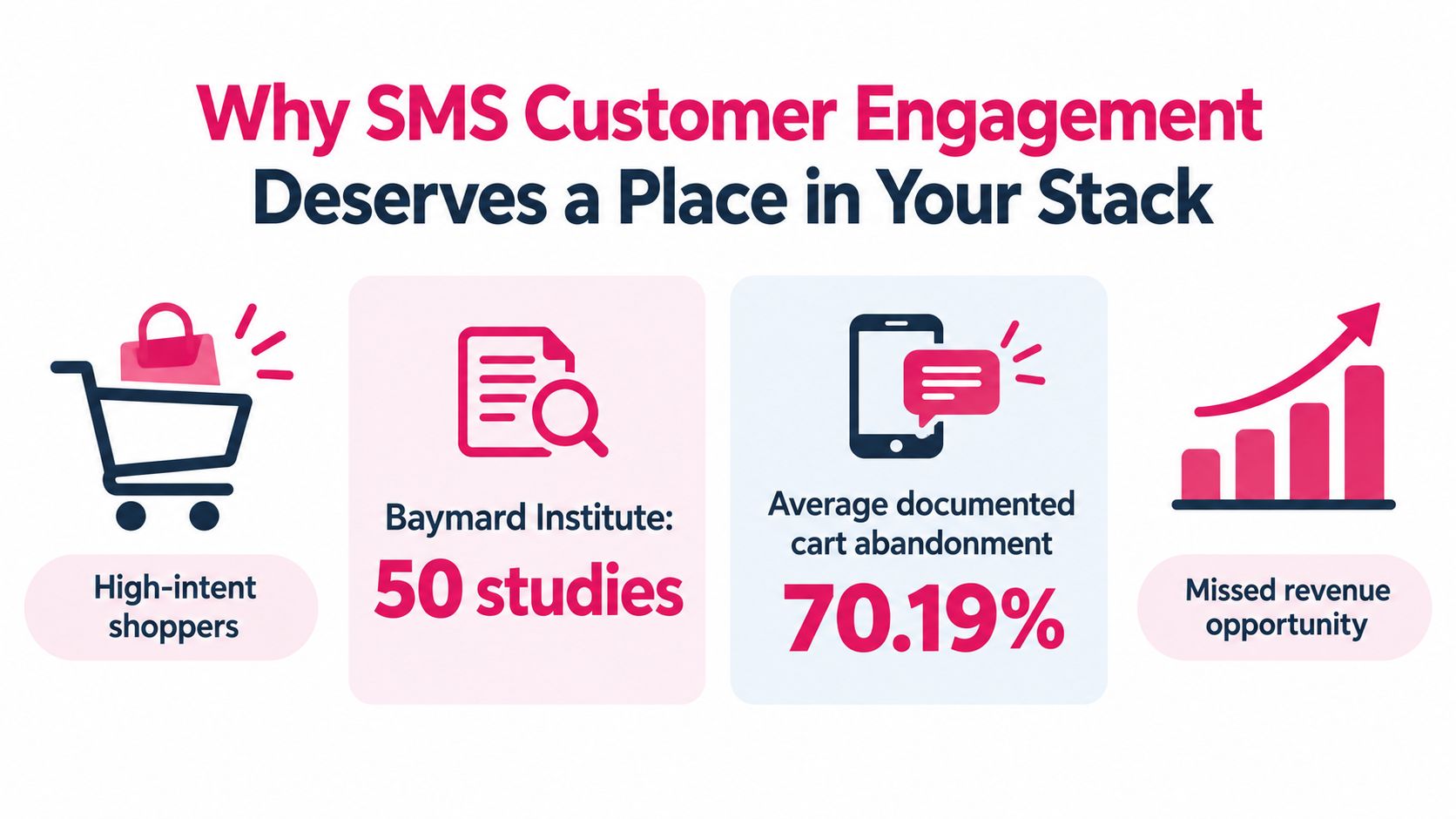
Baymard Institute’s running analysis of 50 studies reports an average documented cart abandonment rate of 70.22%. Read that as an operator, not a marketer. Roughly seven in ten documented carts never become orders, which means your checkout already creates more high-intent leads than most campaigns ever will. SMS customer engagement belongs in your stack because it works that existing demand before you buy more of it.
The Three Jobs SMS Does Best
- Recover abandoned carts: A short reminder with a direct checkout link reaches a shopper while the product, price and reason for hesitating are still fresh.
- Drive repeat purchases: Post-purchase follow-ups, replenishment prompts and loyalty offers land in a channel customers already check throughout the day.
- Deliver time-sensitive updates: Delivery changes, back-in-stock alerts and expiring offers lose value if they sit unread in an inbox for hours.
Email does all three jobs eventually. SMS does them now, and that timing difference is the whole commercial case. A cart reminder read tomorrow competes with every other store the shopper visited. A cart reminder read while they’re still comparing shipping options can close the sale.
That immediacy comes with a trade-off you can’t ignore. A text feels personal in a way an email doesn’t, so an irrelevant text feels intrusive in a way an irrelevant email doesn’t either. Customers forgive a forgettable email. They opt out of a noisy text program and they rarely come back.
High consumer use of texting doesn’t grant you permission to text. Usage is the opportunity, consent is the license.
Set your expectation accordingly before you send anything. SMS isn’t a cheaper way to blast promotions at a bigger list. It’s a narrower channel with a higher bar for relevance, frequency and timing, and the programs that respect that bar are the ones that keep delivering recovered revenue month after month. The rest of this guide builds that kind of program, starting with how the channel behaves.
How SMS Engagement Actually Works
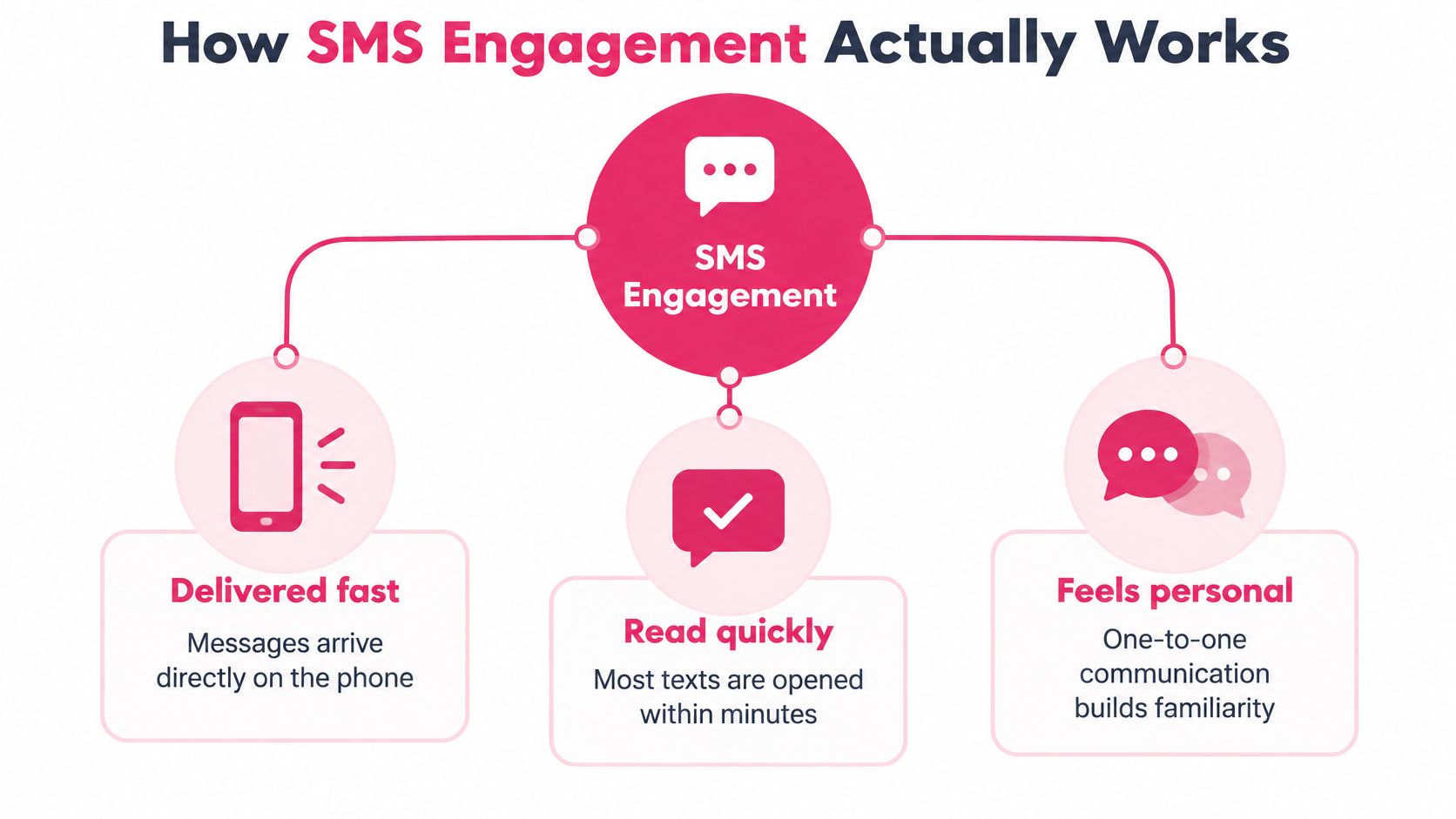
Texting isn’t a new behavior you’re asking customers to adopt. By 2015, 97% of smartphone owners had used text messaging at least once during a Pew Research Center study period, exceeding voice calling, internet and email, and participants reported using it during the previous hour in an average of 7 out of 14 survey check-ins. That combination, near-universal adoption plus repeated recent use, is what makes SMS structurally different from every other channel you run.
The diagram below maps the three mechanics behind that advantage.
Why the Channel Feels Different
SMS doesn’t depend on an app install, an operating system or an inbox filter. It works on virtually any phone, it arrives with a notification few have muted, and it sits in the same thread as messages from family and friends. That context is earned trust you borrow every time you send.
That borrowed trust explains the use cases where SMS outperforms. Delivery updates, reminders, authentication codes, promotional alerts and abandoned-cart prompts all share one trait. Their value decays fast, and SMS reaches people while the value is still intact.
This short walkthrough shows how an event-triggered message moves from a store action to a customer’s phone.
Transactional Versus Promotional
Every message you send falls into one of two buckets, and confusing them is where programs get into trouble. Transactional messages relate to an order or action the customer already took, such as shipping confirmations or cart contents they asked about. Promotional messages try to create a new sale, such as discounts, launches and sale announcements.
The distinction matters because permission, timing rules and customer tolerance differ between the two. A shopper who gave you a number for delivery tracking hasn’t agreed to weekly offers. Keep the buckets separate in your consent records, your copy and your reporting, and the compliance work in the next section gets much simpler.
Building a Compliant Opt-In Flow That Converts
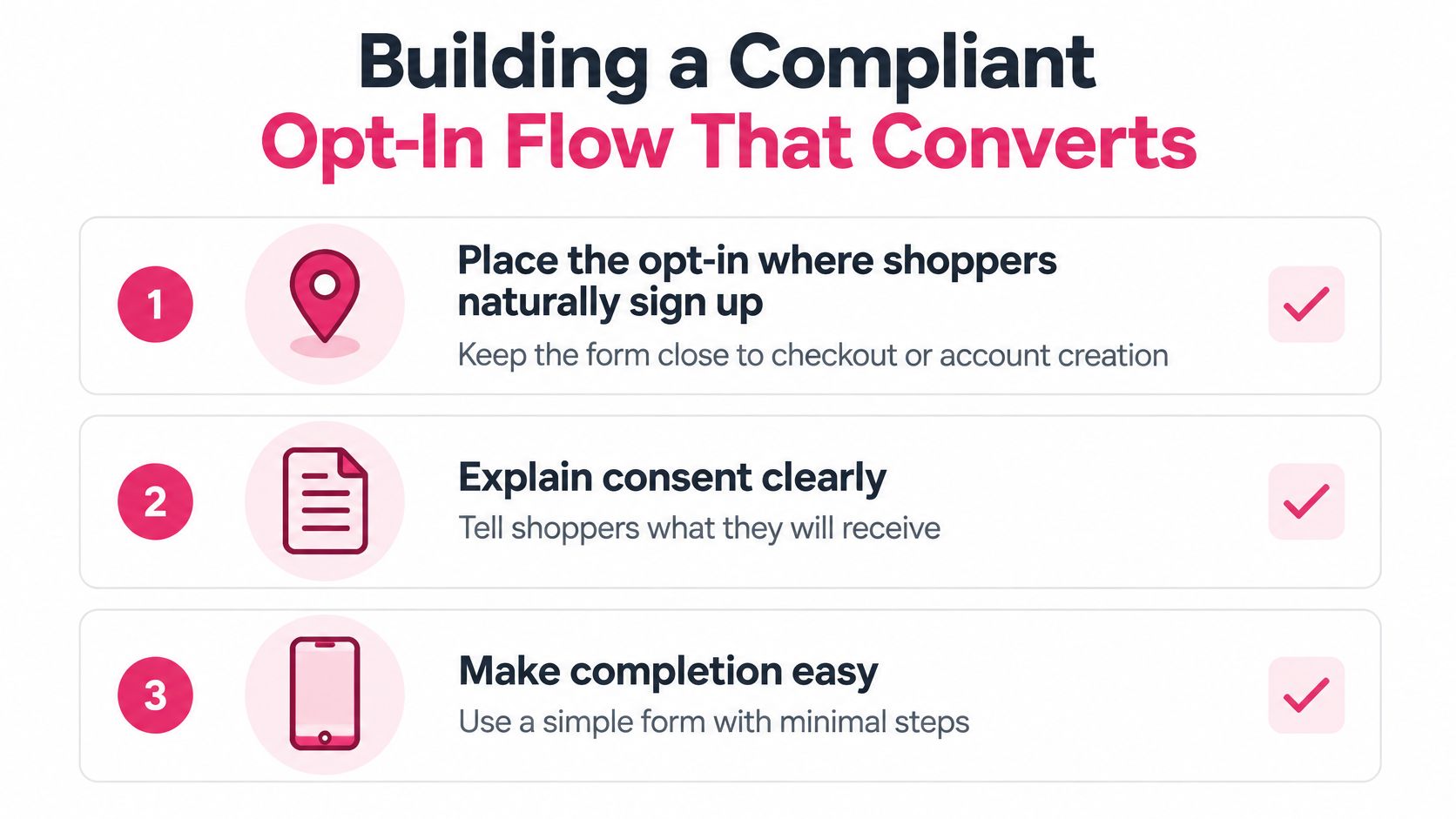
CTIA guidance says senders should obtain consent generally, obtain express written consent specifically for marketing messages, and provide a mechanism to revoke it, with opt-in confirmed in the first message and opt-out requests acknowledged and acted on. Treat that as a design spec, not legal fine print. A clean opt-in converts better because shoppers who understand what they’re joining don’t panic when the first text arrives.
Place the Ask Where Intent Already Exists
Checkout is your strongest placement because the shopper is already sharing contact details, but it’s also where confusion does the most damage. Add a separate, unchecked consent box with plain language instead of burying permission in your terms. Our walkthrough on designing an SMS opt-in that shoppers actually complete covers placement and wording patterns in detail.
Post-purchase and account settings placements convert at lower volume but produce subscribers who know your brand already. Popups produce volume and the weakest consent quality, so if you use one, state message type and frequency in the form itself, not in a footnote.
What a Defensible Consent Record Contains
- Phone number and timestamp: The exact number given and when it was given, stored automatically, not typed into a spreadsheet later.
- Collection source: Which form, page or flow captured it, so you can audit a complaint back to its origin.
- Disclosed program and purpose: The wording shown, the message frequency promised, and whether consent covers transactional updates, marketing, or both.
- Consent status and suppression: A live flag checked before every send, so an opt-out anywhere blocks sending everywhere.
Practical rule: If you can’t show when, where and under what wording a number opted in, don’t send to it.
A phone number captured for order fulfilment is not marketing permission. Store the two separately, enforce your suppression list before every campaign, and include a working STOP pathway in every recurring message. An automated quiet-hours schedule is fine for sending, but it must never delay processing an opt-out. Programs survive on this plumbing, not on clever copy.
Segmenting and Personalizing Without Crossing the Line
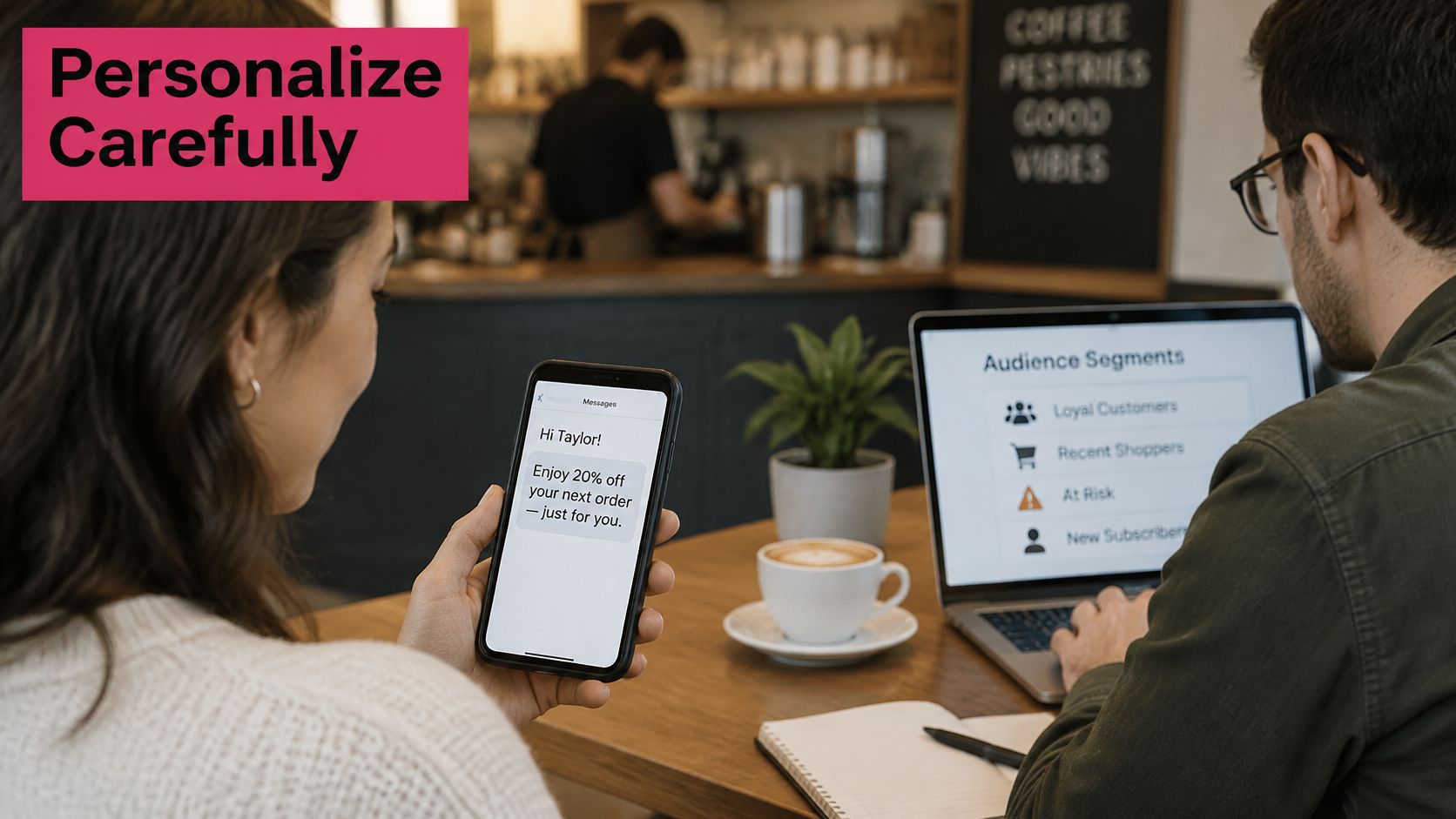
Personalization works when it reflects something the customer did. A 2025 consumer study found that 64% of consumers wanted incentives or loyalty content and 56% supported offers based on birthdays or purchase history, while only 13% were comfortable sharing an address and 9% their income. That gap is your segmentation strategy in one sentence. Customers welcome relevance built on their transactions and resist relevance built on their private lives.
A Privacy-First Segmentation Framework
Start with data the abandoned transaction itself gives you. Segment by cart value, product category, customer status and prior engagement, because each one changes what a helpful message looks like. A returning customer with a high-value cart may need a shipping answer, not a discount. A first-time visitor with a small cart may need reassurance about returns.
Our guide to personalized SMS messages that use purchase context well shows how to reference the cart without sounding like surveillance. The core technique is transparency. Name the reason for the message, reference the item they left, and stop there.
Compare two openers for the same cart:
- Helpful: “You left the Trail Runner in your cart at checkout. Here’s your link to finish, and replies reach our team.”
- Intrusive: “We noticed you browsed running shoes at lunch near your office. Still interested?”
The first uses transaction data the shopper knowingly created. The second reveals tracking they didn’t knowingly agree to, and that feeling drives opt-outs even when the offer is good.
Frequency and Global Audiences
Cap frequency across campaigns, not per campaign, because customers experience your total volume, not your internal campaign structure. If cart recovery, a product launch and a loyalty offer all fire in the same week, the subscriber just feels chased.
If you sell internationally, don’t treat every subscriber as one audience. Localize consent language, identify your sender clearly, respect quiet hours in the recipient’s time zone, and calibrate discount messaging to local expectations. A message that reads as energetic in one market reads as pushy in another, and your opt-out rate by country will tell you which is which.
Messaging Tactics That Drive Clicks and Replies
Blueshift’s 2023 benchmark report, citing Sinch research, found that SMS generated a click-through rate 26% higher than email, while 89% of surveyed consumers wanted to initiate and reply to two-way business conversations. Most stores work hard on the first half of that finding and ignore the second. They optimize the send and abandon the reply, which is exactly backwards for cart recovery.
Anatomy of a Message That Earns a Click
Keep one job per message. Identify your brand in the first few words, name the specific product or reason, give one clear call to action, and place one link. Two links split attention and complicate your click data, and vague urgency (“Hurry!! Act now!!”) reads as spam to customers and to carrier filters.
Template for a first cart reminder:
“[Brand]: You left [product] in your cart. Complete your order here: [link]. Questions on sizing or shipping? Just reply. Reply STOP to end.”
That template works because every element earns its place. Brand first for recognition, product for relevance, link for action, reply invitation for objections, STOP for trust.
Timing, Sequence and the Reply Path
Send the first reminder while the product is still top of mind, then give each later message a different job. A workable sequence looks like this:
- Reminder: Restate the cart and link, no incentive. Watch click-through rate.
- Objection handling: Answer the common blockers, shipping cost, delivery time, returns. Watch reply rate.
- Incentive: Offer help or a discount if margin allows. Watch recovered revenue per message and discount cost.
The reply path is what separates this from a broadcast. When a shopper can ask about sizing, shipping or a discount inside the same thread, you resolve the objection without forcing them to reopen your site and hunt for support. Our breakdown of two-way SMS messaging for ecommerce conversations covers routing and response handling in more depth.
Avoid copy that undermines all of this. Skip excessive capitalization, stacked exclamation marks, misleading claims about stock or deadlines, and shortened links from generic public shorteners that carriers distrust. If a message needs pressure tactics to work, the targeting or timing is wrong.
Measuring SMS Engagement Beyond Open Rates
Delivery and open data tell you a message arrived. They don’t tell you it worked, and optimizing for them leads stores to send more messages to more people while revenue stays flat. Recent survey data shows 52% of consumers text businesses more often than before, 47% use SMS to share feedback, and 57% expect a business response within 15 minutes. If customers treat SMS as a conversation, your measurement has to as well.
The Metric Stack That Matters
| Metric | Question It Answers | Action It Triggers |
|---|---|---|
| Click-through rate | Did the message earn attention? | Rewrite the opener or offer |
| Recovered revenue per delivered message | Did it make money after costs? | Scale, hold or cut the sequence |
| Reply rate and response time | Are shoppers talking back, and are you answering? | Staff or automate reply handling |
| Time to purchase | How fast does the nudge convert? | Adjust send delay |
| Opt-out rate by sequence step | Where does fatigue start? | Shorten the sequence or drop a step |
Our guide to SMS campaign analytics and reporting walks through building this view without a data team.
Benchmark First, Then Test Cleanly
Measure your own abandonment rate before you launch. Without that baseline you can’t tell incremental recovery from orders that would’ve happened anyway, and every vendor dashboard will happily take credit for both.
Then run one clean test at a time. Compare an initial reminder sent shortly after abandonment against a later reminder carrying an incentive, holding audience and offer conditions consistent. Segment results by cart value, product category and customer status to learn whether discounts or helpful replies did the actual work. If opt-outs climb while recovered revenue stays flat, that’s not a copy problem. It’s a frequency problem, and sending harder makes it worse.
Choosing the Right SMS Engagement Tool
Build versus buy is the first decision, and for most stores it’s not close. Building your own sending infrastructure means owning carrier relationships, consent storage, suppression logic and deliverability troubleshooting. Buying means renting all of that and spending your time on offers and copy instead. Unless messaging is your product, buy.
Criteria That Actually Predict Results
- Consent capture: Does the tool store timestamped opt-in records with source and wording, and enforce suppression before every send?
- Event-triggered automation: Can it fire messages from cart, checkout and purchase events without manual list uploads?
- Reply handling: Where do customer replies go, who sees them, and how fast can your team respond?
- Compliance features: Look for automatic do-not-disturb scheduling, easy unsubscribe handling and support for GDPR and CCPA requirements.
- Revenue reporting: Does it report recovered revenue and discount cost, or only sends and clicks?
General-purpose SMS platforms give you broad campaign flexibility and leave ecommerce specifics to you. Cart-recovery specialists trade that breadth for pre-built checkout flows. CartBoss sits in the second category. It’s built for Shopify and WooCommerce, runs automated recovery campaigns, ships pre-written and translated messages with automatic language detection, applies dynamic discounts, uses a branded sender ID, and includes automatic do-not-disturb mode and easy unsubscribe handling.
Our comparison of the best SMS marketing software for online stores lays out how the main categories differ on pricing and features.
Ask every vendor one question on the demo: “Show me exactly what happens when a customer replies STOP, and then show me the consent record for a subscriber.” Hesitation there tells you everything.
Take the criteria list into demos, test with your own cart data, and judge tools on recovered revenue during the trial rather than on feature checklists. The right tool makes compliant, conversational sending the default instead of something your team has to remember.
Your First 30 Days of SMS Customer Engagement
Week one, audit and benchmark. Record your current abandonment rate, review every place you collect phone numbers, and check whether consent records exist for your existing list. Your output is a baseline number and an honest consent inventory.
Week two, build and comply. Fix your opt-in wording, set up suppression enforcement, and write your first three-message cart sequence. If shipping cost objections dominate your support tickets, it helps to weigh shipping fees against extra purchases before you decide whether a free-shipping threshold belongs in your second message.
Week three, launch and test. Send one cart-recovery sequence to a small segment and run a single timing test. Assign a real person to watch replies during business hours.
Week four, review and scale. Read recovered revenue, reply rate and opt-outs by sequence step against your week-one baseline. Scale only what beat the benchmark, and fix the reply path before you raise frequency, since scaling volume on top of unanswered replies is the most common way new programs stall.
Ready to turn that first cart sequence into recovered orders? CartBoss connects to your Shopify or WooCommerce store, sends automated and translated recovery texts with dynamic discounts, and handles do-not-disturb timing and unsubscribes for you. Start with one small segment, compare the recovered revenue against your baseline, and let the numbers make the case.