

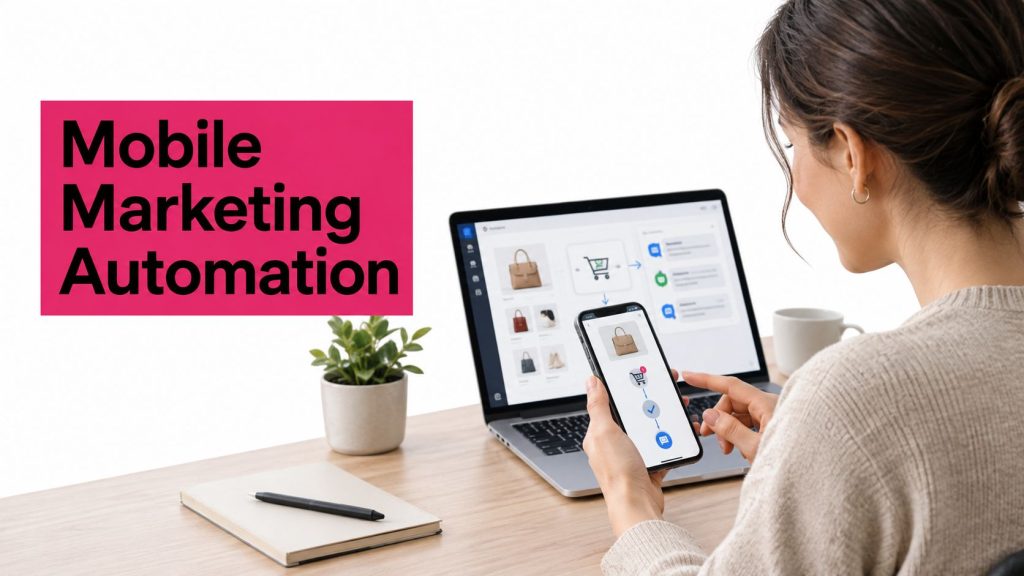
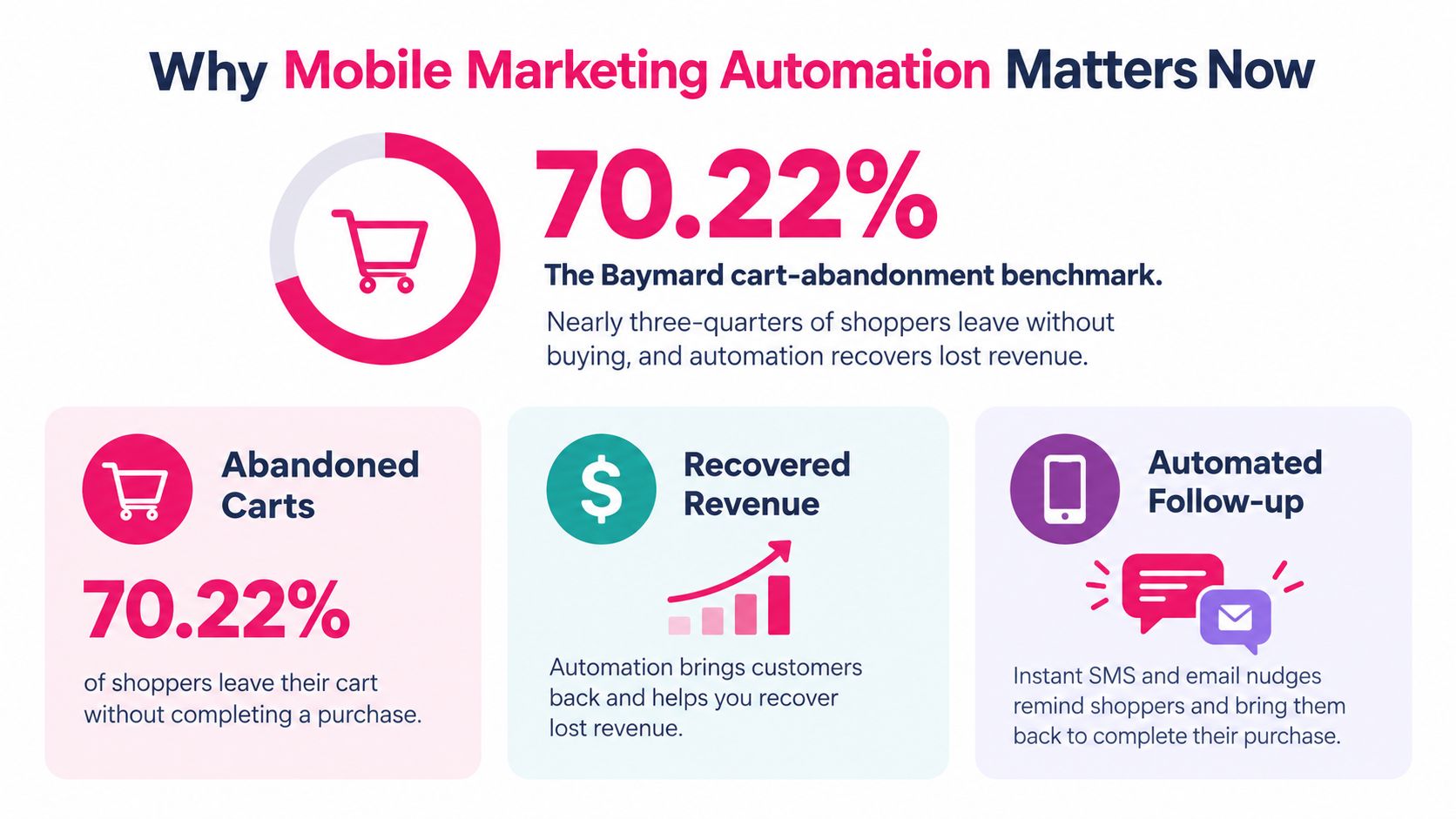
70.22% of online shopping carts are abandoned, according to Baymard’s compilation of cart-abandonment studies. That’s a substantial gap between purchase intent and completed revenue, but sending every shopper more reminders isn’t the answer. Effective mobile marketing automation starts by deciding which message deserves the customer’s attention, then proving that it helped produce an additional sale.
Table of Contents
- Why Mobile Marketing Automation Matters for E-Commerce Now
- What Mobile Marketing Automation Actually Is
- SMS, Push, In-App, and Messaging Apps Compared
- Five Automation Workflows You Can Launch This Week
- Frequency Governance and the Cross-Channel Contact Budget
- KPIs, Attribution, and Reporting That Actually Matter
- Compliance, Deliverability, and Localisation
- Your Mobile Marketing Automation Launch Plan
Why Mobile Marketing Automation Matters for E-Commerce Now
An abandoned cart represents potential revenue, not a guaranteed sale. Some customers need reassurance; others encounter checkout friction or are not ready to buy. Treating all of them as discount prospects wastes margin and risks irritating people who would have returned anyway.
Mobile marketing automation is a revenue-protection system, not a faster way to broadcast promotions. It connects customer behavior to an appropriate response while giving marketers rules for when to stay silent.
The scale is substantial: 4.7 billion people used mobile internet on their own devices by the end of 2024, according to GSMA’s Mobile Economy report. For an individual store, however, the useful starting audience is much narrower: shoppers who showed purchase intent and gave permission to receive marketing.
The recovery opportunity is easiest to understand as a funnel.
Start with coordination, not channel selection
Before choosing SMS, push, in-app messaging, or a messaging app, establish these operating decisions:
- Define the customer goal. Help someone resume checkout, discover a relevant product, or use a purchase successfully.
- Reserve a contact budget. Decide how much promotional contact a customer should receive across all connected channels.
- Set eligibility rules. Use intent, permission, recent activity, and commercial value to determine whether a message qualifies.
- Measure additional revenue. Separate orders influenced by messaging from purchases that would have happened anyway.
For broader commercial planning, Tagada’s 2026 revenue guide for ecommerce is a useful companion resource.
The practical starting point isn’t a complicated lifecycle program. It’s a coordinated recovery journey with a clear customer benefit, a low-friction destination, and an explicit reason to stop.
What Mobile Marketing Automation Actually Is
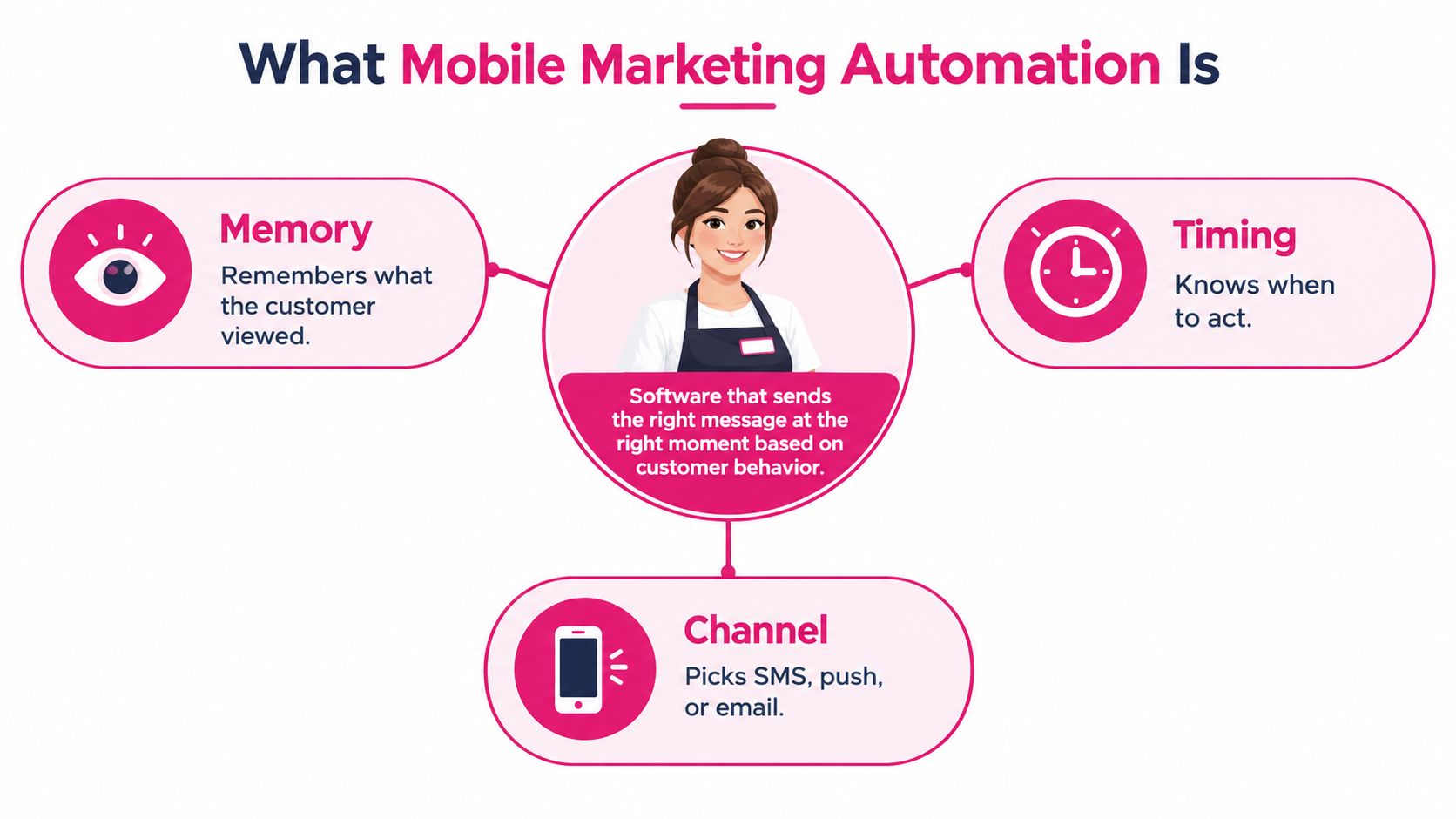
Think of an attentive shop assistant who remembers the product a customer considered, notices when they leave the counter, and follows up politely. The useful part isn’t the reminder alone. It’s remembering the context and recognizing when another approach would be unwelcome.
Mobile marketing automation uses customer events and decision rules to send relevant messages through mobile channels. A scheduled promotion might use the same delivery infrastructure, but it doesn’t necessarily respond to an individual customer’s behavior.
The operating model connects memory, timing, and communication.
The building blocks
- Data source. Collect product views, checkout activity, completed orders, customer attributes, and channel-specific permission. On Shopify or WooCommerce, verify that these events retain a consistent customer identity.
- Decision engine. Evaluate eligibility, timing, channel, incentive, and suppression rules. A customer with an unresolved support issue might qualify for assistance but not a promotional upsell.
- Outbound channel. Deliver the selected message, then return delivery and engagement information to the customer record.
The decision engine matters most when journeys overlap. A shopper might qualify for a welcome offer, browse reminder, and cart reminder simultaneously. Without shared rules, separate automations can send all of them.
Practical rule: Evaluate eligibility again immediately before sending, not only when the customer enters a workflow.
Marketing isn’t the same as service messaging
An order confirmation serves an existing purchase. A message encouraging another purchase serves a marketing purpose. Keep those purposes distinct in templates, permissions, and reporting rather than assuming that a checkout phone number authorizes every subsequent message.
A useful software evaluation question is: Can this workflow change its action when the customer’s situation changes? If it can only send a prepared message at a scheduled time, you’re evaluating scheduling, not a complete behavioral automation system.
SMS, Push, In-App, and Messaging Apps Compared
Choose channels by customer context, not a universal open-rate promise. A message can attract attention without creating additional revenue, and an intrusive message can produce a click while weakening the relationship.
Mobile channel comparison for e-commerce
| Channel | Typical open rate | Cost per send | Best use case | Key limitation |
|---|---|---|---|---|
| SMS | No universal benchmark established here | Provider, market, and message-segment dependent | Permission-based checkout recovery | Delivery cost and interruption risk |
| Push | Depends on audience and measurement definition | Assess platform and implementation costs | Relevant alerts for opted-in users | Customers can disable notifications |
| In-app | Not directly comparable with inbox opens | Assess implementation and platform costs | Contextual help during an active session | Cannot reach an absent customer |
| Messaging apps | Channel and market dependent | Check platform and provider pricing | Preferred-market conversations and recovery | Requires suitable permission and channel access |
Match interruption to intent
SMS is a reasonable candidate when the shopper has demonstrated clear purchase intent and needs a direct route back. Opt-in requires a clear marketing permission process, not merely collecting a number. Compare the operational trade-offs in this SMS versus push notification guide.
Push suits relevant updates for customers who have granted notification permission. It shouldn’t become an unlimited promotional outlet just because its sending economics differ from SMS. Evidence summarized by SMB Guide’s mobile marketing trends reports that 43% of users disable push after receiving two to five notifications weekly, while 30% stop using an app at six to ten weekly notifications.
Those findings don’t establish a universal safe frequency. They do make unlimited push exposure a poor default.
In-app messages belong inside the shopping experience: explain delivery options, clarify product selection, or help a returning customer resume a task. Assess them against completed actions, not inbox-style opens. Their narrow reach is also useful discipline: the customer must already be present.
Messaging apps deserve consideration where customers prefer them. Don’t assume an SMS audience automatically wants promotional conversations elsewhere; verify channel access and permission separately.
Use a goal-based selection rule
- Help during a session. Prefer a contextual in-app message over an unnecessary external interruption.
- Recover clear purchase intent. Evaluate SMS against the customer’s permissions, preferences, and available alternatives.
- Share a routine update. Choose the least disruptive suitable channel.
- Support a conversation. Consider a messaging app where customers already expect that interaction.
A channel earns its place through customer usefulness and incremental margin, not an impressive-looking engagement dashboard.
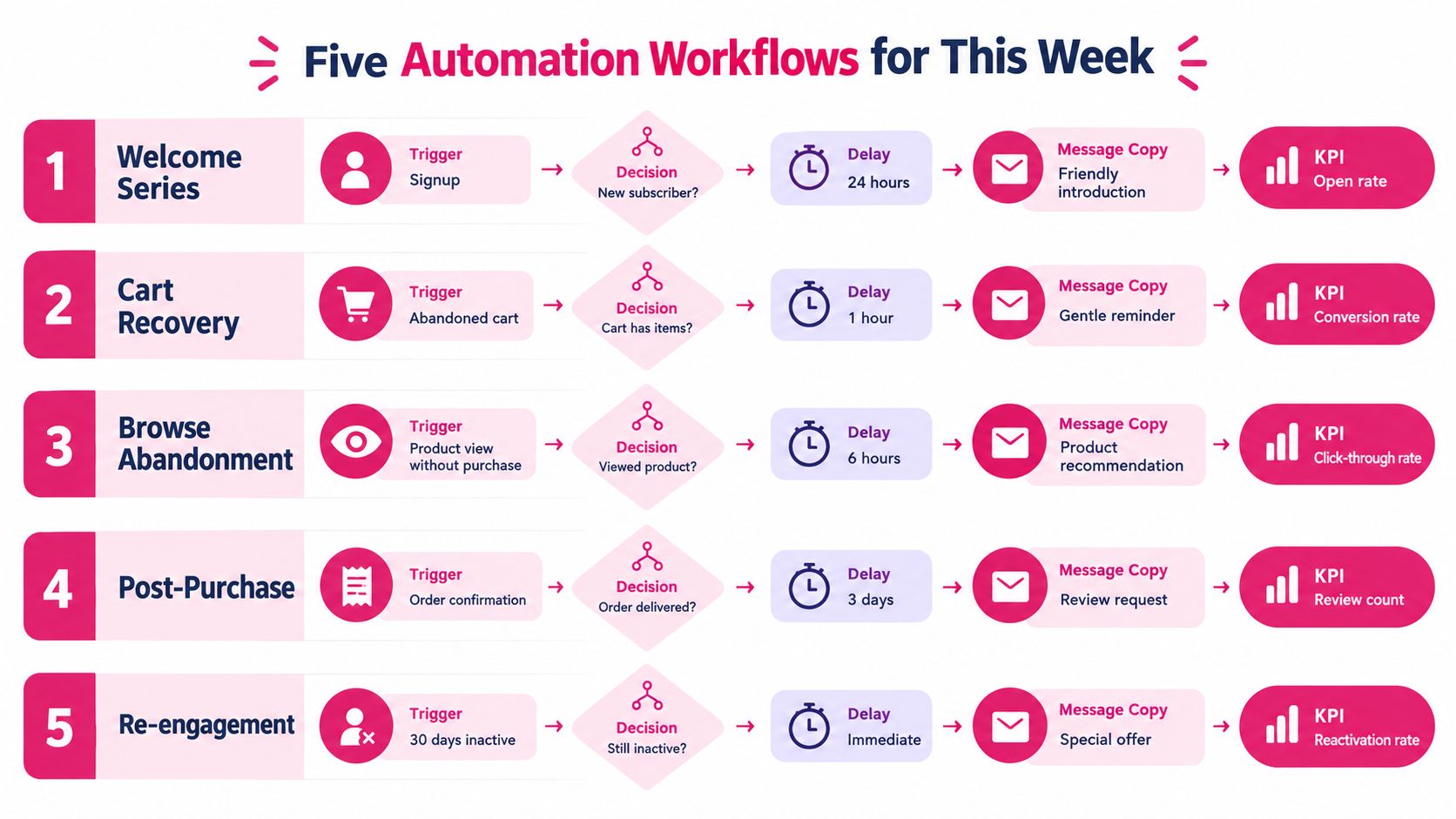
Five Automation Workflows You Can Launch This Week
Build each workflow around an exit condition before writing the message. A purchase, permission change, or conflicting customer-service event should remove the customer from an inappropriate sequence.
Use the following lanes as planning prompts, not fixed timing prescriptions.
Acquisition and purchase-intent workflows
-
Welcome after opt-in. Trigger on confirmed permission, then check whether the customer is already shopping or purchasing. Send the promised welcome promptly and delay further promotion until it offers something distinct. Sample copy: “Welcome to our store. Explore the collection that brought you here.” Monitor first-purchase conversion and opt-outs. Avoid: asking immediately for permissions the customer just supplied.
-
Abandoned-cart recovery. Trigger after a genuine interruption in checkout, not while the shopper is still actively completing it. Test a short-delay, non-discount reminder before offering an incentive to eligible customers. Sample copy: “Your cart is saved. Continue checkout when you’re ready.” Monitor recovered orders and contribution margin. Avoid: discounting every cart automatically.
Timing deserves testing, not blind adoption. Mobile Text Alerts’ SMS benchmarks report 90% of SMS conversions within 15 minutes of sending for digital-product and B2B campaigns, and another benchmark reports 36% click-through for messages triggered within five minutes, compared with a 9.2% industry average. These aren’t guaranteed retail recovery outcomes.
- Browse abandonment. Use a product-view event without subsequent cart activity. Prefer an in-app prompt on return or permission-based push after a deliberate inactivity delay; don’t interpret a passing view as checkout-level intent. Suggest the viewed category or useful buying information. Monitor return visits that progress toward purchase. Avoid: sending an aggressive checkout reminder to someone who never created a cart.
Retention workflows
-
Post-purchase follow-up. Trigger from fulfillment or delivery context rather than treating order placement as proof of product use. Wait until a review or complementary recommendation makes sense. Sample direction: ask about the purchased item before suggesting an accessory. Track review completion and repeat-purchase margin. Avoid: requesting a review before the customer can reasonably evaluate the product.
-
Win-back. Define inactivity around your product’s buying cycle. Check previous engagement and permission before sending a relevant reason to return. Monitor profitable reactivation, and retire the sequence when the customer remains unresponsive. Avoid: escalating discounts indefinitely.
For additional structures to adapt, consult these marketing automation examples.
Use this video as a companion when translating the workflow designs into implementation tasks.
Frequency Governance and the Cross-Channel Contact Budget
A customer experiences your store as a single business. They don’t distinguish between the SMS app, email platform, loyalty tool, and push provider that each decided to contact them.
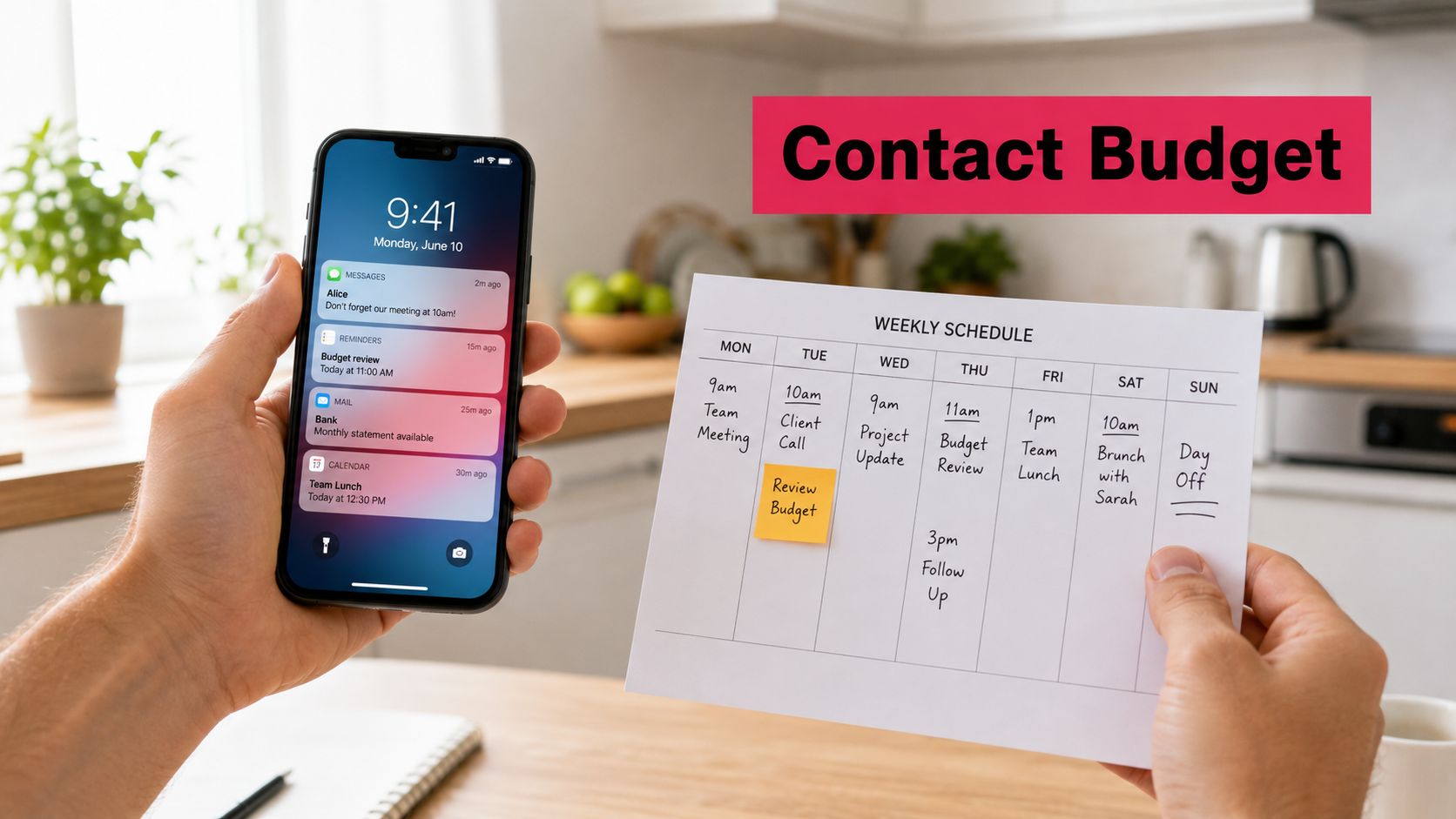
A cross-channel contact budget is a shared limit on promotional exposure, supported by priority rules and cooldowns. Set the limit as a testable operating policy, not an industry-wide constant.
A shared calendar makes overlapping journeys easier to spot.
Give every candidate message a priority
| Message purpose | Priority treatment | Conflict rule |
|---|---|---|
| Essential service communication | Protect delivery separately | Don’t let promotional caps block necessary service messages |
| Clear purchase-intent follow-up | High promotional priority | Suppress competing general promotions |
| Relevant lifecycle promotion | Conditional priority | Send only when the shared budget permits |
| Broad broadcast | Lowest priority | Defer or suppress when more relevant contact qualifies |
Account for service-message exposure without pretending that essential order updates are interchangeable with advertising. A customer receiving several delivery updates may still benefit from a promotional cooldown.
Enforce rules across tools
- Keep a shared contact ledger. Record message purpose, channel, delivery time, and engagement against the customer.
- Apply a rolling weekly cap. Set a conservative starting policy and adjust through controlled testing.
- Pause after meaningful action. If a customer clicks a recovery email, allow time to finish before sending an equivalent SMS.
- Cancel obsolete messages. A completed purchase should clear pending cart reminders.
- Respect permission changes. An opt-out isn’t an invitation to chase the customer through another channel.
A suppressed message can be the correct outcome of a well-designed automation.
Use frequency-capping guidance to translate the policy into implementation requirements. For the broader experience design, Formbricks’ resource on building seamless customer touchpoints provides useful context.
The operational test is simple: can your team explain why a particular customer received each message? If not, adding another workflow will make coordination harder.
KPIs, Attribution, and Reporting That Actually Matter
Klaviyo classifies SMS click-through of 14.6% or higher as “Great” on its campaign benchmark page. Use that as a comparison point, not a forecast or proof of profitability.
Clicks diagnose whether recipients respond to the message. Completed purchases and margin determine whether the journey deserves continued investment.
Build the reporting sheet
| Metric | Calculation | Decision it supports |
|---|---|---|
| Click-through rate | Unique link clickers ÷ delivered messages | Is the message and destination appealing? |
| Recovered-order rate | Recipients completing qualifying purchases ÷ delivered messages | Do recipients finish checkout? |
| Revenue per delivered message | Attributed revenue ÷ delivered messages | How much revenue is associated with delivery? |
| Opt-out rate | Unique opt-outs ÷ delivered messages | Is contact creating excessive friction? |
| Contribution after messaging | Revenue less product, discount, fulfillment, payment, and messaging costs | Is the journey commercially worthwhile? |
Use consistent definitions throughout the reporting period. Deduplicate recipients and orders so repeat clicks or multiple events don’t make performance look stronger than it is.
Separate attribution from incrementality
A last-touch report assigns credit; it doesn’t prove causation. A shopper who intended to return might click a reminder and generate an attributed sale without generating an additional sale.
Define the conversion window before launch. Then randomly retain an eligible control group that doesn’t receive the recovery treatment, keeping other conditions comparable. Compare purchase outcomes and contribution across the groups, and avoid drawing strong conclusions from sparse results.
Use multi-touch attribution to understand channel sequences, but don’t substitute it for a holdout comparison.
Measurement principle: Optimize for additional contribution, not the largest attributed-revenue total.
Break out results by country, device, customer status, and cart value. That prevents a profitable repeat-customer segment from disguising weak acquisition traffic or a problematic market.
During the first 60 days, prioritize controlled experiments:
- Timing. Immediate versus delayed first contact.
- Incentive. Discount versus a useful non-discount reminder.
- Language. Default copy versus localized copy.
Change a single variable within each comparison. Otherwise, you won’t know whether timing, incentive, or wording caused the difference.
Compliance, Deliverability, and Localisation
Delivery starts with permission and sender configuration, not copywriting. A well-written reminder still fails operationally if the carrier filters it or the business can’t demonstrate why the recipient was eligible.
For European campaigns, the ePrivacy direct-marketing framework describes prior consent for direct-marketing electronic communications, including texts, alongside a limited existing-customer exception for similar products with clear opportunities to object. Have qualified counsel verify the currently applicable national rules rather than treating a summary as a complete legal determination.
Turn requirements into send gates
Compliance and deliverability checklist
| Area | What to verify | Automation rule | Owner |
|---|---|---|---|
| Marketing permission | Purpose, channel, timestamp, and collection source | Suppress when permission is missing or unclear | Legal and CRM |
| Sender identity | Recognizable brand and required registration | Use the approved sender for each market | Messaging operations |
| Withdrawal | Working unsubscribe mechanism | Process STOP and other supported requests immediately | CRM engineering |
| Sending windows | Applicable local restrictions | Hold messages outside permitted times | Lifecycle marketing |
| Encoding | GSM-7 versus Unicode and segment length | Validate payload before dispatch | Messaging operations |
| Delivery health | Failures by market, carrier, and sender | Pause problematic routes for investigation | Analytics and operations |
A2P SMS delivery guidance explains the importance of sender reputation, registration, consent evidence, and encoding. Unicode can increase billable segmentation, so review localized copy technically without sacrificing understandable language.
Localise the operating rules
Translation alone doesn’t establish suitable consent wording, sender identity, quiet hours, or channel choice. Sinch’s global consumer research identifies demand for alternative messaging channels alongside promotional texts, supporting market-specific channel evaluation rather than a universal SMS sequence.
- European markets. Review GDPR, applicable ePrivacy implementation, and national telecom requirements together.
- California audiences. Have the privacy owner assess applicable CCPA obligations separately from messaging permission.
- Every market. Test unsubscribe handling and verify the recovery destination on mobile.
Use this GDPR and CCPA compliance resource as an operational discussion aid, not a substitute for jurisdiction-specific advice.
Your Mobile Marketing Automation Launch Plan
Launch a coordinated recovery system before expanding into every available journey. Assign a named owner to each phase so missing event data or unresolved permission questions don’t disappear between marketing and engineering.
A phased rollout
- Week 1, audit. Establish your store’s abandonment baseline, inspect permission coverage, and inventory messages across every connected tool. List which systems can contact the same customer.
- Week 2, instrument. Validate customer identity and event accuracy using test purchases. Document the preferred channel for each customer goal.
- Week 3, govern. Implement the shared budget, priority order, cooldowns, and pre-send eligibility checks. Test conflicting triggers deliberately.
- Week 4, launch recovery. Start the abandoned-cart journey with a controlled experiment. Confirm that purchases cancel pending messages and that recovery links preserve the intended cart.
- Week 5, expand selectively. Add welcome and post-purchase journeys only after checking their interaction with existing messages.
- Week 6, review. Use the measurement framework to decide what to retain, change, or pause. Examine weak segments rather than relying solely on an aggregate result.
Keep a launch log recording each change and the reason behind it. Without that history, interpreting performance after several edits becomes guesswork.
Operational FAQ
How do you recover an already-fatigued subscriber list?
Pause broad promotions and review which promises customers originally accepted. Resume selectively with useful, relevant communication, then judge the response through purchases and opt-outs rather than trying to restore sending volume.
When should a contact move from SMS to push?
When they’ve granted push permission and their preference or observed behavior supports the change. Don’t switch channels merely to bypass an unsubscribe or a contact cap.
What if mobile delivery falls below 90%?
Treat that as an investigation trigger, not a universal verdict on the channel. Check delivery receipts, consent quality, sender configuration, and market-level failures before changing the copy or increasing volume.
CartBoss offers automated SMS abandoned-cart recovery for Shopify and WooCommerce, with direct recovery links and localized messaging. Visit CartBoss to evaluate how its recovery workflow could fit your store’s contact budget, permission rules, and measurement plan.