



At its core, an SMS (Short Message Service) is a simple text-only message sent directly to a mobile phone. You’re limited to just 160 characters, but its power lies in its simplicity. Unlike apps that need Wi-Fi or data, SMS messages travel over the standard cellular network. This makes it the most direct and reliable line of communication you can have with your customers.
Defining the Modern Sales Channel
For your online store, an SMS message is so much more than just a bit of tech—it’s a direct, powerful, and immediate sales channel. Think of it as a personal conversation starter that lands right in your customer’s pocket. It’s this direct connection that makes it a total game-changer for time-sensitive actions like recovering an abandoned cart or announcing a last-minute flash sale.
The real strength of SMS is its simplicity and unmatched reach. With roughly 6.8 billion people owning mobile phones globally, it’s the most universally supported way to communicate on the planet. Every single mobile phone, from the latest iPhone to a basic flip phone, can receive a text message without needing any special apps.
How SMS Compares to Other Marketing Channels
To really get a feel for its value, let’s see how SMS stacks up against the other channels you’re probably using.
| Feature | SMS Message | Social Media DM | |
|---|---|---|---|
| Open Rate | 98% (often within 3 mins) | ~21% (can take hours or days) | Varies, depends on platform/notifications |
| Reach | Universal (any mobile phone) | Requires email account and internet | Platform-specific, requires user to be logged in |
| Immediacy | Instant delivery and notification | Can land in spam, buried in inbox | Competes with other social notifications |
| Customer Action | High; feels urgent and personal | Low; easy to ignore or delete | Can feel spammy or get lost in requests |
While every channel has its place, the table makes one thing crystal clear: SMS cuts through the noise. It’s not just another notification to be swiped away; it’s a direct, one-on-one dialogue that feels personal and encourages an immediate response.
Once you understand what an SMS message truly is, you can start to see what SMS marketing can do for your store. This simple text can easily become your highest-performing tool for boosting engagement and driving sales.
For a deeper look into putting this channel to work, check out our guide on what is SMS marketing for more practical strategies.
How an SMS Message Travels to Your Customer
Ever wonder how a text message lands on a customer’s phone just moments after you hit send? The journey is incredibly fast and direct, sort of like a high-speed digital courier service. This speed is exactly what makes it so powerful for time-sensitive deals from your online store.
When you launch a campaign from a platform like CartBoss, the message doesn’t fly straight from you to your customer. First, it zips over to an SMS gateway. Think of this as the central post office for text messages. The gateway takes your message, translates it into a language that mobile networks understand, and sends it on its way almost instantly.
From Gateway to Handset
Once the gateway does its job, the mobile carriers take over. They’re the delivery fleet. Carriers use a special, always-on signaling channel to push the message directly to your customer’s phone. This channel is completely separate from mobile internet.
What does that mean for you? It means your SMS isn’t competing with data-heavy apps, video streams, or web browsing. It gets a VIP lane straight to the customer.
This whole process is called A2P (Application-to-Person) messaging. It’s the secret sauce behind why SMS is so reliable and immediate, ensuring your flash sales and cart reminders get seen right away.
This simple diagram breaks down the three main steps: sending the message, the gateway processing it, and the customer receiving it.
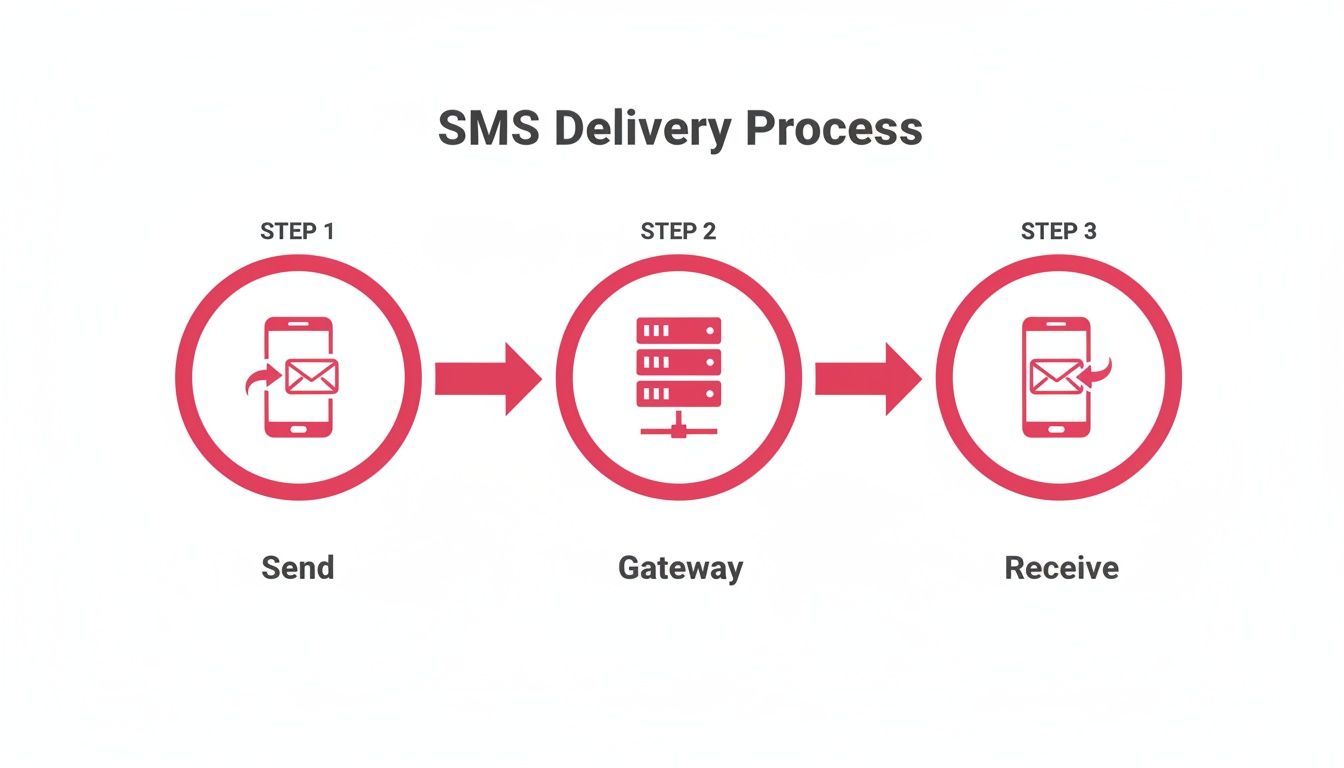
The biggest takeaway here is that the SMS system was built from the ground up for speed and reliability, neatly bypassing all the noise of the regular internet.
To get this working for your business, you need the right tools to connect your e-commerce platform to this powerful network. You can learn more about how to set up an SMS sender API and start sending texts that actually drive sales.
Why SMS Is an E-Commerce Powerhouse
While the technology behind SMS might seem simple, its impact on your store’s revenue is anything but. The engagement numbers are just staggering, making text messaging a must-have tool for any modern e-commerce brand. We’re not just talking about abstract stats here; this is the reality of your abandoned cart message actually being seen almost every single time you send one.
This direct line to your customer’s pocket creates a sense of urgency that other channels, like email, just can’t touch. Your message doesn’t get buried in a crowded inbox or filtered away into a promotions tab. It lands right on their lock screen, demanding attention.
Turning Opens Into Orders
The numbers really do speak for themselves. SMS messages have an almost unbelievable open rate of up to 98%, with most of them being read within just a few minutes of being delivered.
Put that next to email marketing, which averages around a 20-30% open rate, and you start to see the difference. Even more telling is the response rate. For SMS, it’s a remarkable 45% compared to a mere 6% for email. That’s a massive gap in customer interaction.
This incredible level of engagement translates directly into real-world results for your store:
- Recovered Sales: That perfectly timed nudge to a customer who just left their cart can easily turn a lost sale into a completed order.
- Higher Customer Lifetime Value: Keeping in touch with valuable, relevant messages builds loyalty and encourages your customers to come back again and again.
- Stronger Return on Investment: With engagement this high, the return you get on your marketing spend is often significantly better than with other channels.
Ignoring SMS is like leaving a top-performing salesperson off your team. It’s a direct, personal, and incredibly effective line to revenue that you can’t afford to miss.
To truly see SMS drive sales, you need to weave it into a complete strategy for digital marketing for e-commerce. When you combine the immediacy of text messages with your other marketing efforts, you create a powerful system that grabs attention and drives conversions at every stage of the customer’s journey.
Putting SMS Messages to Work in Your Store
Knowing the “what” and “how” of SMS is one thing. Seeing it actually drive sales for your store? That’s where the magic happens. Let’s move from theory to a practical playbook you can use to grow your business, starting with the single most profitable campaign you can run.
Abandoned cart recovery is the undisputed hero of e-commerce SMS. It’s simple: a customer adds items to their cart but gets distracted and leaves. A little while later, an automated text message lands on their phone, gently nudging them to finish what they started.
By sending a timed reminder that includes a direct link right back to their pre-filled checkout, you slash friction and make it incredibly easy for them to come back and buy. This one strategy is a powerhouse for turning otherwise lost sales into real revenue.
High-Impact SMS Use Cases
Beyond saving abandoned carts, SMS can give your sales a serious boost across the entire customer journey. Here are the most effective ways to weave texting into your marketing.
- Promotional Alerts: Got a flash sale, a new product drop, or an exclusive deal? SMS cuts through the noise. The sky-high open rates guarantee your time-sensitive offers get seen almost instantly.
- Transactional Updates: Build trust and keep customers in the loop with automatic shipping confirmations and delivery notifications. These texts are genuinely helpful, reduce “where’s my order?” support tickets, and create a great post-purchase experience.
- Two-Way Conversations: Use texting to offer personalized support or gather valuable feedback. A quick, conversational text feels far more personal than a formal email and helps build a real connection with your customers.
The secret sauce is blending personalization with a clear call-to-action. Every message should feel like it was sent to an individual, not a massive list, while making it dead simple for them to know what to do next.
For the best results, SMS shouldn’t operate in a silo. It works best as part of a bigger customer engagement plan. You can explore effective Omnichannel Marketing Strategies to see how texting fits perfectly alongside email and your other channels.
And if you want to dive even deeper, our complete SMS e-commerce guide is packed with more templates and ideas to get you going.
High-Impact SMS Templates for E-Commerce
Need some inspiration? Here are a few battle-tested, ready-to-use SMS templates for common e-commerce scenarios. These are designed to grab attention and drive action.
| Use Case | SMS Template Example |
|---|---|
| Cart Recovery (Reminder) | Hey [Name]! Did you forget something? The items in your cart are waiting for you. Finish your order before they’re gone: [Link] |
| Cart Recovery (Discount) | Still thinking it over? We’ll make it easy. Use code SAVE15 for 15% off your order. Complete your purchase now: [Link] |
| Welcome Offer | Welcome to [Store Name]! We’re so glad you’re here. As a thank you, enjoy 10% off your first order with code WELCOME10. Shop now: [Link] |
| Promotional Sale | FLASH SALE! Get 25% off everything for the next 24 hours only. Don’t miss out on our biggest sale of the season! Shop here: [Link] |
| Order Confirmation | Thanks for your order, [Name]! We’ve received order #[Order Number] and will let you know as soon as it ships. Track its status here: [Link] |
| Shipping Notification | Good news! Your [Store Name] order #[Order Number] has just shipped. You can expect it to arrive in 3-5 business days. Track it here: [Link] |
Feel free to adapt these templates to match your brand’s voice. The key is to be clear, concise, and provide immediate value to your customer.
Navigating SMS Marketing Rules and Regulations
Building a successful SMS strategy means building trust, and that starts with playing by the rules. Unlike email, where you might have some leeway, SMS is a permission-based channel. This means you absolutely cannot just start sending messages to any phone number you have.
The golden rule is getting explicit consent—what we call an “opt-in”—before a single marketing text ever leaves your system. Think of it like a personal invitation. A customer has to clearly agree to hear from you, usually by ticking a box at checkout. This transparency isn’t just about being polite; it’s the law and the foundation of a healthy, profitable relationship with your audience.
Understanding Key Compliance Rules
Several major regulations govern SMS marketing, all designed to protect consumers from spam. While the legal jargon can get dense, the core principles are refreshingly simple: get permission and make it easy to leave.
- TCPA (Telephone Consumer Protection Act): This is the big one in the U.S. It requires businesses to get express written consent before sending any automated marketing texts.
- GDPR and CCPA: Over in Europe (GDPR) and California (CCPA), the focus is squarely on data privacy. These laws give consumers the right to know what data you’re collecting and demand an easy way to opt out at any time.
- Clear Opt-Out Instructions: This is non-negotiable. Every single promotional message you send must include a clear, simple way for users to unsubscribe, like the classic “Reply STOP to cancel.”
The main takeaway is this: always get permission first, and always give customers an easy way out. This isn’t just about avoiding hefty fines; it’s about respecting your audience and building a brand they actually want to hear from.
Respecting your customers also means being mindful of when you hit send. No one wants their phone buzzing with a flash sale notification at 3 AM. Avoid sending promotional texts during designated “quiet hours”—typically late at night or early in the morning—to keep your subscribers happy.
For a deeper dive into the legal side of things, you can learn more about the TCPA and text messages in our dedicated guide.
Tracking the Metrics That Matter for SMS Success
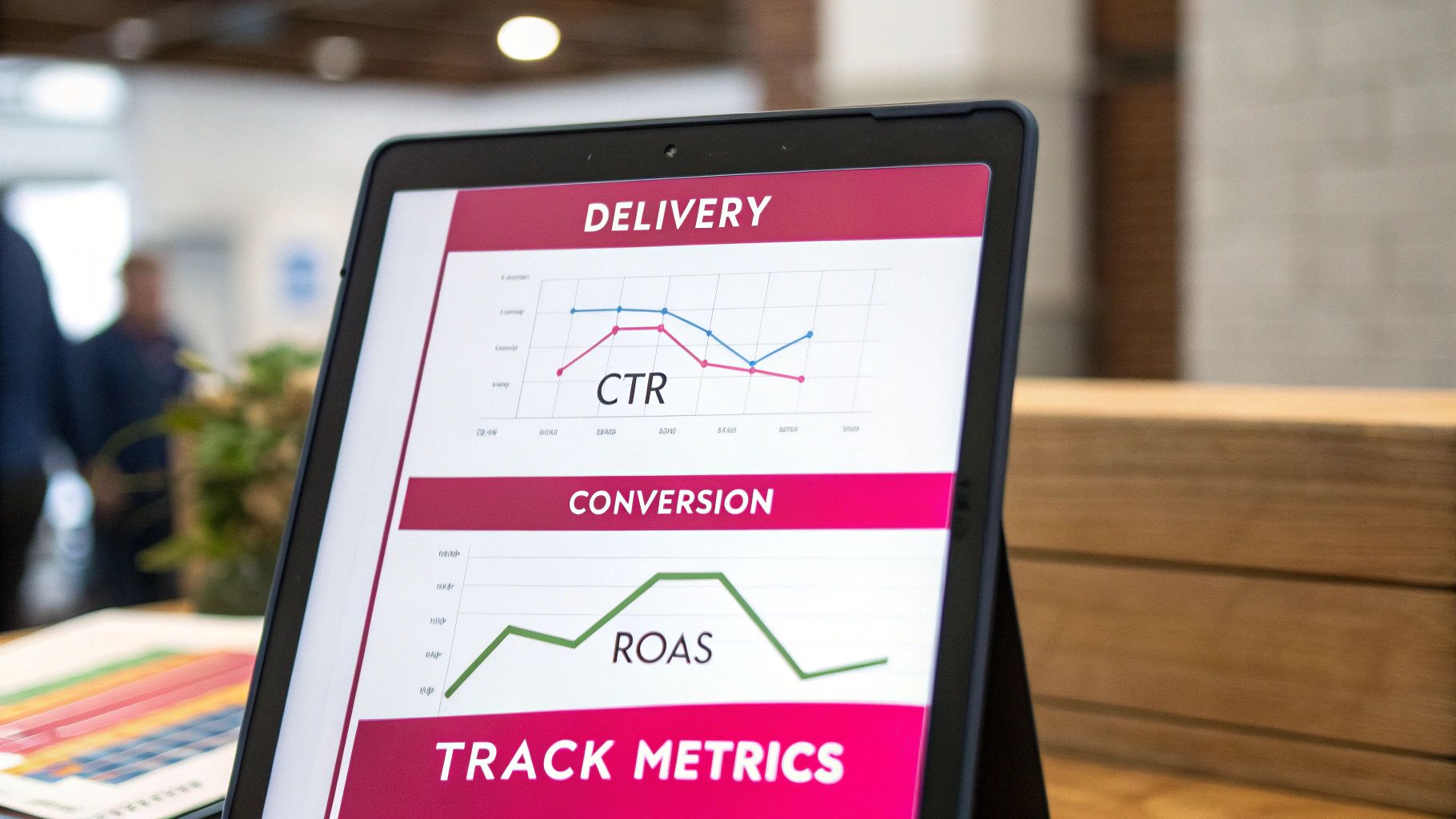
To get a real handle on how powerful your SMS campaigns are, you have to track the right data. Sending texts without looking at the numbers is like driving blind—you have no idea if you’re heading toward profit or a dead end.
Focusing on a few key metrics tells you the whole story of your performance, from the moment a message is sent to the final sale. This clarity is what allows you to make smart, data-backed decisions that actually improve your strategy.
Core SMS Performance Indicators
Here are the essential metrics every e-commerce store owner should be watching to measure the success of their SMS efforts.
- Delivery Rate: This is the percentage of your messages that successfully landed on your customers’ phones. A high rate is a great sign that your contact list is clean and healthy.
- Click-Through Rate (CTR): This number shows how many people actually clicked the link in your SMS. It’s a direct reflection of how engaging and compelling your message was.
- Conversion Rate: This is the big one—the percentage of recipients who clicked your link and went on to complete a purchase. It shows just how effective your texts are at driving sales.
But the most crucial metric of all? Your Return on Ad Spend (ROAS). This tells you exactly how much revenue you’re making for every dollar you put into your SMS campaigns, proving whether it’s truly profitable.
It’s no surprise that 56% of organizations report that SMS performs well for customer engagement. The industry’s growth is proof that brands are seeing a fantastic return on their investment.
By analyzing these numbers, you can pinpoint what’s working and what isn’t, allowing you to continuously fine-tune your campaigns for maximum growth. For a deeper dive, check out our guide on SMS marketing conversion rates.
Common Questions About SMS for E-commerce
Getting started with SMS can bring up a few questions. Here are some of the most common ones we hear from store owners just like you.
“Isn’t SMS marketing too expensive for a small store?”
That’s a fair question, but it’s all about return on investment. While there’s a small cost for each text, the sales you get back from SMS almost always blow other channels out of the water.
Plus, modern platforms like CartBoss have flipped the old pricing model on its head. We use a performance-based system, meaning you only pay when you see actual results. This takes the risk off the table and makes SMS a powerful, affordable tool for any size business.
“Can I send pictures of my products in a text?”
You can, but that’s a different kind of message. A standard SMS is text-only, capped at 160 characters. It’s short, sweet, and gets the job done.
When you add images, videos, or GIFs, it becomes an MMS (Multimedia Messaging Service). While MMS can look great, they cost quite a bit more to send and aren’t always necessary. For core e-commerce tasks like recovering a cart, a simple, punchy SMS with a link is the most reliable and cost-effective way to go.
“How do I get customers’ phone numbers the right way?”
This is a big one. You absolutely must get clear, direct permission—what’s called an opt-in—before you send a single marketing text.
The most common and compliant way to do this is with a checkbox at your store’s checkout. The language needs to be unmistakable, making it clear they’re agreeing to receive texts from you. No tricks, no hidden clauses. Just straightforward permission.
Ready to see what SMS can do for your store? CartBoss turns abandoned carts into sales automatically. Get started with CartBoss today!